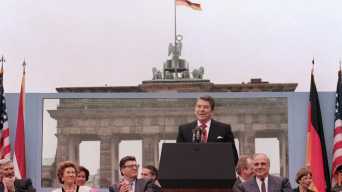
The Man After the Wall: George H.W. Bush and the End of the Cold War

By Kaleena Fraga

reagan wallOn this day in 1987, Ronald Reagan famously called on Mikhail Gorbachev to “tear down this wall”–a wall which physically separated East and West Berlin, and symbolized the separation between the Soviet Block and the West.

Yet the wall did not come down in 1987, or in 1988. It would not be torn down until 1989, after Reagan had left office, and after his vice president, George H.W. Bush, had been elected as president.

A few months before the wall fell, Bush had also advocated for its destruction, albeit in a less dramatic fashion than Reagan. During a speech in Mainz, Germany to celebrate the 40th anniversary of NATO, he noted that barriers in Austria and Hungary had recently been removed, and so:

“Let Berlin be next — let Berlin be next! Nowhere is the division between East and West seen more clearly than in Berlin. And there this brutal wall cuts neighbor from neighbor, brother from brother. And that wall stands as a monument to the failure of communism. It must come down.”

On November 9, 1989 Bush received word that the wall had been breeched.

To Bush, the fall of the wall represented a great symbolic victory, but also a danger of violence. He worried that police in East Germany would fire upon demonstrators, and that this could turn a cold war into a hot one. From the Soviets, the Bush White House received a plea for calm, urging the Americans to “not overreact.” Bush later recalled that, “[Gorbachev] worried about demonstrations in Germany that might get out of control, and he asked for understanding.”

To the gathered press, Bush gave a prepared statement which welcomed the fall of the wall, nothing that the “the tragic symbolism of the Berlin Wall…will have been overcome by the indomitable spirit of man’s desire for freedom.”

But Bush, noted biographer John Meacham in his book Destiny and Power: The American bush briefs reportersOdyssey of George H.W. Bush, was more focused on what could go wrong rather than the symbolic triumph of the West over the Soviets, which led to a contentious exchange between the president and CBS reporter Lesley Stahl.

“This is a great victory for our side in the big East-West battle, but you don’t seem elated,” said Stahl. “I’m wondering if you’re thinking of the problems.”

“I’m not an emotional kind of guy,” Bush replied.

“Well, how elated are you?”

“I’m very pleased.”

Democrats in Congress also sought a stronger response from the president. Senate Democratic leader George Mitchell thought Bush should fly to Berlin so that he could make a statement about the end of Communism, with the fallen wall as a dramatic background. House Majority Leader Dick Gephardt said that Bush was “inadequate to the moment.”

From the Soviets, Gorbachev warned of “unforeseen consequences.” Bush heard reports of violence in other Soviet republics. In the days and weeks that followed, it appeared that Soviet power in Bulgaria and Czechoslovakia were also faltering. In his diary, Bush wrote that Mitchell had been “nuts to suggest you pour gasoline on those embers.”

When Bush met with Gorbachev at the Malta Conference that December, he was cautiously optimistic, and prepared.bush and gorbachev TIME

“I hope you have noticed,” he said to Gorbachev, “we have not responded with flamboyance or arrogance that would complicate Soviet relations…I have been called cautious or timid. I am cautious, but not timid. But I have conducted myself in ways not to complicate your life. That’s why I have not jumped up and down on the Berlin Wall.”

“Yes, we have seen that,” said Gorbachev, “and appreciate that.”

On December 3rd, the two men held the first ever joint press conference between an American president and a leader of the Soviet Union.

Expressing gratitude for Bush’s caution, and recognizing the danger of exaggeration, Gorbachev said that he and Bush agreed that “the characteristics of the cold war should be abandoned…the arms race, mistrust, psychological and ideological struggle, all those should be things of the past.”

Coming home, Bush found he faced criticism not only from the left, but also from the right–from within his own White House. Vice President Quayle, Bush wrote in his diary, saw a chance to become “the spokesman of the right,” a sort of disloyalty to Bush’s efforts that he had never been guilty of during his eight years as Reagan’s vice president.

Ultimately Bush’s caution about the fall of the wall allowed him to navigate fragile relationships with both Gorbachev and the Chancellor of Germany, Helmut Kohl. It allowed him to piece together a new, post-Cold War world order. His refusal to gloat despite pressure on both sides proved crucial, and can serve today as a lesson to other American leaders on the world stage.
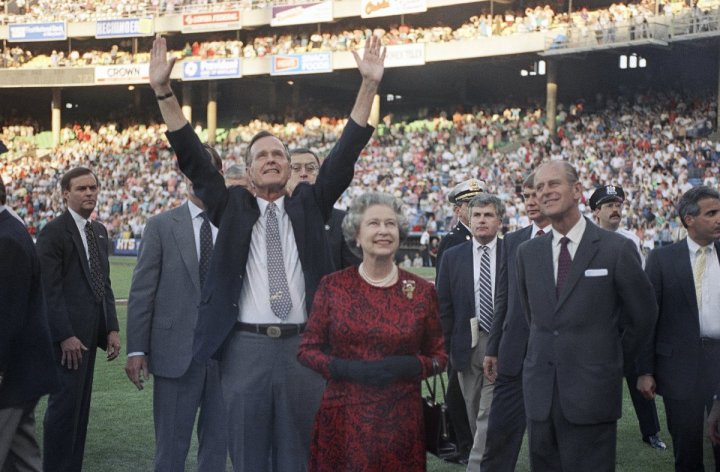
Play Ball! George H.W. Bush, Baseball, and the Queen of England

By Kaleena Fraga

On this day in 1991, the Baltimore Orioles had an unusual fan at Memorial Field. Not only had the President of the United States and the First Lady shown up at the game, the Queen of England also graced the ballpark with her presence.

Queen Elizabeth’s appearance at the game came during her 13-day visit to the United States with her husband, Prince Phillip. The Queen’s parents had been the first reigning monarchs to visit American soil when they came at FDR’s invitation in 1939. The 1991 trip marked Queen Elizabeth’s 9th to the United States–her first being in 1958, and the most recent 15 years prior, in 1976, for the American Bicentennial.

The New York Times noted that at the game, “the Queen will be offered a hot dog, but she Queen Elizabeth II and President George Bush meet baseball pdoes not eat in public.” A waitress later told UPI that the queen did not eat, but she did drink a Beefeater martini.

The players of both teams were told to “be natural” while shaking hands with the four world leaders–Queen Elizabeth, Prince Phillip, George H.W. Bush, and Barbara Bush. Oakland player Jose Canesco reportedly felt so relaxed at the encounter that he chewed gum while meeting the foursome. The baseball commentators in the video above remarked that the players kept on their hats, but that “a lot of bowing and scraping before royalty is not the American way.” The Bushs and the royals then surprised fans by venturing out onto the field to wave hello.

The game was not without disruptions. Even before it started, protestors chanted “IRA, USA.” One group of protestors raised a sign that read: “Irish blood is on the queen’s hands,” and another group lofted a sheet saying, “One world, one struggle, free Ireland.” Once the game was underway, a group of protestors tied a sign that said “Bread Not Bombs” to a flagpole in right field along with several balloons, referencing the violence in Northern Ireland. UPI reported that although Orioles ushers were able to cut the sign and the balloons from the flagpole, it floated up “over center field in full view of the queen and the prince…”

While the game was a somewhat new experience for the royal couple–the queen was reportedly surprised to hear that Prince Phillip had played a little as a boy–President Bush is a well-known baseball fan. He and his father both played at Yale, and Bush was a frequent visitor to Orioles games. Why baseball? According to Bush, “it’s got everything.”

April 14th, 1865: On the Sidelines of Lincoln’s Assassination

By Kaleena Fraga

On April 14th, 1865 Abraham Lincoln was shot in the head by John Wilkes Booth. This much is well known. But the plot to kill the president was larger than two men, and it struck Washington with such force that it left more than one casualty.

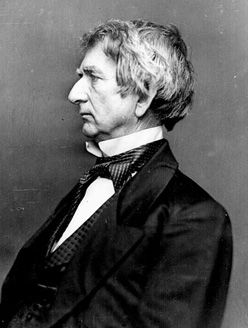
William Henry Seward

seward

Along with Lincoln, the conspirators of the assassination sought to kill both the secretary of state, Seward, and the vice president.  While Booth went to Ford’s Theatre, Lewis Powell headed for Seward’s residence, where the secretary had been bedridden for nine days following a carriage accident that had almost killed him.

The president and his secretary of state, once political rivals, enjoyed a close relationship and partnership. Indeed, when Lincoln visited Seward after his carriage accident, he lay down in bed beside him, and recounted his recent journey to Richmond until Seward fell asleep.

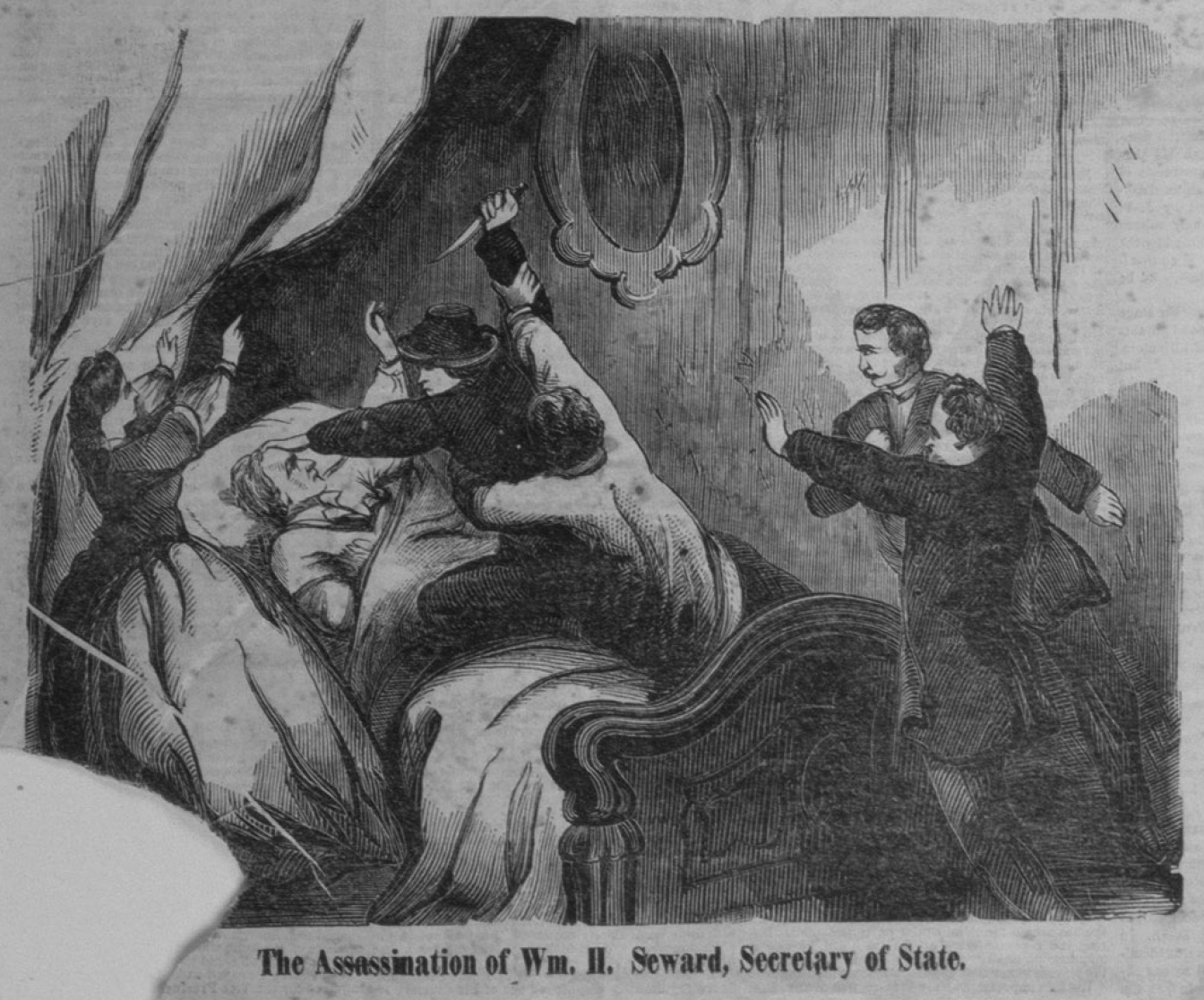
On the night of April 14th, Lewis Powell, a friend of John Wilkes Booth, was dispatched to the Seward residence. Powell claimed he had been sent by a doctor with medicine for Seward and that he must deliver it in person. Seward’s son, Fred, refused to let him by and at this point Powell pulled a pistol. It misfired, but Powell used it to clobber Fred, leaving him unconscious.

stabbing-seward-national-police-gazette-4-22-1865

Powell stormed Seward’s chamber, slashing Seward’s guard in the face. Seward’s daughter, Fanny, ran into the room and begged Powell not to kill her father. According to Doris Kearns Goodwin, the word kill is what revived the secretary–who awoke just as Powell stabbed him in in the neck and face. Seward’s other son, Gus, ran into the room, and he and Seward’s injured guard managed to pull Powell away. Powell fled, stabbing a young State Department messenger on his way out of the house.

Seward had been saved in part by the carriage accident that almost took his life. Goodwin writes that, “the knife had been deflected by the metal contraption holding Seward’s broken jaw in place.”

How Seward learned of the president’s death is disputed. His biographer Walter Stahr wrote that Seward was informed by his wife, who told him “very gently” “Henry, the president is gone.” Goodwin writes, however, that news of the president’s death was kept from Seward because of his fragile condition. According to her biography Team of Rivals, Seward noticed the flag at half- mast at the War Department from his window, and announced:

“The president is dead. If he had been alive he would have been the first to call on me. But he has not been here, nor has he sent to know how I am, and there’s the flag at halfmast.”

Mary Surratt

Mary Elizabeth Jenkins Surratt (1820 or May 1823 – July 7, 1865) Dated 1865

A name largely forgotten by history, Surratt was the first women ever to be executed by the U.S. government. Surratt grew up in a family that owned slaves and during the war she and her husband used their home as a safe house for Confederate soldiers. Her son Isaac fought for the Confederacy. Heavily in debt after the death of her husband, Surratt moved to Washington D.C. and opened a boarding house. Her son John came too, and befriended a frequent visitor to the boarding house, John Wilkes Booth.

On the night of the assassination the police came to the boarding house looking for both Booth and John Surratt, whom they suspected had participated in the failed assassination of William Henry Seward. Neither were there, but as the police were questioning Surratt, Lewis Powell showed up. One of Seward’s servants identified him. Both Powell and Surratt were taken into custody–her son, John, fled and escaped to Canada.

Surratt claimed innocence–however, a tavern keeper named John Lloyd disputed this, testifying that she had told him to keep guns at the ready on the night of Lincoln’s assassination–the same guns that were later used to shoot the president. After he heard of Lincoln’s death Lloyd is reported to have cried, “Mrs. Surratt, that vile woman, she has ruined me!”

Up until her execution, Surratt maintained her innocence. Powell also insisted that she had nothing to do with the conspiracy. Despite this, she was tried and convicted. On July 7th, 1865 she was hanged.

Henry Rathbone & Clara Harris

Major Henry Rathbone and his fiancee Clara Harris accompanied the Lincolns to Ford’s Theatre on April 14th. Clara was a friend of Mary Todd Lincoln, and the two often went to the theater together. The Lincolns had originally invited Ulysses S. Grant and his wife, Julia, but Julia, not a fan of the First Lady, insisted they go to New Jersey instead. With the war over, Clara later recalled that the Lincolns were “in the gayest of spirits.” At one point Lincoln took his wife’s hand and Mary Lincoln chided him, saying, “What will Miss Harris think of my hanging on to you so?” Lincoln, speaking his last words before his death, is reported to have replied, “She won’t think anything about it.”

henry-and-clara

When Booth shot Lincoln, Rathbone leapt up and tried to disarm him. Booth stabbed Rathbone and then escaped, as Clara, now covered with her fiancé’s blood, cried, “The president is shot!”

Rathbone was never the same. In the years following the assassination he was diagnosed with “attacks of neuralgia (intense pain) of the head and face and in the region of the heart attended by palpitations and at times difficulty breathing.”

On Christmas Eve 1883, while living in Germany, Rathbone murdered Clara–attacking her with a pistol and a dagger, and then slashing himself in an eerie reproduction of the night in Ford’s Theatre. He barely survived, and later insisted that he was injured trying to intervene in an attack by someone else.

Rathbone was declared insane and sent to the Provincial Insane Asylum in Hildesheim, Germany. He stayed there until the day in died in 1911, refusing ever again to speak either of the assassination or of the murder of his wife.

George Atzerodt & Andrew Johnson

The original plot to kill the president included the Secretary of State Seward as well as the Vice President, Andrew Johnson. But while Lewis Powell and John Wilkes Booth went through with their plot, the man assigned to kill Johnson, George Atzerodt, lost his nerve.

andrew johnson

Atzerodt had rented a room in the same hotel, the Kirkwood House, where the vice president was staying (lacking foresight, Atzerodt made the reservation in his own name). Anxious about his assignment, Atzerodt tried to steel his resolve by drinking. He was armed with gun and a knife and the vice president, alone and unguarded, would have been an easy target. But Atzerodt couldn’t bring himself to knock on the door. Instead he got drunk, and wandered around Washington D.C. until around two in the morning, when he checked into another hotel.

He was arrested on April 20th, about a week after the assassination. Investigators had found a gun and a knife in his room at the Kirkwood House, and evidence linking him to John Wilkes Booth. Atzerodt confessed to everything–including the role the others had played. Despite his cooperation, he was hanged with the rest of them.

Andrew Johnson became president.

Truman, Roosevelt, and the Day that Changed History

By Kaleena Fraga

On this day in 1945, Franklin Delano Roosevelt died. President since 1933, Roosevelt was only a few months into his fourth term in office.

He was spending some time in Warm Springs, Georgia, hoping that the the temperate climate and hot springs could restore his health. Roosevelt had another reason to visit Warm Springs–he’d planned a rendezvous with his long time mistress, Lucy (Mercer) Rutherford. Rutherford had arranged for her friend, Elizabeth Schoumatoff, to paint a portrait of the president.

unfinished portraitSchoumatoff was standing at her easel painting the president when something in his demeanor changed. She later recalled: “He looked at me, his forehead furrowed in pain, and tried to smile. He put his left hand up to the back of his head and said, ‘I have a terrible pain in the back of my head.’ And then he collapsed.”

Franklin D. Roosevelt died a few hours later. He was 63.

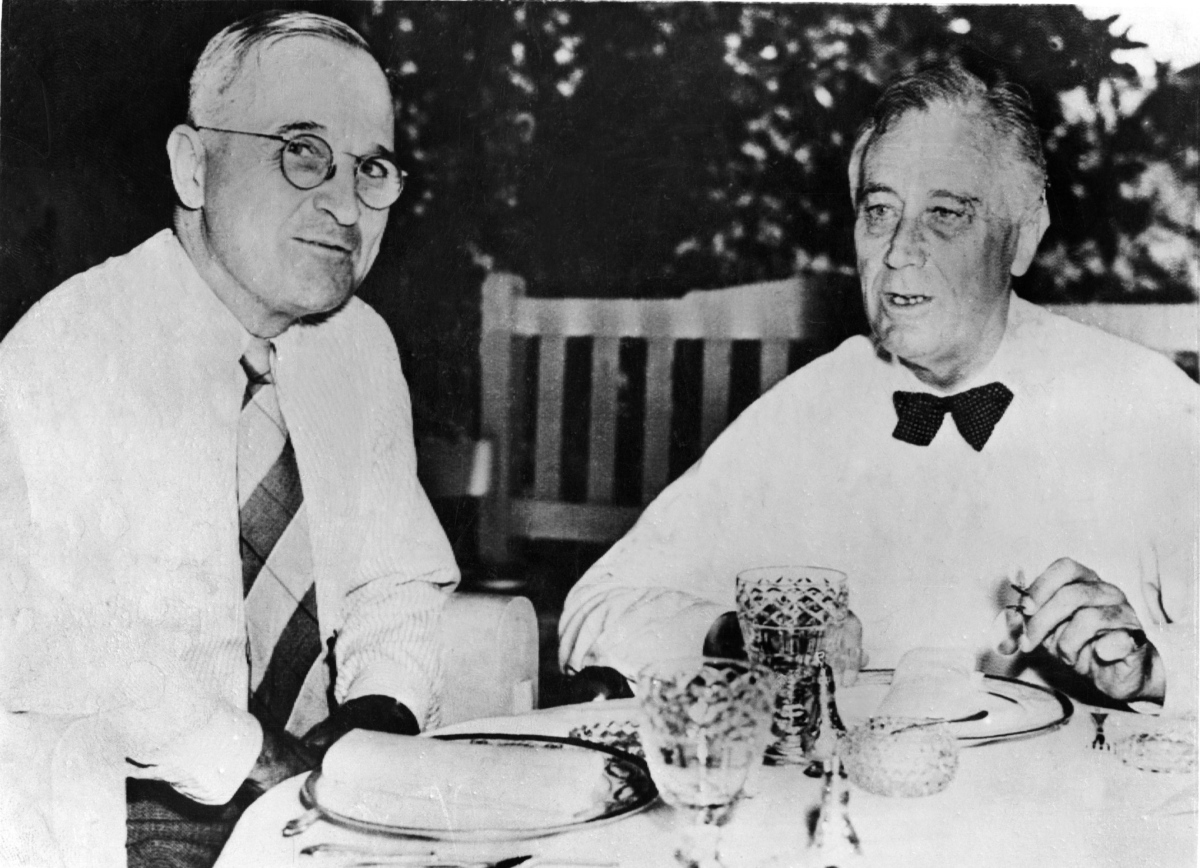
In Washington D.C., Vice President Harry Truman arrived at the White House, where he was greeted by the president’s widow, Eleanor Roosevelt. She told him that the president had died. Truman, stunned, was silent. Then he asked if there was anything he could do for her.

“Is there anything we can do for you?” Eleanor replied. “For you are the one in trouble now.”

For many people, Roosevelt had been the only president they had ever known. He died as WWII had begun to come to an end. In David McCullough’s Truman, McCullough writes that the similarities of Lincoln and FDR’s death were not unappreciated–both had died in April, both died as the wars they’d fought ended, and both would be remembered as great men. “But implicit,” McCullough writes, “was also the thought that Lincoln, too, had been succeeded by a lackluster, so-called ‘common man,’ the ill-fated Andrew Johnson.”

Truman, for his part, told a crowd of reporters:

“Boys, if you ever pray, pray for me now. I don’t know whether you fellows ever had a load of hay fall on you, but when they told me yesterday what had happened, I felt like the moon, the stars, and all the planets had fallen on me.”

Truman’s premature ascension to the presidency prompts one of the what-ifs of presidential history. It was Truman, not Roosevelt, that guided the country through the last stages of WWII, including the dropping of atomic bombs on Japan. Today’s historians have to wonder what FDR might have done in his stead.

Still, Truman finished the three years of Roosevelt’s term and (narrowly) won reelection Harry Trumanin his own right. Although his approval rating hovered in the thirties at the end of his term, history later came to regard Truman as one of the nation’s best presidents. Per McCullough, his legacy includes “the creation of the United Nations, the Truman Doctrine, the Marshall Plan, the Berlin Airlift, the recognition of Israel, NATO; for committing American forces in Korea and for upholding the principle of civilian control over the military.”

Truman certainly had big shoes to fill. When FDR died 73 years ago today, the New York Times eulogized him by writing:

“Men will thank God on their knees a hundred years from now, that Franklin D. Roosevelt was in the White House…it was his leadership which inspired free men in every part of the world to fight with greater hope and courage. Gone, now, is this talent and skill…Gone is the fresh and spontaneous interest which this man took, as naturally as he breathed air, in the troubles and hardships and the disappointments and the hopes of little men and humble people.”


Will, We Hardly Knew Ye: the Legacy of William Henry Harrison

(to listen to this piece in podcast form, click here)

By Kaleena Fraga

William Henry Harrison holds the dubious honor of serving the shortest term in office; and being the first American president to die in office. In honor of the anniversary of his untimely death (April 4th, 1841), let’s review what WHH accomplished while still alive.

His presidency: William Henry Harrison was inaugurated on March 4th, 1841 and died exactly a month later. At the time he was the oldest person ever inaugurated–today he’s beat by Donald Trump, 70, and Ronald Reagan, 69. His death launched a mini constitutional crisis–no one was sure what to do if the president died in office. Harrison’s VP, John Tyler, insisted that it meant that he became president–not “acting president” as some argued at the time. The nation wouldn’t definitively solve the issue of succession until 1967 and the passing of the 25th amendment.

His nickname: Harrison went by the moniker Tippacanoe, a nod to the Battle of Tippacanoe against Native American forces in 1811 during the lead-up to the War of 1812. Although Harrison would later use this battle to his political advantage, James Madison’s Secretary of War originally interpreted the battle as a defeat for the Americans. The skirmish left 62 Americans dead and 126 wounded; thirty six Native Americans were likewise killed.

His legacy: Although Harrison died in office after one month, his grandson Benjamin Harrison was also elected to the presidency, and completed one full term in office. William Henry & Benjamin Harrison are the only grandfather-grandson to serve as president.

His campaign: In what would become known as the Log Cabin campaign, the 1840 battle for the White House pitted the Whig Harrison against Democrat Martin Van Buren, who was running for a second term in office. Democrats, mocking Harrison’s age, wrote in a party newspaper:

“Give him a barrel of hard (alcoholic) cider and settle a pension of two thousand a year on him, and take my word for it, he will sit the remainder of his days in his log cabin.”

Whigs leapt on this, portraying Harrison as a man of the people–someone who, you know, you could grab a beer with. Van Buren, they claimed, was an elitist, out of touch with the common man. Ironically–and in a sign of campaigns to come–Harrison was the aristocrat, having been born to a wealthy family on a plantation. Van Buren’s father was a tavern keeper.

This was not a contest of the Founding Fathers’ day, when it was sacrilegious to campaign. Among other antics, a group of Whigs pushed a ten foot ball made of tin and paper slogans of Harrison’s for hundreds of miles (from this comes the phrase “get the ball rolling”). Other Whig supporters passed out whiskey in log cabin shaped bottles which came from the E.C. Booz distillery (from this comes the word “booze.” See, there are reasons to remember William Henry Harrison!).

It was, as John Dickerson points out in his podcast, Whistlestop, in many ways the first modern campaign.

His speech: At one hour and forty-five minutes, William Henry Harrison’s inaugural address is the longest in history. It’s 3,000 words longer than the runner up’s speech (William Howard Taft, 1909). Given on a cold Washington day, it’s also in all likelihood what killed him.

And so we’ll keep it short. Happy death-day, President Harrison.

Washington and the Myth of Wooden Teeth

By Kaleena Fraga

(to listen to this piece in podcast form click here)

Today is George Washington’s 286th birthday. Name a fact–any fact about him. First president? Revolutionary War general? Something about a cherry tree? Wooden teeth?

Of the many myths surrounding Washington, the one about his teeth is among the most popular. In reality, Washington never had wooden teeth. But he did have dental problems, lots of them, requiring the use of dentures for a good chunk of his adult life. Rather than wooden teeth, however, as Ron Chernow writes in his Washington biography, Washington: A Life, most of the teeth in his dentures were likely made from walrus or elephant ivory. Chernow postulates that the myth arose from the “gradual staining of hairline fractures in the ivory that made it resemble a wood grain.” Washington also used several of his own pulled teeth in his dentures, and there’s documentation of his purchase of teeth from slaves (a grotesque, but common practice in the 18th century).

1789_GeorgeWashington_byChristianGullager

Washington found his dental problems highly embarrassing. They made his lips stick out, and made it hard for him to speak. The fake teeth often became discolored, once so much that Washington sent them to his dentist, John Greenwood for repair. Greenwood noted that they had turned black–possibly because the president drank so much port wine. That Washington felt so self-conscious about his teeth may explain his solemn look in most of his portraits.

Washington’s dental ordeals sound terrible–both painful and embarrassing, especially for someone who, as president and as a beloved public figure, was expected to entertain guests and speak publicly. His wife, Martha, also suffered from dental problems and both of them eventually wore dentures. Martha encouraged her grandchildren to invest in toothbrushes and cleansing powders to avoid the turmoil that she and her husband endured over their teeth.

By the time he became president, Washington had only one natural tooth remaining. When this tooth had to be pulled, Washington gifted it to his dentist, Greenwood. Greenwood originally drilled a hole through the tooth and tied it to his watch chain. He became worried it would break, and transferred it to a locket. On the locket is inscribed: “In New York 1790, Jn Greenwood made Pres Geo Washington a whole sett of teeth. The enclosed tooth is the last one which grew in his head.”

For those curious to see Washington’s smile in person, Mount Vernon has his dentures–the only full set in existence.

“My Fellow Americans”: A Brief History of the State of the Union

By Kaleena Fraga

On January 30th, Donald Trump followed presidential tradition in obeying the words written in the Constitution: that the executive, from time to time, should give Congress information on the state of the nation.

The first ever address was given by George Washington, in 1790. He and his successor, John Adams, both gave speeches to Congress.

Thomas Jefferson ended the short lived tradition of a spoken address, either because he thought it too king-like, because it took too much time, or perhaps due to his fear of public speaking. He instead sent a letter to Congress.

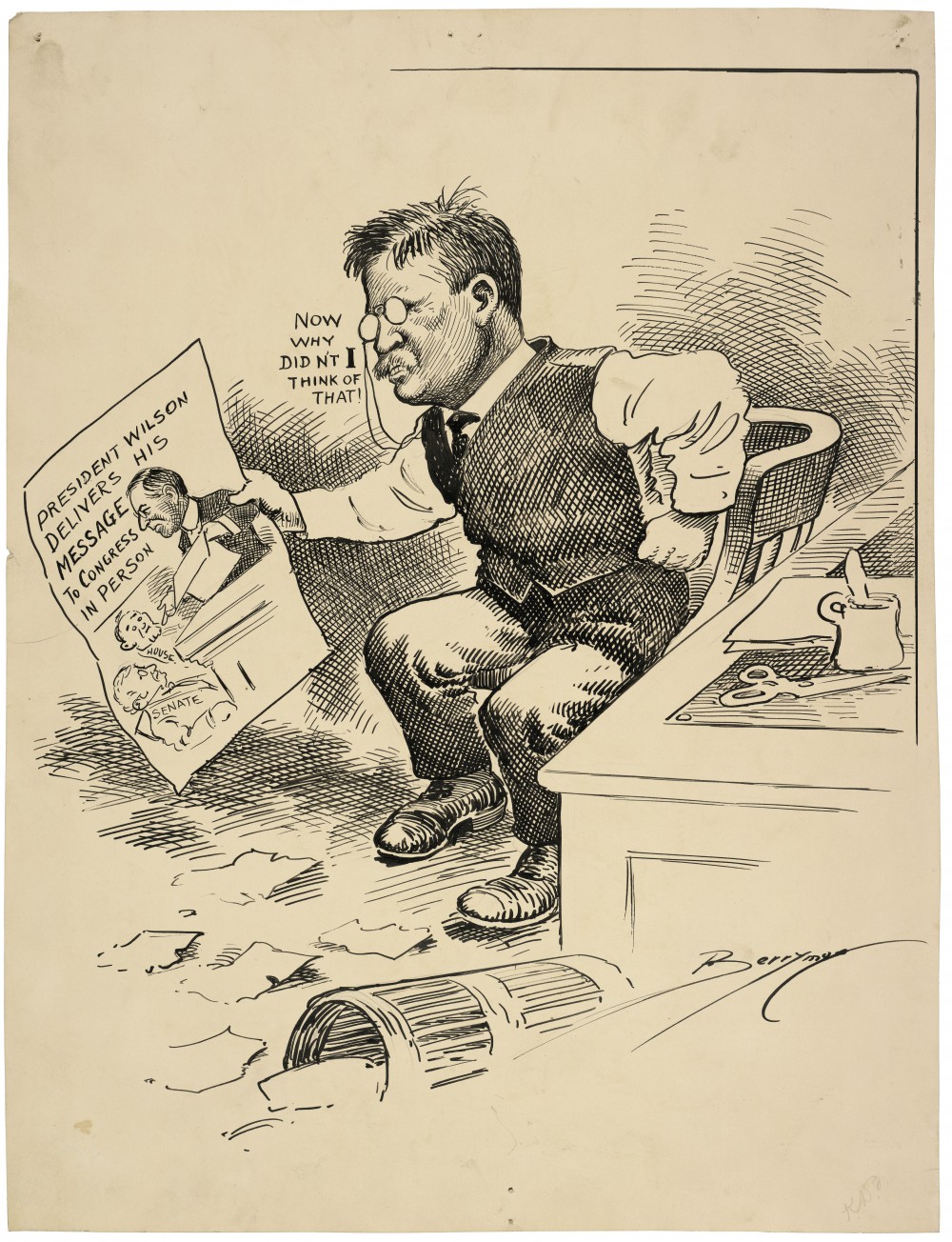
teddy and wilson
Teddy Roosevelt depicted reacting to Wilson’s spoken SOTU

It would take over one hundred years for the speech to return. Woodrow Wilson went to Congress to give his State of the Union, prompting the tradition that Trump followed on Tuesday.

Although most presidents post-Wilson have elected to give a speech, others have fallen back on written messages to Congress. The American Presidency Project has a comprehensive table of presidents giving oral or written addresses–after Wilson they clearly tilt in favor of addressing Congress in person. Still, there have been moments in recent history in which the president has forgone a formal, oral address to Congress. Truman, Eisenhower, and Carter chose to submit a written message instead of a formal address, when the address coincided with the election of a new president (1953, 1961, and 1981). Carter was the last president to do so.

The reach of the State of the Union (indeed, of all presidential addresses) has grown since its inception. Americans have gone from reading about it in the newspaper to hearing it on the radio (after Calvin Coolidge’s national broadcast in 1923) to seeing it on TV (with Harry Truman’s 1947 address) to sitting at home and watching it on the internet (which Bill Clinton did for the first time in 1997).

Two SOTU traditions were born under Ronald Reagan: first, the invitation of guests by the president and First Lady, and second, a response by the opposition party directly following the president’s speech (this had existed before, but would take place a few days later).

Clinton, perhaps unsurprisingly, holds the record for the longest address at one hour and bjctwenty-eight minutes. Each of his addresses to Congress were around or above the one hour mark. His speech was also the longest at 9,190 words (Washington’s, by comparison, was the shortest at 1,089 words).
Trump’s address on Tuesday was one of the slowest in history–in terms of words per minute. Richard Nixon spoke the most words per minute since the metric was recorded during the Johnson administration. He’s followed by Reagan and Clinton, with a near tie between George W. Bush and Barack Obama.

Only two presidents never delivered a State of the Union, through letter or otherwise–William Henry Harrison and James Garfield. Both died (Harrison of pneumonia, Garfield by assassination) early in their presidencies.

As for that that ubiquitous phrase “my fellow Americans”? Lyndon Johnson coined that for the first time during one of his State of the Union speeches.

As Seen on TV: Presidents & the Press

By Kaleena Fraga

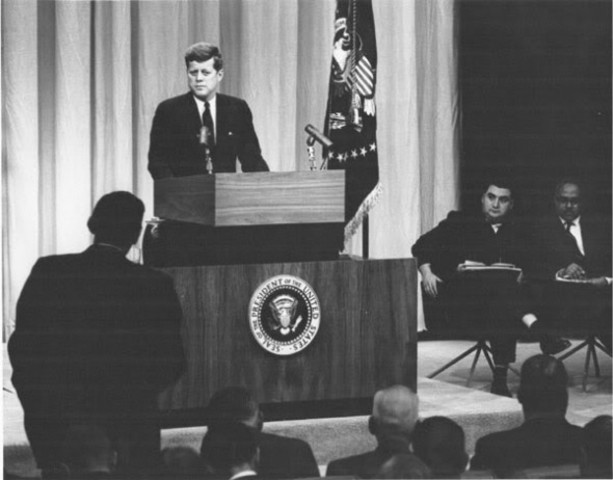
On this day in 1961, John Kennedy gave the first live televised press conference. The exchange can be watched in its entirety below:

Kennedy had observed what an effective medium television had been for him during the debates in 1960, and was determined to utilize it in his presidency–popular political lore says that TV viewers picked Kennedy as the debate winner over the sickly, sweaty Nixon, but listeners of the radio thought that Nixon’s deeper voice gave him the victory.

Kennedy was not the first president to utilize television during his press conferences, but he was the first to do it live. Dwight Eisenhower first held a televised press conference in 1955. Ike walked up to the podium, looked over the gathered reporters, stuck one hand in his pocket and said, “Well, I see we’re trying a new experiment this morning. I hope it doesn’t prove to be a disturbing influence.”

In between 1961 and his death in 1963, Kennedy gave 65 press conferences, about twice a month, an average of every sixteen days.  He and Eisenhower both gave about 700 public addresses, big and small, which says something about the pace of the Kennedy White House–Eisenhower had eight years in power, Kennedy less than three. Kennedy always went in prepared to meet the press–his aide Pierre Salinger described how they would go over 20-30 possible questions the press might ask the night before.

fdrpress
Roosevelt greets reporters at his first press conference, 1933

It was certainly a more studious method than that of Franklin Roosevelt, who, during his first press conference, let 125 reporters into the Oval Office to shoot their questions at him. The three presidents before him–Hoover, Coolidge, and Harding–had required that all questions were written down and submitted in advance. The new system was met with relief and excitement from the reporters who followed the White House. Roosevelt, with the advantage of being in office for an unprecedented 12 years, gave more news conferences than any other president. Over his tenure, he would give 881. It was no wonder that, after his first address, the assembled reporters gave the new president a round of applause.

rooseveltandreporters
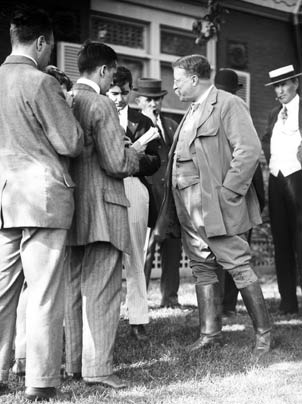
Roosevelt talking to reporters, 1906

Teddy Roosevelt, too, had a nonchalant attitude toward the press. According to biographer Doris Kearns Goodwin, Teddy understood that the strength of his message relied on his relationship with the press (Roosevelt is the one, after all, who coined the term “bully pulpit”). Kearns writes that Roosevelt “called reporters by their first names, invited them to meals, took questions during his midday shave…[and] brought them aboard his private railroad car during his regular swings around the country.”

Curiously, perhaps because early century presidents lacked other methods of communication, the number of news conferences given per year gradually declined toward the end of the 20th century. In other words, as the use of television grew, presidents used it less, at least for press conferences. According to the American Presidency Project, Coolidge, over six years in office, delivered an average of 72.9 news conferences a year, 407 total, barely beating FDR’s average of 72.66. (Somewhat surprisingly, since Coolidge was known by the moniker “Silent Cal.”) By contrast, more modern presidents have given far fewer. Ronald Reagan gave the least, with an average of just 5.75 conferences per year.

That’s more than the current president. Donald Trump still has three years in his term, but as of January 2018, he’s given just one solo press conference.

Inauguration 1961: Truman, Kennedy & a Return to the White House

By Kaleena Fraga

(To check out this piece in podcast form, click here)

January 20th is full of stories of the passage of power from one administration to the next. Since 1936 presidents have been inaugurated on this day, so so there is plenty to remember–FDR marking the beginning of his unprecedented 3rd and 4th terms; Eisenhower playfully lassoed by a cowboy; Jimmy Carter & Rosalynn Carter walking the inauguration route in spite of the protests of the Secret Service–the list goes on and on.

Still, there’s one event worth reflecting on which happened the next day, on January 21st, 1961, and this is President Truman’s invitation to the White House. It was his first time returning to the White House since he’d left eight years earlier.

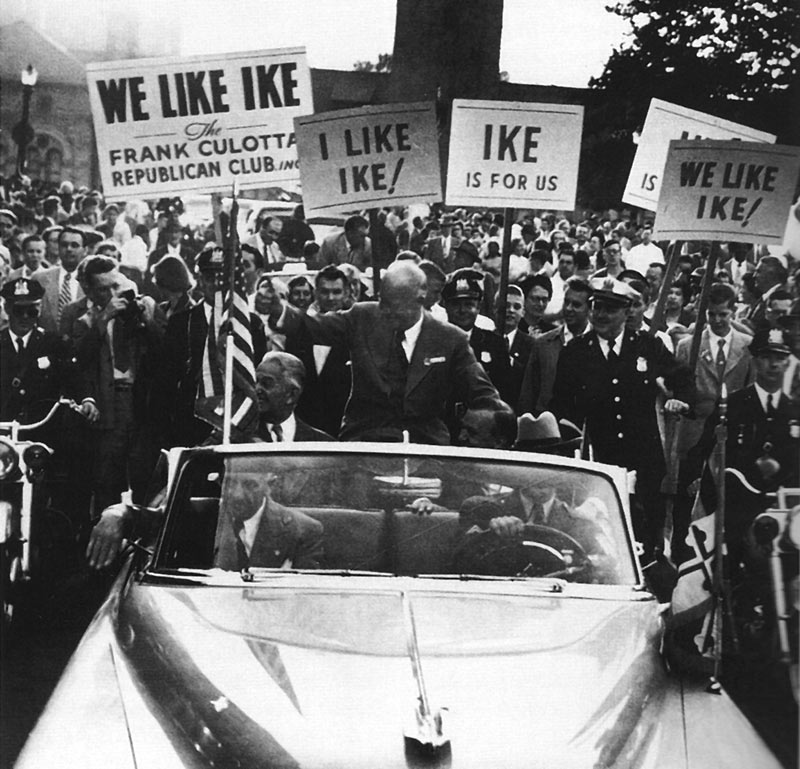
ike campaign

Truman had left in 1953 after a hard defeat for his party. Eisenhower had won a decisive victory over the Democratic candidate, Adlai Stevenson, whom Truman encouraged to run, becoming the first Republican victor in 20 years. Still, Truman was gracious in defeat. He invited Ike to the White House in November 1952 to talk about the job, but later wrote that all he had said to Ike “went into one ear and out the other.” He later postulated that Ike, a war hero, would be unsuited to the task of president. “He’ll sit right here and he’ll say do this, do that! And nothing will happen. Poor Ike–it won’t be a bit like the Army. He’ll find it very frustrating.”

eisenhower-truman1

Inauguration itself had been an awkward affair. Eisenhower, determined to not step foot in the White House that day until he could do so as president, disregarded the tradition of calling on the current president & first lady. The Eisenhowers declined the Trumans’ invitation to lunch, or even a cup of coffee, and did not come out of their car until Truman appeared outside of the White House. As they drove off, an aid to President Truman remarked that he was glad to not be in the car. 

Despite all this, Truman had invited Eisenhower’s son, John, currently serving in Korea, back to the States to watch his father’s inauguration. Neither son nor father knew it had been the president’s orders until Eisenhower asked Truman in the car. According to Eisenhower, Truman simply replied: “I did.”

But any thaw that took place during the car ride had little effect on the Truman/Eisenhower relationship. Shortly after the ceremony ended, Truman returned to Missouri, where he’d largely remain for Ike’s next two terms. It seems the two presidents had little contact during that time. When Ike was in Missouri Truman tried to set up a meeting, but was told that the president’s schedule was much too full. Later in life, according to Truman biographer David McCullough, he could hardly refer to Eisenhower without using profanity.

Truman didn’t exactly start off much better with the man destined to replace Eisenhower. During the Democratic convention in 1961, Truman spoke out against Kennedy, saying:

“I am deeply concerned and troubled about the situation we are up against in the world now…That is why I hope someone with the greatest possible maturity and experience would be available at this time. May I urge you to be patient?”

Kennedy shrugged off the criticism. He had fourteen years in major political office–that was enough.

When Kennedy did become the nominee, Truman offered up his services. But he had his doubts. Writing to his former Secretary of State, Dean Acheson, he declared that “[we] are stuck with the necessity of taking the worst of two evils or none at all. So–I’m taking the immature Democrat as the best of the two. Nixon is impossible. So, there we are.”

Despite his lackluster support, Truman, then seventy-six, went in all for Kennedy. He traveled to nine states and delivered thirteen speeches in support of the Democratic candidate.

Kennedy was grateful. As a gesture of thanks, he made Truman his first official guest to the White House, the day after his inauguration in 1961.

Truman, a talented piano player, was even invited to take up the keys after a formal dinner.

truman piano wh

Truman later wrote of his disappointment that Kennedy did not call on him for advice during his presidency. Later in Kennedy’s term, Truman wrote Acheson to say, “You must remember that our head of State is young, inexperienced and hopeful. Lets hope the hopeful works.”

In any case, Kennedy’s overture to Truman is a reminder that inaugurations don’t have to be chilly affairs–rather, they can be an occasion for mending bridges. Truman would certainly note–especially after the Bay of Pigs–that current presidents have much to learn from the men who occupied the office before them. A lesson that could be applied to 1961 as any political era.

Special thanks to David McCullough’s fantastic tome “Truman”

A Busy Day for JFK (& RMN)

By Kaleena Fraga

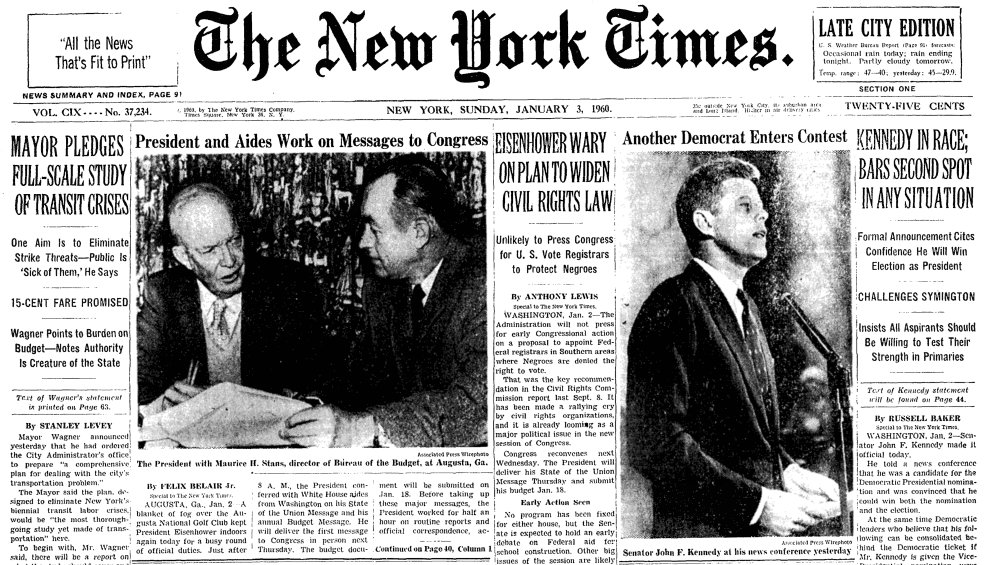
January 3rd is a day that holds special significance for John F. Kennedy. In 1947, it was the day that he was sworn into Congress for the first time as a member of the House of Representatives. On January 3rd in 1960, 13 years later, it was reported that JFK had thrown his hat in the ring to be the next president.

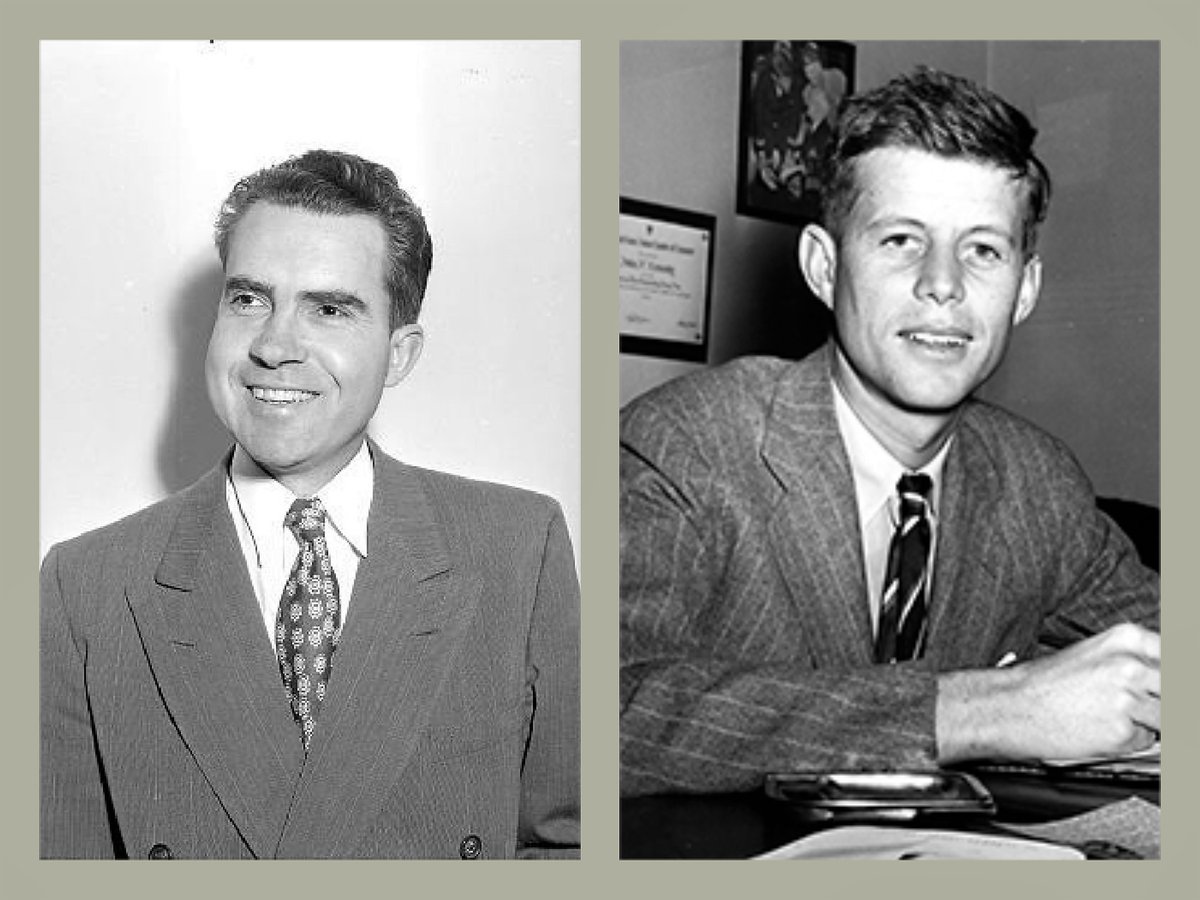
JFK wasn’t the only young Congressman to be sworn in that day in 1947. He was joined by his future political rival Richard Nixon.

jfkrmn
Richard Nixon and John F. Kennedy, circa 1947

Although they would face each other in the bitterly contested election of 1960, Kennedy and Nixon were friendly in the House. According to the 2017 Nixon biography Richard Nixon: The Life by John A. Farrell, the two young congressmen once shared a train car back to D.C. after a cordial debate in West Virginia. They bonded over their passion for international affairs. “Neither one of us was a backslapper,” Nixon wrote later. “He was shy…but it was a shyness born of an instinct that guarded privacy and concealed emotion. I understood these qualities because I shared them.” The Nixons were later invited to attend Jack Kennedy’s wedding.

When Nixon ran for Senate he had the support of the Kennedy clan. According to Farrell’s biography, John Kennedy stopped by Nixon’s office with a check from his father for one thousand dollars. The message? Joseph Kennedy wanted Nixon to win.

By 1960, the two would be rivals. Although Kennedy had followed Nixon to the Senate, Nixon had become Dwight D. Eisenhower’s vice president. While Kennedy finished his Senate term, Nixon spent eight years traveling the world on Ike’s behalf. In 1960 Nixon would argue experience; Kennedy would insist that after eight years of Ike, the country was ready for something new. Kennedy officially announced his candidacy on January 2nd–on January 3rd the announcement made front page news as Kennedy added his name to a growing list of White House-hungry Democrats. A week later, on January 9th, Richard Nixon likewise declared his candidacy.

jfkdeclares

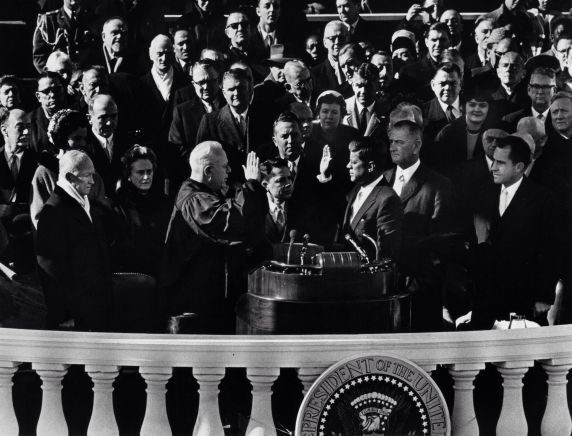
On another January day in 1961, Nixon (the outgoing vice president) would stand behind Kennedy to watch his rival take the oath of office.

inagjfk
January 1961. Nixon is standing behind Kennedy, to the right of the frame

Although the Nixon/Kennedy relationship soured, Nixon later penned a thoughtful note to Jackie Kennedy following her husband’s assassination in Dallas in 1963.

“Dear Jackie

In this tragic hour Pat and I want you to know that our thoughts and prayers are with you. While the hand of fate made Jack and me political opponents I always cherished the fact that we were personal friends from the time we came to the Congress together in 1947…If in the days ahead we could be helpful in any way we shall be honored to be at your command.

Sincerely,
Dick Nixon”

Jackie later replied, thanking Nixon for his note, and writing:

“Dear Mr. Vice President –

I do thank you for your most thoughtful letter –

You two young men – colleagues in Congress – adversaries in 1960 – and now look what has happened – Whoever thought such a hideous thing could happen in this country –…please be consoled by what you already have – your life and your family…

Sincerely

Jacqueline Kennedy”

See full letters here and here