“Seeking Monsters to Destroy”: Isolationism in America after WWI

By Kaleena Fraga

On November 11, 2018, world leaders gathered in Paris to recognize the 100 year anniversary of the end of WWI–on the eleventh hour, of the eleventh day, of the eleventh month. In his speech, French president Emmanuel Macron pointedly remarked that:

“Patriotism is the exact opposite of nationalism. Nationalism is a betrayal of patriotism. By putting our own interests first, with no regard for others, we erase the very thing that a nation holds dearest, and the thing that keeps it alive: its moral values.”

The remark was pointed because Donald Trump had recently declared himself a “nationalist” at one of his rallies. Macron went on to say:

“Old demons are rising again. New ideologies are manipulating religions, and history is threatening to repeat its tragedies. Let us vow once more as nations to ensure peace is the utmost priority, above all else, because we know what it cost.”

Since WWI and certainly since WWII there has been a strong push to erase nationalism, and to instead create a global world order that can prevent mass warfare. Yet this world order was not an inevitable result of world war, and certainly in the months after the armistice in 1918, President Woodrow Wilson faced fierce critics of his plan to create a “League of Nations.”

He first introduced the idea in January of 1918, eleven months before the war ended. Wilson called for a “general association of nations” which would work together to protect a global peace. This eventually became the League of Nations, which Wilson insisted the victors of WWI tie to the Treaty of Versailles.

As the war ended and Wilson’s idea seemed to be solidifying across the Atlantic, the strong strain of isolationism that had existed in American politics since John Quincy Adams warned of “seeking monsters to destroy” began to rise.

Whether this was out of real angst over the idea, or because the president had made a fatal political error, Henry Cabot Lodge sought to defy this shaky new world order.
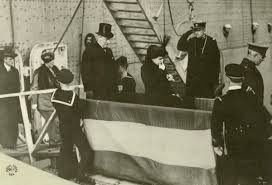
Wilson to ParisLodge, the Republican chairman of the Foreign Relations committee, watched Wilson go to Paris to sign the Treaty of Versailles without consulting the Senate. Then, although Wilson asked Lodge to not speak publicly about the League of Nations until they could meet at the White House, the president spoke to a crowd in Boston to try to garner support. Lodge saw this as a betrayal.

Two days after the White House meeting in February 1919, Lodge gave a speech in the Senate casting doubt on the League of Nations. Lodge warned against “casting aside these policies which we have adhered to for a century and more and under which we have greatly served the cause of peace both at home and abroad.” He worried that such an agreement would necessitate an enormous American military force “capable of enforcing” the League at “a moment’s notice.”

Lodge asked, using rhetoric that many would recognize today, whether Americans were l of n cartoonready “to give to other nations the power to say who shall come into the United States and become citizens of the Republic?”

Wilson desperately tried to corral support for the League of Nations, but the damage at home had been done. In October of 1919, following an 8,000 mile 22-day tour attempting to muster support at home, Wilson suffered a terrible stroke. The Senate voted against the Treaty a month later. The end of the war was finally declared in a joint resolution in 1921, but the damage to both Wilson, his presidency, and any pretense of an American endorsement of the League of Nations had been done.

In the following two decades the League proved largely ineffective without American support. As Depression haunted people around the world, Americans at home increasingly leaned toward isolationist policies–and many saw WWI as a lesson that American casualties were not worth involvement in conflicts abroad. By the time FDR came to office, he had to combat not only growing fascism abroad, but the bitter memory of Wilson’s failures.

Since the end of WWII, and the creation of international bodies like the United Nations, the new global world order has felt permanent–the result of two world wars. Yet there remains a strong strain of isolationist feeling in the United States and abroad. Whether or not the world continues on a global path, or tips back into nationalism, has yet to be seen.

Shifting Tides: The Midterms of 1966

By Kaleena Fraga

In terms of crazy presidential campaigns, 2016 has nothing on 1968. The election of 1968 saw horrifying violence, the shattering of the Democratic party along lines of civil rights and Vietnam, and the end of liberalism in the Republican party. The election of 1968 brought an incumbent president to his knees, and Richard Nixon to the White House. It changed everything, including how we think about presidential campaigns and state primaries.

Today, many Americans will cast a ballot. Midterm elections usually aren’t as attention-grabbing as presidential ones, yet this year Americans have been told that this is the most important election of their life. Certainly, given recent violence, the stakes feel high.

No, 2016 has nothing on 1968. But 2020 could be another wild-ride. As the country turns out to the polls, we look back at the midterm election of 1966, and the seeds planted that year that burst through the soil in 1968.

Two years earlier, Lyndon Johnson had won a landslide victory, winning the election in his own right after serving the rest of John F. Kennedy’s term. Meanwhile, the Republicans had suffered a terrible defeat under the banner of Barry Goldwater, who infamously declared at the Republican convention that “extremism in the defense of liberty is no vice. And moderation in the pursuit of justice is no virtue.” Johnson won a stunning 486 electoral votes to Goldwater’s 52. He took every state except for Arizona, Louisiana, Mississippi, Alabama, Georgia, and South Carolina.

The Republican party, pundits declared, was done.

Controlling both houses of Congress and the White House, Lyndon Johnson and the Democrats seemed unstoppable. They passed Johnson’s Great Society programs, including Medicare, and legislation that strengthened civil rights and voting rights. But as Johnson’s Great Society expanded, so did the conflict in Vietnam.

In 1966, tides had shifted. The public paid more attention to Vietnam, where they could see scant evidence of American victories. The economy began to slow. Race riots erupted across the nation. Johnson saw his popularity drop to below 45%. Republicans saw their opportunity. And they fought. Hard.

Determined to help restore the party to power (and to set himself up as a presidential candidate in 1968) Richard Nixon leapt into the fray. Nixon had not won an election since 1956, as Dwight Eisenhower’s vice president. After his failed bid for governor of California, he had bitterly told the press that they “would not have Nixon to kick around anymore.” And yet the former vice president had quietly been making moves behind the scenes. In the final months before the 1966 election, Nixon campaigned for 86 Republican candidates down the ballot. In the end, 59 of them won their elections.

“Tricky Dick”, thought to be politically dead, gained a lot of friends in 1966. Friends who would answer the phone when he called about running for president in 1968.

Although it was not enough to wrest control of the government from Johnson and the Democrats, Republicans won 47 seats in the House, 3 in the Senate, and 8 governorships. His majorities reduced, Newsweek wrote, “in the space of a single autumn day… the 1,000 day reign of Lyndon I came to an end: The Emperor of American politics became just a President again.”

In 1966, Ronald Reagan became governor of California. George H.W. Bush won a House seat in Texas. Gerald Ford won his reelection campaign and became House Minority Leader, increasing his prominence on the national stage. Republicans, wounded after 1964, suddenly believed they could win again. And they did–seven out of the next ten presidential elections were won by the GOP.

From 1966, Johnson became increasingly unpopular and unable to push legislation like he had in the first two years of his term. In 1968, he stunned the nation by announcing he would not “seek, nor accept” the nomination of the presidency.

The election of 1968 was the most dramatic of the 20th century, but it all started in 1966. Today, Americans vote. Who knows what seeds the nation will plant today, that may bloom in 2020 or beyond?


Ghosts of the White House

By Kaleena Fraga

Happy Halloween from History First!

Since John and Abigail Adams moved into the White House in 1800, the executive mansion has had its fair share of inhabitants–from this world and the next. Jared Broach, who offers tours of haunted places in America, calls paranormal sightings in the White House “verified.” To say otherwise, he noted, would be “calling eight different presidents liars.”

One of the first people to live in the White House–Abigail Adams–is reported to continue to roam the halls. Witnesses have claimed to see her en route to the East Room–where she once would hang laundry–and some White House staff have smelled wet laundry and the scent of lavender. Why Abigail Adams would prefer to spend her time in the afterlife doing laundry at the White House, instead of relaxing at home in Massachusetts, is beyond the comprehension of History First.

Harry Truman wrote a letter to his wife in 1945 expressing the haunted feeling of his new home–he was only two months into his term at the time.

“I sit here in this old house and work on foreign affairs, read reports, and work on speeches–all the while listening to the ghosts walk up and down the hallway and even right in here in the study. The floors pop and the drapes move back and forth–I can just imagine old Andy [Jackson] and Teddy [Roosevelt] having an argument over Franklin [Roosevelt].”

Truman wasn’t the only one to imagine Jackson’s lingering presence in the White House. Mary Lincoln, who wanted desperately to believe in the afterlife after the death of her sons, and then her husband, also felt Jackson. She told friends that she had heard Jackson “stomping and swearing.” Jackson has also been spotted lying in his bed in today’s Rose Room, and others have heard his “guttural laugh” in the White House since the 1860s. In addition to Jackson, Mary Lincoln also once reported seeing the ghost of her dead son, Willie, at the foot of her bed, and even thought she heard Thomas Jefferson playing the violin.

In 1946, Truman wrote another letter to his wife detailing a more concrete supernatural experience. He writes that he went to bed, and six hours later heard a strong knock on his bedroom door.

“I jumped up and put on my bathrobe, opened the door, and no one there. Went out and looked up and down the hall, looked in your room and Margie’s [the president’s daughter]. Still no one. Went back to bed after locking the doors and there were footsteps in your room whose door I’d left open. Jumped and looked and no one there! The damned place is haunted sure as shootin’. Secret Service said not even a watchman was up here at that hour.”

“You and Margie had better come back and protect me before some of these ghosts carry me off.”

Perhaps the White House’s most famous ghost is Abraham Lincoln–killed only a month and a half into his second term in office. Grace Coolidge first reported seeing Lincoln’s ghost in the 1920s, staring across the Potomac at old Civil War battlefields. Other first ladies also sensed Lincoln’s presence. Eleanor Roosevelt, who worked out of a room near the Lincoln Bedroom, said she strongly felt Lincoln’s presence one night. Two European visitors, staying down the hall, said that they had felt the same thing. Lady Bird Johnson, after watching a documentary about Lincoln, admitted to similar feelings in the private residence, where Lincoln had once worked out of his office.

Other visitors to the White House have had more tangible crossings with the assassinated president. Queen Wilhelmina of the Netherlands visited the White House in 1942, and slept in the Lincoln Bedroom. She claimed to have heard a knock on the bedroom door, and to have discovered Abe Lincoln on the other side–an experience so frightening that she fainted outright.

Winston Churchill liked to tell a story about his own ghostly Lincoln encounter during a visit to the White House in 1940. As Churchill tells it, he had just stepped out of the bath and picked up a cigar. Walking into the next room wearing nothing and still dripping wet, he found Lincoln by the fireplace.

“Good evening, Mr. President,” Churchill reportedly said. “You seem to have me at a disadvantage.”

Even Ronald Reagan’s dog, Rex, seemed to sense something unsettling about the Lincoln Bedroom. It was the only room in the White House that the dog refused to enter. Reagan himself said that Rex had twice barked “frantically” in the Lincoln Bedroom, then backed out and refused to come back in. The president went on to say that one night while the Reagans were watching TV in the room below the Lincoln Bedroom, Rex began to bark at the ceiling. The president thought the dog might be detecting some sort of spy equipment, perhaps an electrical signal too high pitched for Reagan to hear himself.

And yet Rex the dog wasn’t the only one to feel uneasy about the Lincoln Bedroom during the Reagan administration. The president related a story in which his daughter Maureen and her husband both saw a ghosty figure in the bedroom, looking out the window.

It seems that the ghosts of the White House have been fairly quiet in recent years–or perhaps the current and recent inhabitants are hesitant to tell their stories.

Impeachment from the Bench: Thomas Jefferson, Samuel Chase, and Brett Kavanaugh

By Kaleena Fraga

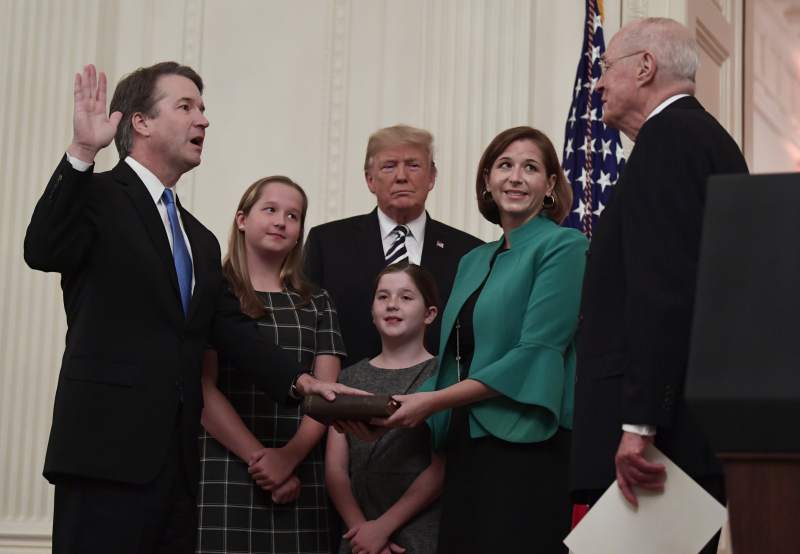
Even before the newest Supreme Court justice, Brett Kavanaugh, placed his hand on the Bible and swore to uphold the Constitution, Democrats in Congress faced pressure to remove him from the bench. A petition to impeach the judge quickly hit over 150,000 signatures and think pieces arguing for and against impeachment began to pop up across the Internet.

Faced with this, Democrats in Congress hesitated. “I have enough people on my back to impeach the president!” House Minority Leader Nancy Pelosi exclaimed, when asked if she would impeach Kavanaugh.

Hesitancy on their part is understandable: attempts to impeach justices from the Supreme Court have been few and far between, and have never resulted in an actual impeachment.

The first example of this came early in American history. Thomas Jefferson had swept to power in the “revolution of 1800”, a repudiation of the last twelve years of Federalist rule. Still, despite the ascension of Jefferson’s party to both houses of Congress, most of the Supreme Court remained staunchly Federalist.

One of Jefferson’s first moves as president was to repeal the Judiciary Act of 1801–an act with a dry title and a dramatic history. Jefferson’s predecessor, his frenemy John Adams, had passed the Act in the waning weeks of his one-term in office. It reduced the size of the Supreme Court, and, more importantly, created a lower level of courts which Adams briskly filled with like-minded Federalists with life-terms. Jefferson and his allies accused Adams of packing the court with so-called “Midnight Judges“, giving birth to the lore that the ink on Adams’ appointments had not dried by the time Adams left Washington, skipping out on Jefferson’s inauguration.

When the Judiciary Act of 1801 was repealed (and replaced with the Judiciary Act of 1802, eliminating the circuit judgeships that Adams had created), Supreme Court Justice Samuel Chase–a Federalist with a “volcanic” personality–declared in front of a Baltimore jury that “Our republican Constitution will sink into a mobocracy–the worst of all possible governments.”

Jefferson already disliked the justices of the Supreme Court (his biographer Jon Meacham writes that Jefferson’s “hatred of his cousin John Marshall [the Chief Justice] was cordial, but it was hatred nonetheless”) and found that this outburst from Chase could not stand. He wrote to Congressman Joseph H. Nicholson asking: “Ought this seditious and official attack on the principles of our Constitution and on the proceedings of a State go unpunished; and to whom so pointedly as yourself will the public look for the necessary measures?”

Ever the behind-the-scenes man, Jefferson professed that it would be better “that I should not interfere.”

Jefferson’s cousin and friend, Congressman John Randolph, launched impeachment proceedings against Justice Chase. Chase argued he was being persecuted for his political convictions rather than any actual crimes. (Indeed, one of the articles of impeachment pointed to Chase’s political speech from the bench).

Chase escaped with an acquittal. His impeachment trial set two norms: that judges should not be removed based on their political beliefs, and that judges should remain non-partisan while speaking from the bench.

One hundred and sixty-five years later, a second Supreme Court justice, Abe Fortas, faced impeachment proceedings. Rather than face a trial, he resigned.

Between the dawn of the Republic and 2010, fourteen other federal judges (serving on lower courts) have faced charges of impeachment–eight were removed from office, three were acquitted, and three resigned. It’s no wonder that Democrats today hesitate to engage in impeachment rhetoric when it comes to Kavanaugh; given the history, it would be an extreme move on their part.

Still, for those who shudder at the partisanship plaguing the nation and the Supreme Court today, recall that amidst Jefferson’s time as president, he infuriated the Federalists by such actions as repealing the Judiciary Act of 1801 and attempting to impeach Samuel Chase. One frustrated American wrote to the president he hoped “that your Excellency might be beheaded within one year.”

Thomas Jefferson, Time, and the Supreme Court

By Kaleena Fraga

michelle obama voteAddressing a rally in Las Vegas, former first lady Michelle Obama likened young people’s dismal voting records to her daughters letting their grandmother pick out their clothes or their playlists.

“Now, no offense to grandma,” said Obama. “When you don’t vote, that’s exactly what you’re doing. You’re letting other people make some really key decisions about the life you’re going to live.”

Michelle Obama would have an ally in Thomas Jefferson.

Jefferson, in a letter to his friend James Madison, professed his belief that each generation should play a role in determining their own destinies.

“The question,” Jefferson wrote Madison, in 1789, “whether one generation of men has a right to bind another, seems never to have been started either on this or our side of the water.”

Jefferson was writing from Paris, less than a month before he would travel back to the newly formed United States to serve as George Washington’s secretary of state.

“I set out on this ground,” Jefferson wrote, “which I suppose to be self evident, that the earth belongs in usufruct to the living.” After a lengthy piece describing how each generation should be free of the last generation’s debt, Jefferson mused:

“On similar grounds it may be proved that no society can make a perpetual constitution, or even a perpetual law. The earth belongs always to the living generation…every constitution, then, and every law, naturally expires at the end of 19 years. If it be enforced longer, it is an act of force, and not of right.”

Madison, having recently helped create a constitution which he hoped would last much longer than 19 years, refuted much of Jefferson’s claim, arguing that such a design would create anarchy.

Madison also belonged to the camp of Founders who believed  that judges should hold their positions as long as they exhibited “good-behavior,” a point which Jefferson routinely professed disagreement. In a letter written in 1822, Jefferson once mused to a friend, “Let the future appointments of judges be for four or six years and renewable by the President and Senate.” Jefferson oversaw the only attempted impeachment of a Supreme Court Justice, Samuel Chase, a George Washington appointee whom Jefferson believed was overtly partisan.

As Congress grows more partisan itself, unable to pass significant legislation without a fight, the Supreme Court, and its judges, have become more powerful. Certainly, the Court is not what the Founders envisioned–the first ten justices only served for ten years, whereas most justices since 1970 have spent upwards of twenty-five years on the court.

In 2005, 45 leading legal scholars agreed “in principle” to a plan that would limit supreme court justices’ terms to just 18 years. The proposal’s authors, Paul Carrington (a Democrat) and Roger Cramton (a Republican) note that: “the Founders could not foresee that increases in longevity would imperil the rotation in powerful office essential to representative government.” Their plan, a staggered eighteen year term for justices, would allow for an appointment every two years, or two per presidential term, thus resolving the randomness and the overblown significance of Supreme Court appointments.

Thomas Jefferson, in his belief that the Constitution should be reviewed every nineteen years, would have found this an interesting idea. But it’s a complex one, and would be a tough sell to Congress and the American people, especially as life-terms for justices are engrained in American political life.

In the meantime, for people who want to see change on the political stage, there’s only one thing to do: VOTE!

Garfield, Guiteau & the Unrealized Presidency

By Molly Bloom

“This honor comes to me unsought. I have never had the presidential fever; not even for a day.” James A. Garfield reportedly spoke these words on the night before his inauguration as President of the United States in 1881. In a field of ambitious career politicians and war heroes, including former president Ulysses S. Grant, Garfield inexplicably received the Republican nomination without participating in a campaign or even desiring to run in the first place.

Garfield’s upbringing was practically the inspiration for a Horatio Alger novel. (In fact, Alger wrote a “biography” of Garfield, From Canal Boy to President, which was more similar to Alger’s fictionalized narratives than factual). Garfield was born in a log cabin and grew up on a small farm in Ohio. His father had died before Garfield turned two; as a result, his family was so impoverished that he did not own a pair of shoes until he was four years old. Garfield was raised by his widowed mother and older siblings before leaving to work on the Erie Canal when he was 16, but he always sought to better himself through education. He worked as a teacher before and after attending Williams College and graduated salutatorian. He went on to pass the bar in Ohio, became a colonel in the Union Army, and served in Congress as a Republican at the urging of President Abraham Lincoln.

After seventeen years as a congressman, Garfield was seen as a political leader in the Republican Party, and yet he continually turned down requests to run for a higher office. During the Republican nomination of 1880, Garfield was in attendance to deliver the speech announcing the nomination of fellow Ohioan John Sherman. After 35 ballots in which no candidate reached the necessary 379 votes for the nomination, the 36th vote led to Garfield’s surprise nomination as the Republican candidate, eventually leading to his election as president.

james garfield memorial
Garfield memorial in Cleveland, OH

It is generally believed that Garfield would have been an excellent and progressive president, had he been given the chance. As a supporter of civil rights, he was endorsed by Frederick Douglass and secured votes from many freed slaves. Education, free trade, and civil liberties were all causes that Garfield believed were important for the progress of the nation following the Civil War. Yet, his presidency was cut short by an assassination attempt by Charles Guiteau and the poor medical treatment that he received in the aftermath. No one can say for sure if Garfield would have secured his place as one of the most effective US presidents- he was shot approximately four months into his term.

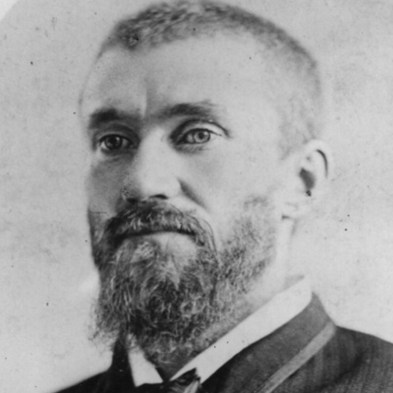
Garfield’s assassin Charles Guiteau may have seen much of himself in the presient. Both born into poverty in the Midwest, the two men were drawn to Christianity and education as a means to learn more about the world around them and advance their lives. While Garfield’s education drove him to serve in the Union Army and enter the House of Representatives, Guiteau joined a cult. He moved to the Oneida Community in upstate New York to follow the religious tenets of the community’s leader, John Humphrey Noyes.

The Oneida Community was a utopian commune founded, as most cults are, by an egotistical and religiously fanatic leader. Noyes believed that he was a flawless human who was granted by God the mission of helping others reach similar perfection. One concern in the commune was humans’ tendency toward monogamy; therefore, cult members practiced free love and sex to ensure that they stay away from monogamous relationships and avoid connecting too strongly to one person.

Despite Guiteau’s initial interest in the cult, he never quite fit into the community. Other members saw him as strange and egotistical. Guiteau felt that he, not Noyes, was the person to whom God spoke and believed that the commune members should be indebted to him and his power. Guiteau eventually left the cult, as he felt that he was unable to carry out the mission that God had set forth for him.

charles guiteau
Charles Guiteau

After leaving the Oneida Community, Guiteau continued from one profession to another, attempting to feed his delusions of grandeur and receive recognition. Even his family believed that he was mentally ill and tried to have him committed to an asylum; however, Guiteau eventually turned his interest to politics. He wrote a speech “Grant vs. Hancock” for the anticipated campaign in 1880, but once Garfield emerged as the Republican nominee, Guiteau made a few small adjustments so that the speech would fit Garfield, instead. Guiteau was given the chance to deliver the speech to an audience in New York, but he was only able to speak for a few minutes before getting overwhelmed and leaving the scene. Continuing his pattern of misplaced self-importance, he felt that his speech was a major factor in Garfield’s election and that there should be a proportionate reward. After being rejected by various government staff, he decided to shoot Garfield in a manic state where he believed God willed the outcome and that a fellow member of the Stalwart faction of Republicans, Vice President Chester Arthur, ought to become president.

On July 2, 1881, Guiteau shot Garfield twice, once grazing his arm and once in his back, at the Baltimore and Potomac railway station in Washington D.C. The New York Times reported that Guiteau stated, “I did it and will go to jail for it. I am a Stalwart and Arthur will be President.”

After carrying Garfield on a mattress into a private room, doctors began to search for the bullet, which was the standard medical practice at the time. Many doctors used unhygienic tools and fingers to reach into the gunshot wound and attempted to locate and remove the bullet. Furthermore, when the president was bandaged, the dressings were not sterile. This lack of care was fatal to Garfield.

The most tragic part of the story is that Garfield could have recovered from his injuries had doctors been more careful and thoughtful in the aftermath of the gunshot wound. As Candice Millard writes in Destiny of the Republic, “Had he been able to receive modern medical care, he likely would have spent no more than a few nights in the hospital. Even had Garfield been simply left alone, he almost certainly would have survived” (178). The poor medical care and resulting infections led to his death, and Guiteau even claimed in his trial that medical malpractice, not the gunshots, killed the president. Despite this defense, Guiteau was found guilty and hanged in 1882.

Garfield died 137 years ago on September 19th, 1881. The presidency of a man who never had ambitions to hold the office was cut short and left his term in relative obscurity. Garfield is often remembered for his assassination (the second in sixteen years), but his humble background and the unlikely Republican nomination are extraordinary details that would have certainly been remembered had his presidency lasted longer. What he would have done as president is hard to say, but Garfield was living proof that a president can be for the people and by the people without the egotism and ambition that plague many politicians.

Sources:

Destiny of the Republic: A Tale of Madness, Medicine, and the Murder of a President by Candice Millard

James A. Garfield by Ira Rutkow

Dark Horse: The Surprise Election and Political Murder of President James A. Garfield by Kenneth D. Ackerman

Ulysses S. Grant, Reconstruction, and the Voting Rights Act of 1965

By Kaleena Fraga

The 14th amendment guaranteed all citizens “equal protection of the laws”, effectively ending the 3/5 Compromise enshrined in the Constitution (stating that states could count black people as 3/5 of a person). As president, Andrew Johnson fought against the 14th amendment and convinced southern states to do the same. Following his lead, southern states refused to ratify it. Still, the amendment was ratified on July 9th, 1868. It was followed by the 15th amendment, which ensured equal voting rights, regardless of race.

This was, Grant said during his presidency, a mistake.

Grant was no racist–far from it–but he recognized the inherent problem of states disenfranchising voters, while using their bodies as tallies toward their power in the electoral college.

What was it about the 14th and 15th amendments that Grant didn’t like?

Grant’s secretary of state, Hamilton Fish, recorded Grant’s thoughts during a particularly tense point in his presidency. The recent presidential election–which would eventually put Rutherford B. Hayes in office–had been highly contested, and Grant and Fish had heard reports from Louisiana that stated that black voters had been so terrorized that “overwhelmingly Republican parishes had ended up in Democratic columns.” A Senate investigation even later uncovered that in one parish 60 black Republicans had been murdered before the election.

Fish wrote of Grant, “He says he is opposed to the XV amendment and thinks it was a mistake; that it had done the negro no good, and had been a hindrance to the South, and by no means a political advantage to the North.”

Grant later clarified what he meant: “[The South] keep[s] those votes, but disfranchise[s] the negroes,” he told journalist John Russell Young. “That is one of the gravest mistakes of reconstruction.” In other words, the 14th amendment increased the population of the South, which gave southern states more heft in the electoral college. So although the South suppressed the black vote, it could count them fully for election purposes. The result was an imbalance of power.

Grant saw it as his prime responsibility–indeed, the prime responsibility of the government–to ensure that everyone had safe, easy access to voting. “I will not hesitate to exhaust the powers thus vested in the Executive,” he said, “for the purpose of securing to all citizens of the United States the peaceful enjoyment of the rights guaranteed to them by the Constitution and laws.”

Grant oversaw the passage of the Civil Rights Act of 1875, which outlawed racial segregation in public accommodations, schools, transportation, and juries. Democratic states did not bother to enforce it, and it was struck down by the Supreme Court in 1883 as unconstitutional. It would take almost 100 years for Congress to attempt anything similar.

It wasn’t until 1957 that Congress passed another civil rights bill; and it wasn’t until 1964 that laws first proposed in 1875 were enshrined into law. Then, in 1965 the country saw the Voting Rights Act, which enabled fair voting to the very citizens that Grant sought to protect, 90 years earlier.

Ulysses S. Grant’s presidency was a long time ago, but his mission, to protect voters, is today more important than ever.

In 2013, the Supreme Court struck down key tenets of the Voting Rights Act. Chief Justice John Roberts, writing the majority opinion, stated that such protections were no longer needed because “our country has changed” for the better. “While any racial discrimination in voting is too much,” Roberts wrote, “Congress must ensure that the legislation it passes to remedy the problem speaks to the current conditions.”

Since 2013, it’s become harder for Americans to vote. In light of the 2013 ruling, southern states have closed at least 868 polling places–the Voting Rights Act of 1965 allowed the Department of Justice to stop closures like these, but that part of the legislation was struck down. Vox points out that these 868 closures are in about half of the counties that were once targeted by the Voting Rights Act because of their history of racial discrimination. This means that there could be hundreds, or perhaps thousands, of closures that are untracked.

In 2018, the United States faces the same problem it faced in the 1860s and 1870s. Americans have a limited ability to vote. Those who work long hours, or shifts, or live far away from polling places, face difficulties having their voices heard. Yet they are still counted, and states can use their bodies (even while it silences their voices) on the electoral stage. To Grant, this oversight on the part of the U.S. government would be nothing less than a dereliction of duty.

Donald Trump, Andrew Johnson, and Impeachment

By Kaleena Fraga

Talk of impeaching Andrew Johnson began even before his ill-fated presidency.

When Johnson was first sworn in as Abraham Lincoln’s vice president in 1865, he rewarded onlookers to a drunken tirade about his “Plebeian roots” and how he had triumphed over the ruling elite. Senators in attendance covered their faces with embarrassment–Lincoln’s former vice president, Hannibal Hamlin tugged at Johnson’s coattails in a vain attempt to get him to sit down, while the president looked on with an expression of “unutterable sorrow.” A group of Radical Republicans promptly drafted a resolution demanding that Johnson resign, or be impeached.

Johnson survived the demand. Lincoln came to his defense, saying, “It has been a severe lesson for Andy, but I do not think he will do it again.”

A little over a month later, Lincoln was dead–the first president to be assassinated–launching Andrew Johnson, a Democrat, into the presidency just as the Civil War drew to a close.

Although Republicans in Congress had had high hopes for Johnson–after all, he remained loyal to the Union, even though he hailed from Tennessee–they quickly found that he did not intend to reform the South, but rather sought to reinforce old power structures. Johnson got to work choosing conservatives as state governors and issuing pardons to white southerners. He was lenient toward the Southern ruling class, and dismissive and hateful toward newly freed black Americans. “This is a country for white men,” he once declared, “and by God, as long as I am president, it shall be a government for white men.” Before long, the relationship between the new president and Congress became contentious.

As racial violence flared in the South, the Republican Congress, increasingly distrustful of Johnson’s willingness to interfere, passed the Tenure of Office Act. The act was meant to protect members of Lincoln’s Cabinet, whom Johnson had retained when he took over the presidency. The law prohibited the president from removing any officials that had been confirmed by the Senate, without the Senate’s approval. It especially sought to protect the Secretary of War, Edwin Stanton, who had close ties to Radical Republicans in Congress.

When Johnson tried to remove Stanton, Congress responded with articles of impeachment. Nine of the eleven articles related to the Tenure of Office Act–others related to Johnson’s “attempt to bring into disgrace, ridicule, hatred, contempt and reproach, the Congress of the United States…to impair and destroy the regard and respect of all the good people of the United States for the Congress…and to excite the odium and resentment of all good people of the United States against Congress.”

Ultimately the Tenure of Office Act was unclear enough-after all, Stanton had been appointed and confirmed under Lincoln-that Johnson escaped impeachment by one vote.

What does Andrew Johnson have to do with Donald Trump? Aside from sharing several characteristics, recent actions by Congress could put Trump in the same position as Johnson, when Johnson faced impeachment charges.

In the wake of Trump’s decision to revoke security credentials from the former CIA Director John Brennan, Senator Mark Warner has announced his intention of introducing a bill that would bar the president from “arbitrarily revoking security clearances.” The amendment is unlikely to pass–at least as long as Republicans control Congress. Yet, if midterms bring a political shift to Washington D.C. it’s not implausible that such legislation would be revisited.

If that were the case, and if Trump continued to use the revocation of security clearances as a way to punish his critics, he would find himself in the same position as Andrew Johnson–breaking a law set by Congress meant to control him (not to mention Trump has the whole insulting Congress thing in the bag).

For now, at least, it’s a lot of ifs. Still, if Trump finds himself facing a hostile Congress, as Johnson did, it’s not out of the realm of possibility that he would face a similar outcome.

Eisenhower & the 50th State

By Kaleena Fraga

On this day in 1959, Dwight D. Eisenhower issued Proclamation 3309, creating the state of Hawaii. The admission of Hawaii brought the total of U.S. states up to fifty, and it is the most recent addition to the Union.

Upon signing his proclamation, the president said:

All forty-nine States will join in welcoming the new one–Hawaii–to this Union. We will wish for her prosperity, security, happiness, and a growing closer relationship with all of the other States. We know that she is ready to do her part to make this Union a stronger Nation–a stronger people than it was before because of her presence as a full sister to the other forty-nine States. So all of us say to her, “Good Luck.” And to each of her representatives, a very fine tour of service in the public domain. We know that they will find their work interesting and fruitful for all of us.

Ike had long been a proponent of admitting both Hawaii and Alaska to the Union, and his presidency saw the absorption of both territories.

The road to statehood was a bumpy one–Hawaii’s royal family first proposed joining the Union in 1919. Congress voted down the idea multiple times before 1959, although Eisenhower made it a proponent of his 1952 campaign. Democrats feared that Hawaii would become a Republican stronghold, and pushed for the inclusion of Alaska to balance things out. Some Americans found its distance from the continental U.S. problematic; others opposed Hawaii’s inclusion on racial grounds.

Some native Hawaiians did not want to join the Union, either, and today there is a Hawaiian sovereignty movement.

ike and flagStill, for most Americans today there has never been a United States without Hawaii. The flag that changed under Eisenhower to include 50 stars is the one that most Americans grew up seeing flying over buildings, hanging off porches, or being held on the 4th of July.
Barack Obama, the only American president born in Hawaii, attributes his famous calm demeanor to his childhood in the 50th state. “I always tell folks part of it’s being born in Hawaii,” Obama said, “and knowing what it’s like to jump into the ocean and understanding what it means when you see a sea turtle in the face of a wave.”

Happy Statehood, Hawaii!

“Right Hand Man”: The People Around the President

By Kaleena Fraga

In the hit broadway play Hamilton, George Washington sings about his need for a right hand man. Washington has a point–presidencies can either thrive or wilt depending on who the president choses to include in his inner circle.

Often the focus is on the chief of staff–Chris Whipple wrote an excellent book detailing the make-or-break relationships presidents have had with their COS. This includes Bob Haldeman, who knew better than other aides when to listen to Nixon, and when to ignore his commands as venting.

Yet the president can draw strength on people other than their chiefs of staff–a relatively new position, anyway. We take a look at members of presidential political circles who–through their absence–proved their importance to the presidency.

Ulysses S. Grant

Grant entered the White House as war hero after the Civil War. Grant was a military genius in his own right, creating and executing battle plans that eventually defeated the Confederacy. Upon hearing suggestion that his victory was due only to the overwhelming manpower he possessed in comparison to the South, Grant objected–after all, generals before him had had just as many men, and yet failed.

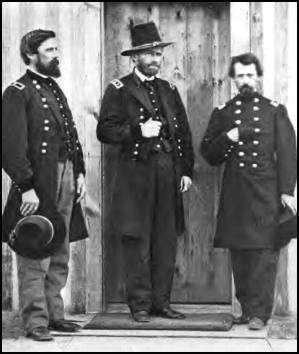
grant and rawlins
Rawlins, left, and Grant, center

Grant owed some of his success to his aide, John A. Rawlins. As the war slogged on, Grant wrote that Rawlins “comes the nearest to being indispensable to me of any officer in the service.” Rawlins, writes Grant biographer Ron Chernow, “could confront [Grant] with uncomfortable truths and fiercely contest his judgement…with his thoroughgoing skepticism and mistrust of people, he was the ideal foil to Grant’s excessively trusting nature.”

Rawlins, along with Grant’s wife, Julia, also largely succeeded in suppressing Grant’s alcoholism during the war. Rawlins had Grant pledge he would not drink at all until the war ended, and he himself took a pledge to remain sober. Rawlins also organized Grant’s affairs, and helped him to maintain a positive relationship with politicians in Washington D.C. Rawlins kept Grant sober with mixed success–he always reacted with disappointment and alarm when he learned that his friend had gone on a bender. When Grant drank, he got drunk. But thanks to Rawlin’s watchful eye, he drank rarely during the war.

When Grant became president in 1869, Rawlins was one of many loyal army friends who followed Grant to the White House. But the war had worn heavily on Rawlins, and he had suffered with health problems for years. At the age of thirty-eight, he died of tuberculosis.

Grant possessed battle savvy but little business acumen, and he was more trusting of men than his late friend. Rawlins’ loss was devastating to the Grant Administration. Chernow writes: “Rawlins would have warned the president against predatory, designing figures who encircled him in Washington. He would have detected wrongdoers and been a stalwart voice against corruption…with Rawlins gone, Grant lacked that one trusted adviser…”

Grant and his administration would be plagued by charges of corruption, as the easily trusting Grant let people into his inner circle that Rawlins would have likely barred.

Harry S Truman

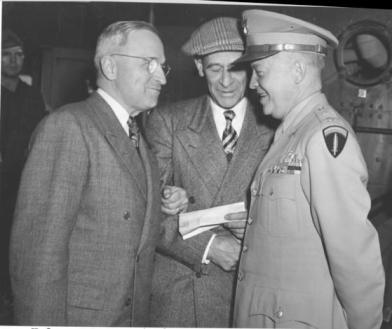
When Truman unexpectedly became president in 1945, he reached out to his old high school friend, Charlie Ross, to be his press secretary. Ross accompanied the president all over the world, even playing poker with Truman and Winston Churchill. David McCullough details their close relationship in his biography of Truman.

truman and ross
Truman, Ross, and Eisenhower

Aside from his duties as press secretary, Ross was a friend and a shoulder for the president to lean on. When Truman started talking walks on doctor’s orders, he confided in Ross that it helped him sleep better. On Ross’ counsel, Truman learned to better respond to “smarty questions” at press conferences, answering “No comment”, “your guess is as good as mine”, or, “I’ll cross that bridge when I come to it.” Ross also played a crucial role in cooling down the president, especially as an editor. When railroad workers threatened to strike, Truman was furious. He wrote a seven page speech, which he gave to Ross to read. Ross told him he needed to rework it, so they did, with the help of several other aides.

In a letter Ross wrote to Truman in 1947, he said:

“There is nothing in life, I think, more satisfying than friendship, and to have yours is a rare satisfaction indeed…the greatest inspiration, Mr. President, has been the character of you–you as a President, you as a human being. Perhaps I can say best what is in my heart by telling you that my admiration for you, and my deep affection, have grown steadily since the day you honored me with your trust.”

When Ross died unexpectedly of a coronary occlusion in 1950, Truman was devastated by his loss. He wrote a tribute describing Ross as “the friend of my youth…a tower of strength…patriotism and integrity, honor and honesty, lofty ideals and nobility of intent were his guides…” Truman could not bring himself to give the statement to the press without breaking down. “Aw hell,” he said to a group of reporters. “I can’t read this thing. You fellows know how I feel, anyway…”

That night, Truman’s daughter sang at Constitution Hall, prompting a journalist named Paul Hume to write a scathing review. Truman responded the next day, calling Hume a “frustrated old man”, the review “lousy”, and suggested that he’d like to beat Hume up.

The country, reeling under an increasingly bloody and unpopular war in Korea, reacted with fury. Telegrams to the White House were 2:1 against Truman. One such telegram read:

“How can you put your trivial personal affairs before those of one hundred and sixty million people. Our boys while your infantile mind was on your daughter’s review. Inadvertently you showed the whole world what you are. Nothing but a little selfish pipsqueak.”

George Elsey, a Truman speechwriter, noted sadly that “Charlie Ross would never have let the Paul Hume letter get out…Charlie was…a calming fine influence on Truman, a tempering influence…much more than a press secretary.”

Lyndon B. Johnson

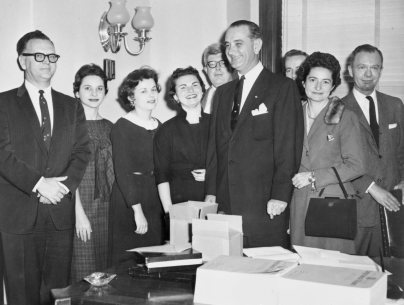
lbj and jenkins
Jenkins (far left), LBJ, and Lady Bird

Walter Jenkins had long been an LBJ loyalist, joining his staff in 1939 while Johnson was still in Congress. He was close with both LBJ and his wife, Lady Bird, and had been a political aide of Johnson’s through good times and bad. One of Jenkins’ children was named “Lyndon.” In her book on Lady Bird and the Johnson marriage, Betty Boyd Caroli writes that the Johnsons loved Jenkins “like a blood relative.”  By 1964, he had worked for LBJ for 25 years, “[working] eighteen hour days, [canceling] critical medical appointments, and doggedly [tackling] all of LBJ’s assignments, even those delivered in such condescending, abusive terms that Jenkin’s face flushed red,” writes Caroli.

So it came as a shock to Lyndon and Lady Bird when they received a call that Jenkins–a married father of six–had been arrested on a “morals charge.” Jenkins had been caught in a homosexual encounter in a public restroom.

The subsequent conversation between LBJ and Lady Bird was recorded–known only to the president–and captures a fascinating moment in their marriage. Lady Bird wanted to help Jenkins–if he could no longer work at the White House, she wanted to offer him a job with one of the family’s television stations in Texas. LBJ refused.

“I don’t think that’s right,” Lady Bird said. “When questioned, and I will be questioned, I’m going to say that this is incredible for a man that I have known all these years, a devout Catholic, a father of six children, a happily married husband.”

Lady Bird told the president he should make some gesture of support to his longtime aide. LBJ refused.

“We just can’t win this,” the president said. “The average farmer just can’t understand your knowing it and approving it or condoning it.”

Because Johnson refused to issue a statement of support, Lady Bird wrote one herself, which she gave to The Washington Post. 

(Their full conversation is available online, and is a look at the dynamics of their marriage.)

Aides to Johnson later speculated that Jenkins’ absence was detrimental to LBJ and his presidency. Johnson’s Attorney General, Ramsey Clark, thought that Jenkins’ “counsel on Vietnam might have been extremely helpful.” Johnson’s press secretary, George Reedy, agreed, later saying, “All of history might have been different if it hadn’t been for that episode.”


When it comes to a presidency, those in the inner circle can make a real difference on the president’s success. But often their impact is not felt until they’ve vanished.