K1C2: Lessons for Political Messaging from 1952

By Kaleena Fraga

As Democrats gear up for midterm elections in 2018 and the presidential election in 2020 the party struggles to define its message. It cannot simply be the party of anti-Trump–especially if it aims to win back two-time Obama voters who turned Republican in 2016. Dan Pfeiffer, Obama’s former communications director and current co-host of the left-leaning podcast Pod Save America, has suggested that the Democrats take up “corruption” as part of their messaging. In recent weeks, his colleagues at Crooked Media have pushed this–corruption, collusion, and chaos.

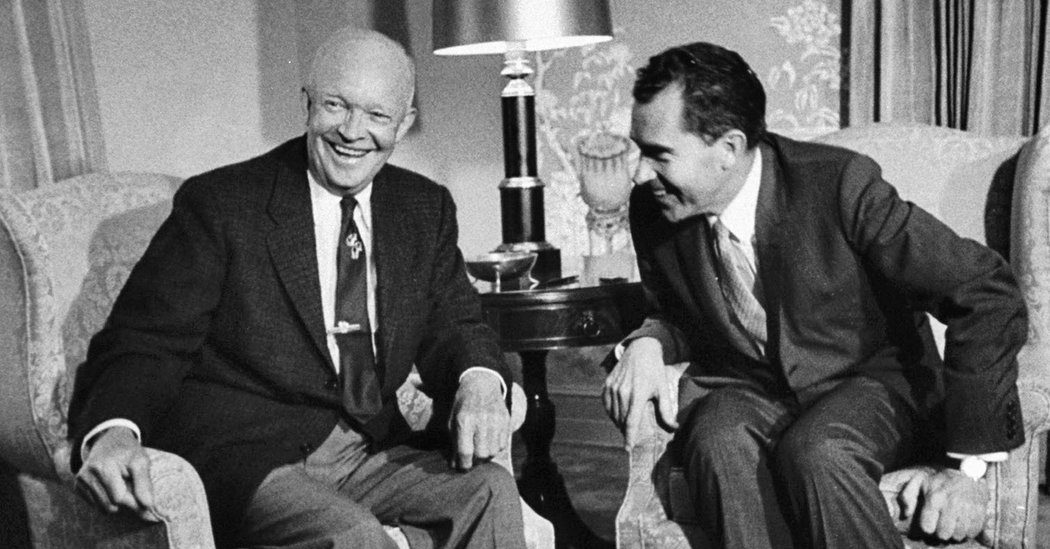
It’s reminiscent of another young political operative. This one a Republican, and in the year 1952. Richard Nixon, as a candidate for the vice presidency, pushed the similarly sounding message of “Korea, Communism, Corruption”–K1C2.

nixon crowdWhile Eisenhower maintained a healthy distance from the campaign, Nixon leapt into the fray. He put up a fight for the presidency that would embitter many against him for the rest of his political career, including Harry Truman, who interpreted Nixon’s messaging as a sly way of calling him a traitor. (Truman would later insist that Nixon had personally accused him of treason, although no evidence exists to support this). Even in Nixon’s lowest point of the campaign–when he was forced to defend his use of a political slush fund in the now famous “Checkers” speech–he was sure to add at the end that electing Eisenhower was important because the Democrats had left the government riddled with Communists and corruption.

At one rally, Nixon said: “If the record itself smears, let it smear. If the dry rot of corruption and Communism, which has eaten deep into our body politic during the past seven years, can only be chopped out with a hatchet, then let’s call for a hatchet.”

At another, he went further, accusing the Democratic nominee, Adlai Stevenson, of “carrying a Ph.D. from Dean Acheson’s cowardly college of Communist containment.”

As for Korea, Eisenhower, a war hero, promised to visit the battlefield after the election. He and Nixon could argue that Stevenson lacked the necessary military experience, while no one could doubt Ike’s credentials. The war weighed heavily on the country. Truman kept a letter and a purple heart from a distraught parent in his desk, who sent it to him as the man “directly responsible” for their son’s death.

In the end, the alliteration worked–Eisenhower won 55% of the popular vote, won 39 out of 48 states, and took 442 electoral votes. He even won Stevenson’s native state of Illinois. Of course there were other factors at play. The Democrats had been in power since 1933 and there was a general feeling of fatigue toward their policies. Ike also campaigned on the promise of change.

Still, perhaps communications professionals of the Democratic party can take a page from Richard Nixon’s book. A s simple message, endlessly repeated, can go a long way.

Sources: 

Richard Nixon: The Life by John A. Farrell

The President & the Apprentice by Irwin F. Gellman

Truman by David McCullough

Theodore Roosevelt & the American Museum of Natural History

By Kaleena Fraga

Any visit to New York City is lacking without a stop at the American Museum of Natural History–an experience that can be described a mix between walking through a zoo and stepping back in time. The museum is deeply linked to Theodore Roosevelt, and his love of nature and conservation.

TR journal1
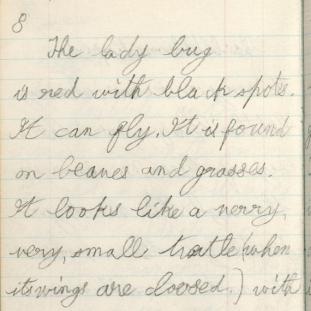
Roosevelt’s journal as an 11 year old

The roots of the museum are as old as 1867, when a young Roosevelt started the “Roosevelt Museum of Natural History” in his bedroom. A sickly child, often confined indoors, Roosevelt found joy in adventure novels and in animals. When he was given a seal skull by a family friend, it quickly became one of his prized possessions–and the first exhibit at the Roosevelt Museum of Natural History. Reflecting on the skull Roosevelt wrote in his autobiography that, “My father and mother encouraged me warmly in this, as they always did in anything that could give me wholesome pleasure or help develop me.” Even once he’d become a young man, Roosevelt’s passion continued. As a student at Harvard, he studied natural history.

The museum was chartered in 1869, and Roosevelt donated his own prized specimens to the museum’s young collection.

Upon leaving office, Roosevelt could boast of an impressive record of conservation that merits the museum’s fawning memorial of him–he had created 51 bird reservations, 18 national monuments, 5 national parks and 4 game preserves, and had enlarged or created 150 national forests. He also established the United States Forest Service and protected over 200 million acres of land for conservation.

Of course, Roosevelt was also a hunter. When he went on a safari after leaving office, the Smithsonian partially funded his trip knowing that he would shoot and bring animals home to be displayed–many of these are now in the Mammals Hall in the Museum of Natural History. His legacy of conservation and his legacy as a hunter leave us with a compelling, yet complicated, legacy.

In trying to describe his view of nature, Roosevelt once said:

“There are no words that can tell the hidden spirit of the wilderness, that can reveal its mystery, its melancholy, and its charm.”

For city-dwellers of Manhattan, and for visitors from afar, the American Museum of Natural History is the next best thing.

Play Ball! George H.W. Bush, Baseball, and the Queen of England

By Kaleena Fraga

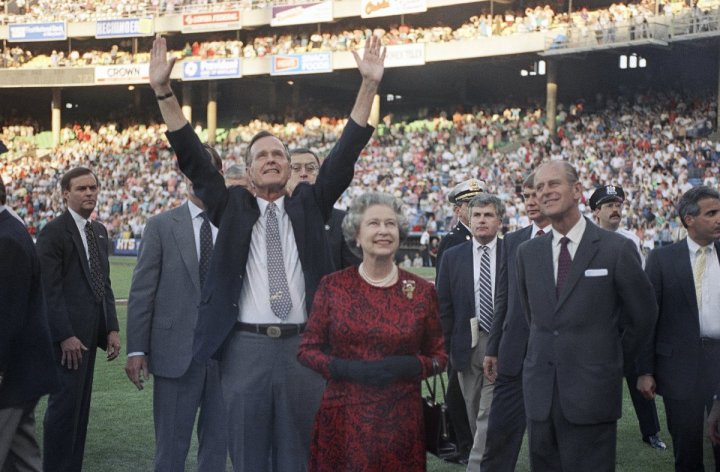
On this day in 1991, the Baltimore Orioles had an unusual fan at Memorial Field. Not only had the President of the United States and the First Lady shown up at the game, the Queen of England also graced the ballpark with her presence.

Queen Elizabeth’s appearance at the game came during her 13-day visit to the United States with her husband, Prince Phillip. The Queen’s parents had been the first reigning monarchs to visit American soil when they came at FDR’s invitation in 1939. The 1991 trip marked Queen Elizabeth’s 9th to the United States–her first being in 1958, and the most recent 15 years prior, in 1976, for the American Bicentennial.

The New York Times noted that at the game, “the Queen will be offered a hot dog, but she Queen Elizabeth II and President George Bush meet baseball pdoes not eat in public.” A waitress later told UPI that the queen did not eat, but she did drink a Beefeater martini.

The players of both teams were told to “be natural” while shaking hands with the four world leaders–Queen Elizabeth, Prince Phillip, George H.W. Bush, and Barbara Bush. Oakland player Jose Canesco reportedly felt so relaxed at the encounter that he chewed gum while meeting the foursome. The baseball commentators in the video above remarked that the players kept on their hats, but that “a lot of bowing and scraping before royalty is not the American way.” The Bushs and the royals then surprised fans by venturing out onto the field to wave hello.

The game was not without disruptions. Even before it started, protestors chanted “IRA, USA.” One group of protestors raised a sign that read: “Irish blood is on the queen’s hands,” and another group lofted a sheet saying, “One world, one struggle, free Ireland.” Once the game was underway, a group of protestors tied a sign that said “Bread Not Bombs” to a flagpole in right field along with several balloons, referencing the violence in Northern Ireland. UPI reported that although Orioles ushers were able to cut the sign and the balloons from the flagpole, it floated up “over center field in full view of the queen and the prince…”

While the game was a somewhat new experience for the royal couple–the queen was reportedly surprised to hear that Prince Phillip had played a little as a boy–President Bush is a well-known baseball fan. He and his father both played at Yale, and Bush was a frequent visitor to Orioles games. Why baseball? According to Bush, “it’s got everything.”

Reagan & the Radio; Trump & Twitter: Provocative Statements & the Path to Peace

By Kaleena Fraga

When Donald Trump tweeted about North Korea’s Kim Jong-un last year, mocking him as “Little Rocket Man” and a “madman”, some worried that Trump’s cavalier attitude could lead to a nuclear war. The president often speaks off the cuff, without prepared remarks vetted by advisors. During a meeting on the opioid crisis, Trump improvised the now infamous line “fire and fury” to describe the American response to any North Korean provocation.

Trump isn’t the only president to spark fears of war through idle talk (or tweets). Ronald Reagan did the same in 1984. Now, Trump finds himself similarly faced with the possibility of peace after much stone-throwing on both sides.

In the age before Twitter, Reagan gave weekly radio addresses every Saturday starting in 1982. He would give 331 such addresses during his time in the White House. (In his first year as president, Trump tweeted 2,461 times). During a sound check for one of Reagan’s radio addresses, the president joked:

“My fellow Americans, I’m pleased to tell you today that I’ve signed legislation that will outlaw Russia forever. We begin bombing in five minutes.”

News of the remark quickly leaked, to the outrage of American allies and adversaries abroad. The central Soviet news agency, TASS (Telegraph Agency of the Soviet Union) released a statement condemning “this unprecedented and hostile attack by the U.S. president…this kind of behavior is incompatible with the great responsibility borne by heads of nuclear states for the destinies of their own people and mankind.”

Likewise, when Trump tweeted:

North Korea responded by calling the president a frightened “lunatic.” Many in the American political class condemned the president’s tweet as overtly provocative and undiplomatic.

Reagan would go on to develop a close relationship with the Soviet General Secretary Mikhail Gorbachev, and the two of them would work together to reduce the number of nuclear weapons–boosting Reagan, but dooming Gorbachev. Trump likewise is flirting with peace in North Korea. His recently appointed Secretary of State, Mike Pompeo, met with Kim Jong-un over Easter, and high-level talks seem imminent.

Trading barbs is the easy part–now the Trump administration, like Reagan’s, must see if they can find diplomatic footing with the North Koreans in search of stability on the Korean peninsula.

America Needs a John Quincy Adams

By Kaleena Fraga

(to listen to a version of this piece in podcast form click here)

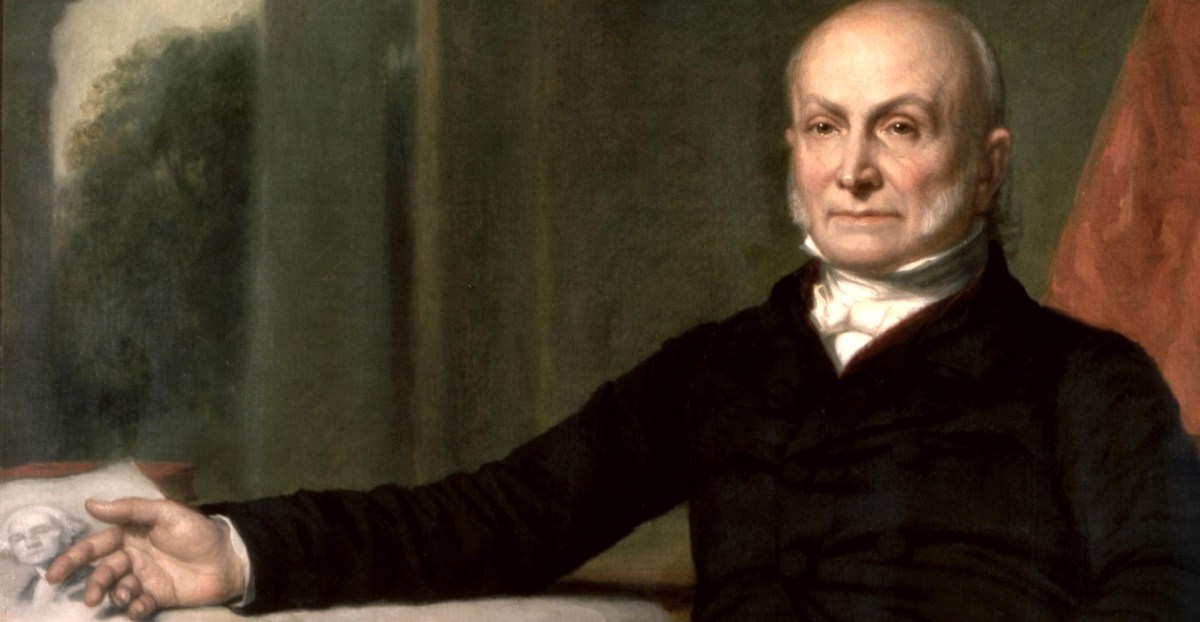
John Quincy Adams, America’s sixth president and the son of the nation’s second, had a reputation as a prickly, aloof man. He was a one-term president and by no means a popular one–yet he came to be seen as a man of iron principle and honesty, even in the face of political pressure from his own party. Politicians of his ilk are largely missing from the political landscape today.

I: Switching Parties

Adams, the son of one of America’s most prominent Federalists, entered the Senate in 1803 as a Federalist himself. Yet he remained distant from his colleagues. In an era of hyper-partisanship in which Federalists accused the Republicans of colluding with France, and the Republicans accused the Federalists of colluding with England (sound familiar?) Adams stubbornly trod his own path. He supported both President Jefferson’s Louisiana Purchase and the administration’s hardline on England, which his fellow Federalists opposed. His father, former president John Adams wrote:

“You are supported by no Party. You have too honest a heart, too independent a Mind and too brilliant Talents to be sincerely and confidentially trusted by any Man who is under the Dominion of Party Maxims or Party Feelings.”

His stubborn refusal to fall in line with the Federalists, and his support of Jefferson, cost Adams his seat in the Senate, his place in the party, and many friends back in Boston. To Adams, it was a matter of principle, and a matter of what he thought was right and wrong according to the U.S. Constitution.

This sort of political courage is rare in Washington today. To be fair to today’s politicians, the landscape has changed. There is pressure from lobbyists, constituents on social media, and from within the party itself to toe the party line. Political purity tests are the cause celebre of today, and politicians that stray too far from the party line face possible challenges from the left or right of their own parties. It’s doubtful that Adams–with his iron will and stubborn personality–would be swayed. But it’s also likely that he’d never make it to Congress (or the presidency) in the first place.

II: As President 

John Quincy Adams’s presidency spanned a divisive time in American. After the relative political tranquility of Jefferson, Madison, and Monroe’s presidencies–“the Era of Good Feelings”–, in which the Republicans enjoyed almost unanimous support, Adams entered office as the country’s political unity began to fray. The nature of campaigning had also begun to change–in the day of George Washington, a man had to practically be dragged to the presidency by his fellow citizens. In John Quincy Adams’ day, it was becoming permissible for a man or his friends to campaign actively.

The electoral system in America of the 1820s had begun to evolve as more states joined the union, and although there wasn’t a uniform way of voting, regular people had more of a sway than ever before. Adams’ political rival, Andrew Jackson, supported this democratic uprising. The fact that Adams entered office in 1824 under the auspice of a “corrupt bargain”–Jackson won the most electoral votes, but not a majority, so the election was sent to the House of Representatives where Adams was alleged to have struck a deal with Henry Clay–only increased the divide between the two parties.

John Dickerson’s piece for the Atlantic The Hardest Job in the World postulates that the presidency has become a beast unmanageable for one man, and that the current system of campaigning rewards skills that aren’t necessary applicable or important to the presidency once he/she is in the office. Campaigning rewards skills like charisma and debate; the office requires management and governance. Adams would probably agree with Dickerson–part of his cohort’s campaign against Jackson was that the fiery formal general couldn’t spell and lacked the necessary political experience to be president. Adams likely couldn’t be elected today, and perhaps was the last person to be elected based on political merits, rather than his power of campaigning. James Traub, an Adams biographer, notes of Jackson’s victory over Adams in 1828: “Of course, the whole episode was founded on the archaic assumption that Americans would not elect a man who couldn’t spell or hold his temper.”

III: Post Presidency

Adams served a single term as president–becoming only the second man to be voted out after four years, after his father, John Adams. But Adams refused to be cast into political obscurity. As part of his upbringing in Massachusetts, his parents had always encouraged him to find ways to be useful. “Usefulness” is also a reason James Comey invoked to justify writing his book after he was fired by Donald Trump.

When the opportunity rose for Adams to join the House of Representatives, he took it. Although many of his friends and family feared it would be degrading for an ex-president to join a lower chamber, Adams refuted this logic, saying it wouldn’t be at all degrading to serve “as a selectman of his town, if elected thereto by the people.” He joined the House in 1830 and would serve until his death in 1848–Adams literally collapsed on the House floor and died in the Speaker’s office.

As a member of the House, Adams took on slavery as his cause. Although he never labelled himself an abolitionist–at the time, abolitionists were hated by both the North and South as dangerous rabble rousers–Adams became a thorn in the side of the “slavocracy.” He insisted on introducing petitions to the House which raised questions about slavery–and continued to do so even after the passage of the gag rule, which forbid any such thing on the House floor. A rival Congressman once tried to bait Adams, reading back a line that he’d spoken to a group of black citizens: “The day of your redemption is bound to come. It may come in peace or it may come in blood; but whether in peace or blood let it come.” The Congressman read the line twice. He reminded his colleagues what this meant–emancipation and maybe civil war. Adams replied:

“I say now let it come. Though it cost the blood of millions of white men let it come. Let justice be done though the heavens fall.”

Although the political climate was not at all amenable to this sort of thought–indeed, at the time such a statement was shocking, and Adams received his fair share of death threats–Adams never cowered from a controversial political issue that he thought was right, or wrong. He challenged the slavocracy as a Congressman and as a lawyer, when he defended the men and women of the Amistad and won their freedom. 

In today’s increasingly partisan climate, where politicians are falling over themselves to move further to the left or right in order to move up the ladder, a politician like Adams, who sticks to his principles even under immense political pressure, would be a welcome change.
Of War and Poets: Walt Whitman and Abraham Lincoln

By Duane Soubirous

In celebration of National Poetry Month, History First recognizes Walt Whitman for crafting his observations into poetry, giving future generations of Americans the ability to see Whitman’s time period through his eyes.

Walt Whitman is best known for his poetry collection Leaves of Grass, first published in 1855 with 12 poems. He continuously revised and added to Leaves of Grass throughout his life, and the final 1892 “deathbed” edition consists of almost 400 poems, including “Drum-Taps,” a collection of poems written about the Civil War, and “Memories of President Lincoln,” containing Whitman’s best-known poem, “O Captain! My Captain!”

ralph waldo emersonIn 1842 Whitman attended a lecture given by Ralph Waldo Emerson, where Emerson predicted that America would soon have its own poet who would write about the American experience in a uniquely American style. “When he lifts his great voice, men gather to him and forget all that is past, and then his words are to the hearers, pictures of all history,” Emerson said.

If Walt Whitman believed he could be the “genius of poetry” that Emerson prophesied, few others shared his confidence. The first edition of Leaves of Grass, where Whitman debuted his style, free of the forms that defined poetry, was met with scathing reviews. It sold fewer copies than Whitman had given away. One reviewer called Leaves of Grass “a mass of stupid filth,” and Whitman’s brother even said he “didn’t think it worth reading.” Emerson, however, wrote Whitman a letter of encouragement, praising Leaves of Grass as “the most extraordinary piece of wit and wisdom that America has yet contributed.”

The 1850s were a time of unprecedented divisions in the United States. Northerners denounced pro-slavery laws of Congress and Supreme Court decisions, and Southerners threatened secession over Northerners’ hostility to slavery. Whitman hoped Leaves of Grass would unite the country. “I think that Whitman believed that Leaves of Grass was going to prevent a Civil War,” Whitman scholar Ed Folsom said in the Walt Whitman episode of PBS’s American Experience. “Leaves of Grass is really a book about preserving the Union. It’s a book about holding things together, being able to absorb contradictions and still maintain a single identity.”

Whitman’s poetry couldn’t keep the country together, and the ensuing Civil War hit especially close to home. Whitman read in the papers that his younger brother was a casualty in almanack-battle-fredericksburg-painting.jpgthe Battle of Fredericksburg, where the Union was badly defeated. Whitman rushed to the battlefield, only to find that his brother was minimally injured. Whitman stayed with his brother for over a week and witnessed the realities of war. “Living so close to the front, to the dressing stations and the hospital tents pitched on the frozen ground, the fresh barrel-stave markers in the burial field, the vexed Rappahannock, and the ruins of Fredericksburg, he saw ‘what well men and sick men and mangled men endure,’” Justin Kaplan wrote in Walt Whitman: A Life. Whitman began writing down these observations, later using them for his “Drum-Taps” poems.
After his experience on the battlefield, Whitman, too old to fight, became a dedicated volunteer in army hospitals. He served the non-medical needs of wounded soldiers, providing them with items like food, linens, stationery, and money. He often wrote letters informing families of a loved one’s death. “In his poem ‘Come Up from the Fields Father,’ Whitman imagined the family that received a letter like those he wrote,” Drew Gilpin Faust wrote in This Republic of Suffering. “It reports his gunshot wound but does not yet communicate the more terrible truth that ‘he is dead already’ by the time the letter arrives. It is a letter that will destroy the mother, as a rifle has already destroyed the son.”

Whitman captured the widespread grief after Abraham Lincoln’s assassination. He wrote “Hush’d Be the Camps To-day” on the day of Lincoln’s funeral. “Whitman speaks as one of the people, leading the soldiers in mourning and urging common men to whom he is so devoted to join him in tribute to ‘our dear commander,’” Faust wrote. Another poem commemorating Lincoln, “O Captain! My Captain!” was written with a rhythm so uncommon to Whitman’s poetry, a democratic style that is accessible to common people. In this poem, Whitman represents “the searing grief of a single man, in a representation of the individual pain of which the cumulative loss is constituted.”

If Irish folklore is to be believed, Irish clans fighting in the old wars had an agreement to spare the poets. “Don’t kill the poets, because the poets had to be left to tell the story,” historian David Blight said. Through Walt Whitman’s poetry, the modern reader can see the total devastation of war and pain of losing a leader and a hero.


First Lady Feature: Lucy Webb Hayes

By Molly Bloom

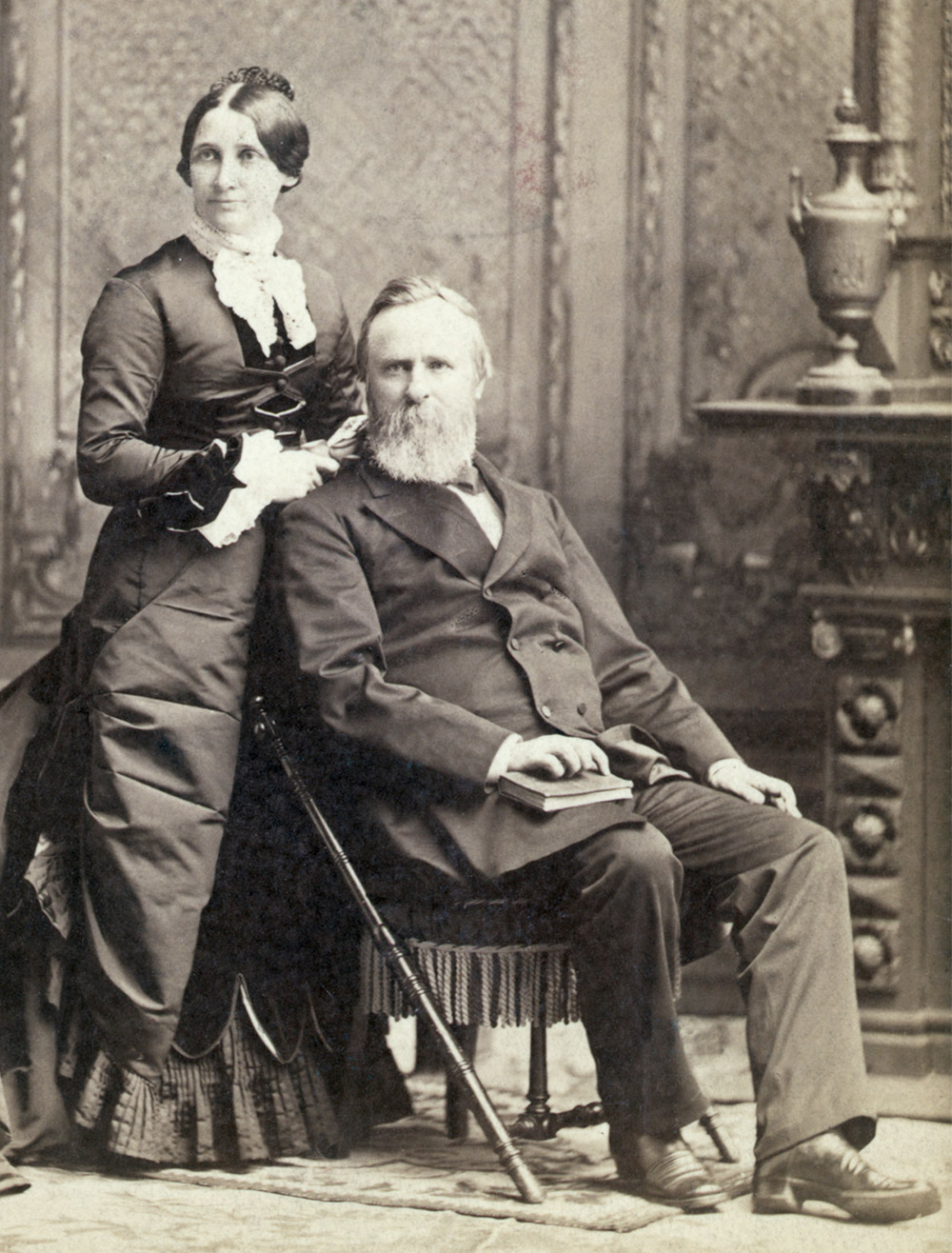
Like many First Ladies, Lucy Webb Hayes devoted herself to charitable causes, exercised a great influence over her husband’s politics, and left her mark on the role of the First Lady of the United States. Most identified in the modern era by her nickname of “Lemonade Lucy,” she was notable for not serving alcohol in the White House more than 40 years before the start of Prohibition—although her husband Rutherford B. Hayes likely barred alcohol from the White House due to his support of the temperance movement, and Lucy followed suit.

Lucy Ware Webb met Rutherford B. Hayes at Ohio Wesleyan University when she was a lucy and rbhyoung teenager. Her brothers were studying at the University, and Lucy attended college prep courses. Too young to establish a relationship, they reunited years later when they were both members of a wedding party and married in 1852 when he was thirty and she was twenty-one. Lucy was a major influence on Hayes’ life during his entry into politics. The Ohio-born Hayes followed a fairly typical trajectory to the White House, checking off many of the most common boxes for U.S. presidents—he was educated at Harvard Law School and opened a law practice before serving in the military, then became a Congressman, and then Governor of Ohio. He won the presidency as the Republican nominee in 1876 and moved with Lucy and their family to Washington.

Lucy and her husband wrote letters to each other during the entirety of their relationship, and much of their correspondence took place during the Civil War. They expressed their love for each other and a deep appreciation of their relationship. In an 1851 letter, Hayes wrote,

“I feel that you will not only be the making of my happiness, but also of my fortunes or success in life. The truth is I never did half try to be anything, or to do anything… Only now I believe I shall have purpose and steadiness to keep ever doing, looking to your happiness and approval as my best reward.”

Lucy, though less eloquent than her husband, expressed strong sentiments as well. She wrote in 1864, I am thinking of you constantly- longing to hear from you thinking of the dangers and suffering through which you are passing- but while sad thoughts are with me- I think of your love- your tenderness and kindness to me- and feel that could I only be with you- could I only know that you will be returned to me- Oh darling one what would life be without you.”

Once in the White House, Hayes famously quipped, “I don’t know how much influence Mrs. Hayes has with Congress, but she has great influence with me.” Lucy and her husband had a close relationship, and Hayes valued her opinions. Lucy’s stances on major political issues of the time have been well-documented; she was an abolitionist and supported the new Republican Party during its anti-slavery developments. She was rumored to have encouraged her husband to join the Union Army during the Civil War. As was traditional for the time, Lucy’s primary role was as a wife and mother to her eight children; yet she also held progressive views and was committed to charitable causes. She was known to visit prisons, mental health facilities, and the National Deaf Mute College in Washington (now Gallaudet University). Despite these open-minded views, she never took a strong stance on women’s suffrage, and her husband was not an advocate either.

lucy hayes cartoonThe “Lemonade Lucy” moniker was not a title used during Lucy’s lifetime, but a name used by journalists, political cartoonists, and historians to poke fun at the strict nature of the First Family of teetotalers. Later historians credited Lucy’s husband with the decision not to serve liquor in the White House. As Emily Apt Greer, author of First Lady: The Life of Lucy Webb Hayes, explains, “many factors entered into it: a wish to set a good example; Lucy’s life-time abstinence from liquor; a desire to keep the temperance advocates in the Republican ranks rather than have them join the Prohibition Party; and Hayes’ firm conviction that government officials should conduct themselves at all times with discretion and dignity.” The decision to abstain from serving alcohol has been attributed to Lucy’s moral, religious upbringing, but in reality, politics were also at play.

Lucy Webb Hayes inspired one recognizable First Lady tradition: the annual Easter Egg Roll. Children used to roll eggs on Capitol Hill on the Monday after Easter, but the ruckus led Congress to pass a law in 1877 forbidding children from playing on the Capitol Hill grounds. In 1878, Rutherford and Lucy Hayes held the first Easter Egg Roll on the White House lawn. Subsequent First Ladies have added their own traditions to the Roll. Pat Nixon provided a costumed Easter Bunny for the occasion, and Nancy Reagan included signed wooden eggs as keepsakes for the children. First Lady Melania Trump will host the Easter Egg Roll on April 2nd, 2018, 140 years after the inaugural event, continuing the legacy of Lucy Webb Hayes.

First Lady Feature: Edith Wilson

By Kaleena Fraga

Over the course of Women’s History Month, we’ve featured several remarkable first ladies who had the wits and wisdom to be president themselves. Edith Wilson, who hid the depth of her husband’s illness from the country, is the only one who actually got close to assuming the presidency.

2-ebw-electric-car_1_origEdith met Woodrow Wilson during a chance encounter at the White House. His first wife, Ellen, had died of Bright’s disease only seven months earlier. They had a quick and passionate courtship which alarmed many of Wilson’s advisors. Not only would the president soon run for reelection (his advisors fretted that his pursuit of a woman so soon after the death of his wife would hurt his chances), but Edith was known in town for being one of the first women to ever drive a car, and was shunned by Washington’s elite because her money came from her (deceased) first husband’s jewelry store.

Three months after they met, the Wilsons wed.

Then in 1919, two years into Wilson’s second term, and four years into their marriage, Wilson suffered a devastating stroke that left him paralyzed. The president had been barnstorming around the country in the aftermath of WWI, trying to whip up support for his inspired but doomed plan for a League of Nations.

As the 25th amendment wouldn’t be ratified for almost fifty years, there wasn’t really anedith and woodrow answer to what the government should do if the president became unable to perform his duties. Wilson wasn’t dead, so there didn’t seem to be a reason for the vice president to step into his role. Without the 25th amendment, Congress and the Cabinet had no real power to act (and the extent of Wilson’s condition was kept top secret). To Edith, protective of her husband and his presidency, the answer was clear.
Anything that came to the president first had to go through the first lady. This included Cabinet members, policy papers, and any other pressing issues. As such, Edith Wilson decided what was important enough for the president to see–and what he could live without knowing.

Although Edith Wilson denied ever becoming president herself, she did acknowledge her “stewardship” during the Wilsons’ waning White House years:

“So began my stewardship, I studied every paper, sent from the different Secretaries or Senators, and tried to digest and present in tabloid form the things that, despite my vigilance, had to go to the President. I, myself, never made a single decision regarding the disposition of public affairs. The only decision that was mine was what was important and what was not, and the very important decision of when to present matters to my husband.”

President Wilson slowly recovered from his stroke, but remained paralyzed on one side. He died five years later, having remarked, “I am a broken piece of machinery–when the machinery is broken–I am ready.” When he died on February 2nd, 1924, his last word was the name of his wife, who’d guided him through his illness and the final years of his presidency. Edith.

Edith Wilson would live for almost forty years after her husband’s death. She was active in political life, speaking at the 1928 Democratic Convention and attending the inauguration of John F. Kennedy in 1961. Although Americans have never elected a female president, Edith Wilson got close. During her husband’s illness, she arguably ran the country in his stead.

First Lady Feature: Mary Todd Lincoln

By Duane Soubirous

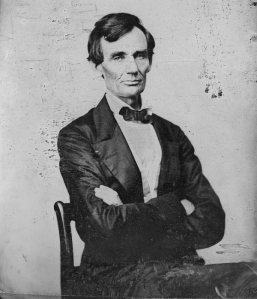
Like Abraham Lincoln, Mary Todd was born in Kentucky, but their childhoods were worlds apart. The Todds were as well off as the Lincolns were poor. While Lincoln educated himself by reading in the candlelight after laboring all day, Mary Todd was sent to exclusive schools. The one childhood similarity they shared is what led them to meet: the death of their mothers. Mary Todd did not get along with her new stepmother, so she came to Springfield to live with her sister, who was married to a former governor of Illinois. Lincoln worked in Springfield as a state legislator, and their paths crossed in the Springfield political scene.

abraham-lincoln-youngLincoln wasn’t exactly smitten with Mary Todd. After they got engaged, Lincoln had second thoughts and he tried to get out of their engagement. Several of Lincoln’s friends recollected his misgivings about Mary, which Michael Burlingame documented in his book Abraham Lincoln: A Life. Lincoln confided to John J. Hardin “that he thought he did not love her as he should and that he would do her a great wrong if he married her.” To Mrs. William Butler, Lincoln declared, “it would just kill me to marry Mary Todd.”

Shortly after Lincoln and Mary Todd reunited, they shocked Mary’s family one morning by announcing  they would get married that day. Despite his apparent urgent desire to marry Mary Todd, Lincoln didn’t seem enamored by her. Lincoln’s best man recalled Lincoln telling him “directly and indirectly” that “he was driven into the marriage,” Burlingame wrote. While Lincoln dressed for the wedding ceremony, “he was asked where he was going. ‘I guess I am going to hell,’ came the reply.” Historian Wayne C. Temple hypothesized that Mary Todd had seduced Lincoln and convinced him he was honor-bound to marry her. This argument is supported by the birth of Abraham and Mary’s first son, Robert Todd Lincoln, which happened just three days shy of  nine months after the wedding.

Lincoln patiently listened to Mary’s many opinions, but he didn’t often follow them. One time Lincoln did yield to her was when she vetoed his plan to become governor of Oregon, a position offered to Lincoln by president Zachary Taylor’s administration after Lincoln campaigned for Taylor in the election of 1848. Mary Todd Lincoln refused to move to the frontier. “During her husband’s presidency,” Burlingame wrote, “Mary Lincoln ‘did not fail to remind him that her advice, when he was wavering, had restrained him from “throwing himself away” on a distant territorial governorship.’”

The White House was in a dilapidated state when the Lincolns arrived in 1861, and Mary Todd Lincoln immediately set to work refurbishing it. In contrast to Abigail Adams using the East Room to hang laundry, Mary Todd Lincoln used that room to host receptions. “The most exquisite carpet ever on the East Room was a velvet one, chosen by Mrs. Lincoln,” wrote Mary Clemer Ames, quoted in Doris Kearns Goodwin’s Team of Rivals. “Its ground was of pale sea green, and in effect looked as if ocean, in gleaming and transparent waves, were tossing roses at your feet.”

Mary Todd Lincoln overspent her $20,000 budget (about $560,000 in today’s dollars) by $6,800 ($190,000 today). She tried to hide her opulence from Lincoln in several corrupt schemes, explained by Goodwin. She asked the White House groundskeeper to inflate his budget and pass the extra money over to her. She offered patronage in exchange for cash from wealthy donors or reduced bills from vendors. After failing to raise all the money she needed, Mary sent an intermediary to ask Lincoln for help. Lincoln was indignant when he heard the news. “He said it would stink in the land to have it said that an appropriation of $20,000 for furnishing the house had been overrun by the President when the poor freezing soldiers could not have blankets,” the intermediary said, quoted by Goodwin. “He swore he would never approve the bills for flub dubs for that damned old house!”

Mary Todd Lincoln’s lavish East Room hosted a mob of people vying to get a glimpse ofhith-10-things-lincoln-assassination-E General Ulysses S. Grant at his first appearance in Washington, D.C. as the top general in the Union army. That reception, a journalist noted, was the first time Abraham Lincoln wasn’t the center of attention in the East Room. Grant was elected president in the first election after Lincoln’s assassination. He might have been assassinated with Lincoln on April 14, 1865, if Mary Todd Lincoln hadn’t thrown a tantrum a few weeks earlier in front of Grant’s wife Julia Dent Grant. Even though the morning newspaper reported that the Lincolns and the Grants would attend a showing of Our American Cousin at Ford’s Theatre, Julia persuaded Ulysses into traveling home to New Jersey instead of going out with the Lincolns. Julia Grant later said she “objected strenuously to accompanying Mrs. Lincoln,” Burlingame wrote. “Grant said ‘we will go visit our children … and this will be a good excuse.’”

Loss of a loved one was a recurring theme in Mary Todd Lincoln’s life. Between losing her mother in childhood and witnessing her husband’s assassination, she lost three brothers who all fought for the Confederacy, even though Kentucky officially remained loyal to the Union; one son died before Lincoln was elected president and another died in the White House. In 1871 her youngest son died shortly after turning 18. Four years later, Mary was declared insane and sent to an asylum. Her sole surviving son, Robert Todd Lincoln, testified against her. “There was a second trial, at which she managed to convince the jury that she was perfectly sane,” Richard Norton Smith wrote in First Ladies: Presidential Historians on the Lives of 45 Iconic American Women. “She and Robert never really reconciled.”

Mary Todd Lincoln spent the rest of her life in relative obscurity, and died while living with her sister back in Springfield, Illinois–in the same house where she’d wed Abraham Lincoln 40 years before.

First Lady Feature: Dolley Madison

By Kaleena Fraga

Dolley Madison is best known for rescuing a portrait of George Washington from the White House during the British attack on Washington D.C. in 1814. She, like Nellie Taft, was an indispensable member of her reticent husband’s presidency.

dolley madisonIn David McCullough biography’s of Madison-foe John Adams, the nation’s fourth president is described as “a tiny, sickly-looking man who weighed little more than a hundred pounds and dressed always in black.” When Dolley Madison caught his eye and he asked for an audience with her (bonus trivia: mutual friend Aaron Burr set them up), she wrote her sister that “the great, little Madison” wanted to meet her. Great because of Madison’s political reputation; little because at 5’7, Dolley Madison was several inches taller than her future husband.
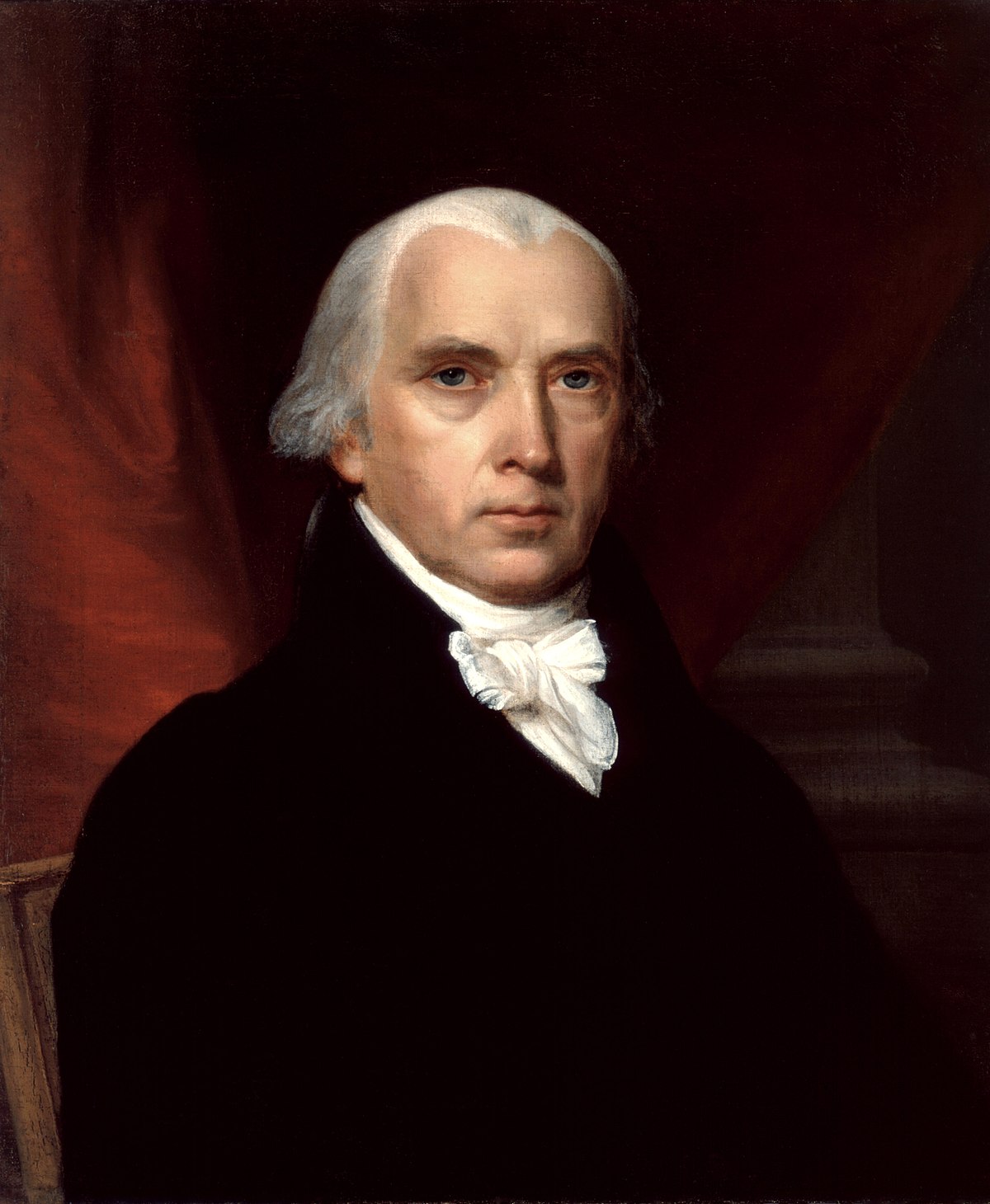
When Thomas Jefferson won the election of 1800, James & Dolley Madison moved in with the new president to the White House (James Madison was the new Secretary of State). Jefferson had been a widower for several years, and his daughters had not come to live with him in Washington. Although the Madisons eventually found a home of their own near the White House, Dolley Madison became the de facto First Lady.

Whenever Jefferson held dinners at the White House where women were invited, Dolley Madison was the hostess. To her husband, who was a prolific writer, and who had conducted much of his politicking through letters, Dolley was an immense asset–especially in a city like Washington D.C. where politics were based more on social relationships. Dolley thrived in such an environment.

As Secretary of State, Madison needed to become better at face-to-face interactions. In james madison1the James Madison biography The Three Lives of James Madison by Noah Feldman, Feldman writes that Dolley was instrumental in forming Madison’s ability to converse with diplomats and their wives. “Under Dolley’s tutelage,” Feldman writes, “Madison developed what would become a lifelong habit of telling witty stories after dinner, the ideal venue for his particular brand of dry wit.”

Dolley Madison presided over the first inaugural ball when her husband was elected in 1808. While Dolley “looked like a queen” according to an attendee, her less social husband remarked to a guest that he “would much rather be in bed.”

In the eight years of her husband’s presidency that followed, she went on to shape the role of first lady more than her predecessors. She was the first one to live full-time in the White House, and as such set out to transform the executive mansion, and to make it a social center of the nation’s capitol.

When the British invaded Washington D.C. in 1814, Dolley was alone at the White House, her husband out rallying the troops. He had sent messengers telling her to flee, but she white house burningwanted to wait for his return. According to an account by Paul Jennings, a man born into slavery at Madison’s estate of Montpelier and then working at the White House, the table had been set for dinner when a rider came charing to the mansion with the message that they must evacuate immediately. Dolley wrote her sister that she insisted on waiting until they could unscrew the portrait of George Washington from the wall.

“This process was found to be too tedious for these perilous moments. I have ordered the frame to be broken, and the canvas taken out.”

It was then rolled up and sent to New York, where it would be safe. Dolley Madison instructed its guardians that they should destroy the painting rather than allow it to fall into British hands. When the British troops arrived they found the table set for dinner. They ate their fill, and then burned the house to the ground.

Dolley outlived her husband by thirteen years, and continued to play a social role in politics after his death. She often told stories of the Founding Fathers and their generation, and advised other First Ladies on their role in the White House. Her last public appearance was on the arm of then-President James K. Polk.