First Lady Feature: Abigail Adams

By Kaleena Fraga

While John Adams convened at the First Congress, Abigail Adams wrote her husband a letter reminding him to:

“Remember the ladies…remember all men would be tyrants if they could. If particular care and attention is not paid to the ladies we are determined to foment a rebellion, and will not hold ourselves bound by any laws in which we have no voice or representation.”

In his reply, John Adams was light-hearted, telling his wife:

“Depend on it, we know better than to repeal our masculine systems…in practice you know we are the subjects. We have only the name of masters, and rather than give up this, which would completely subject us to the despotism of the petticoat, I hope General Washington and all our brave heroes would fight.”

Her early (early) wave feminism continued. Later in life, Abigail sent a note along with a abigail-adams-9175670-1-402book she’d purchased for her niece, which she’d discovered portrayed women as unequal to men. The note was a warning to read the book with a grain of salt. Abigail wrote: “I will never consent to have our sex considered in an inferior point of light.”

Abigail Adams had no formal education, but benefited from the libraries of her father and grandfather, of which she had free reign as a girl. She took a special interest in philosophy, theology, Shakespeare, the classics, history, government, and French. Her wit and intelligence is preserved in the letters she wrote in her lifetime–to her husband, to friends, and to political frenemies like Thomas Jefferson.

She advocated for equal education for boys and girls, believed in emancipation for American slaves, and, above all, in the cause of independence. Although they spent many years apart (once, while John Adams lived in Europe, they spent a consecutive five years without seeing each other), Abigail and John Adams remained close throughout their marriage. Abigail Adams was a political partner as well. During her husband’s presidency, some even darkly referred to her as Mrs. President.

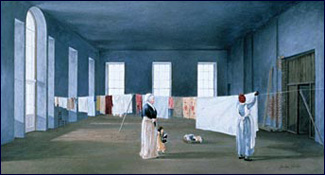
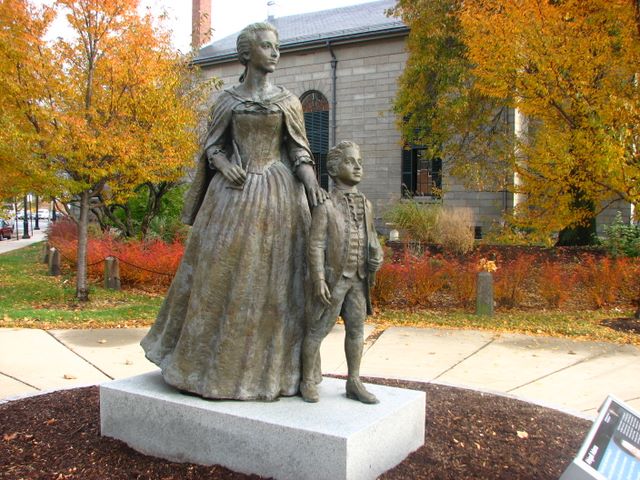
aaAbigail Adams was the first First Lady to live in the White House. She and John Adams moved to Washington D.C. from Philadelphia once the mansion was finished. As she wrote a friend, the executive mansion was huge and sparse. “It is habitable by fires in every part, thirteen of which we are obliged to keep daily, or sleep in wet and damp places.” Abigail used today’s East Room to dry the family’s laundry.

When she died, Abigail’s son John Quincy Adams (who would go on to be president himself) wrote in his diary, “My mother was an angel upon earth. She was a minister of blessing to all human beings within her sphere of action. Her heart was the abode of heavenly purity. She [had no] feelings but of kindness and beneficence; yet her mind was as firm as her temper was mild and gentle.”

Despite her forward-thinking views, and despite Abigail Adams’ relationship with men in power like John Adams and Thomas Jefferson, she would not see equality between men and women in her lifetime. Women would not have the right to vote for another 143 years from the time she asked her husband to “remember the ladies.”

First Lady Feature: Barbara Bush

By Kaleena Fraga

On a late spring day in 1990, Barbara Bush stepped up to the podium at Wellesley College to deliver the school’s commencement address. Her invitation had prompted furor across the student body. To many students at Wellesley, Barbara Bush was no role model. One hundred and fifty students signed a petition which read:

‘Wellesley teaches that we will be rewarded on the basis of our own merit, not on that of a spouse. To honor Barbara Bush as a commencement speaker is to honor a woman who has gained recognition through the achievements of her husband, which contravenes what we have been taught over the last four years at Wellesley.”

Her defenders said the outrage was generational. When asked about the controversy herself, the First Lady said that she understood the students’ perspective. “They’re 21 years old and they’re looking at life from that perspective,” Mrs. Bush said. “I don’t disagree with what they’re looking at. But I don’t think they understand where I’m coming from. I chose to live the life I’ve lived, and I think it’s been a fabulously exciting, interesting, involved life. In my day, they probably would have been considered different. In their day, I’m considered different. Vive la difference.”

Her husband didn’t mince words. In his diary, George H.W. Bush wrote that the “elitist kids” of Wellesley dismissed her accomplishments as a wife, a mother, a volunteer, and a “great leader for literacy.”

Barbara Bush was made of presidential stuff long before she met her husband–she’s a descendent of Franklin Pierce, the 14th president. She and Abigail Adams are also the only women in history to be both a wife and a mother to a president.

bush and hwBarbara Bush met her husband at sixteen and married him four years later, after his brush with death during WWII. Before marriage Mrs. Bush had enrolled in Smith College–she was a voracious reader as a girl–and helped out in the war effort by working at a nuts and bolts factory in the summer of 1943. As the wife of George H.W. Bush–who, over the course of their marriage, was the Ambassador to the United Nations, the Director of the C.I.A., and the Vice President of the United States–Mrs. Bush had the opportunity to see the world. She oversaw moving her family twenty-nine times.

Within a few weeks of her husband’s inauguration to the presidency in 1989, Barbara Bush made literacy her cause as First Lady. At the launch of the Barbara Bush Foundation for Family Literacy, Mrs. Bush stated that, “In 10 years of traveling around the United States of America, visiting literary programs, libraries, kindergarten groups, day-care centers, single-parent classes for high school dropouts, public housing projects, food banks – you name it, I’ve visited it – it has become very apparent to me that we must attack the problem of a more literate America through the family. We all know that adults with reading problems tend to raise children with reading problems.” The foundation today is active in all 50 states. It seeks to support parents who are improving their reading level, with the goal that the parents will read to their children.

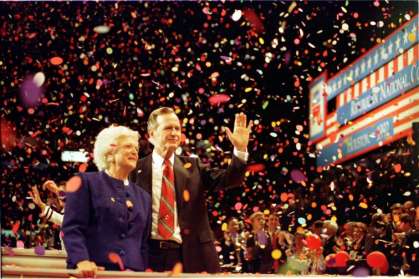
Although during her husband’s presidency Barbara Bush rarely drew attention on her bbush conventionown political views, she was more outspoken before and after H.W.’s term in office. During his vice presidential run she expressed support for the ratification of the Equal Rights Amendment and embrace pro-choice views on abortion. During the 1992 presidential campaign, Mrs. Bush stated that the abortion debate had no place in the party platform at all. Abortion, she said, “was a personal thing.”

Barbara Bush would also redefine the role of first spouses when she became the first First Lady to deliver prepared remarks at the 1992 Republican Convention. During the (increasingly bitter) campaign, Mrs. Bush also defended Hillary Clinton, who was under fire for her own outspoken political views.

As for that speech in 1990, Barbara Bush (whose husband voted for Hillary Clinton in 2016) left the Wellesley class of ’90 with this:

“Who knows? Somewhere out in this audience may even be someone who will one day  follow in my footsteps and preside over the White House as the president’s spouse–and I wish him well.”

First Lady Feature: Nellie Herron Taft

By Kaleena Fraga

If William Howard Taft’s hold on the collective American memory is that he got stuck in a White House bathtub (likely false), his wife Nellie’s grip is weaker still. Yet Nellie played a crucial role in propelling her husband to the White House, and her subsequent stroke during his term in office irrevocably changed his presidency for the worse.

Née Helen Louise Herron, Nellie grew up immersed in American politics. Her father was a college friend of future president Benjamin Harrison, and shared an office with another future president, Rutherford B. Hayes. Hayes and Nellie’s father were especially close. When she was sixteen, Nellie was invited to accompany her parents to the Hayes White House for the president and his wife’s silver anniversary. Later in life, Nellie told journalists that, “Nothing in my life reaches the climax of human bliss, which I felt as a girl of sixteen, when I was entertained at the White House.”

Indeed, she told President Hayes that the visit had convinced her that she would marry “a man who will be president.” Hayes is reported to have responded, “I hope you may, and be sure you marry an Ohio man.” Hayes, Harrison, and the Herrons were all proud Ohioans (as was Nellie’s future husband).

nellie taftNellie herself was bright–she had a gift for languages, and studied French, German, Latin and Greek. She wrote in her diary that, “A book has more fascination for me than anything else.” Nellie wanted to continue her education–her brothers went to Yale and Harvard–but her father told her he could not afford to send her to college. Anyway, she was expected to find herself a husband, instead.

But this sort of lifestyle didn’t suit Nellie at all. Out of school, unable to take as many music lessons as she wanted because her father didn’t think they were worth the money, Nellie found herself “blue as indigo.” She wrote in her journal that, “I am sick and tired of my life. I am only nineteen. I feel as I were fifty.” The solution, she thought, was to find a job. “I read a good deal to be sure…but I should have some occupation that would require active work moving around–and I don’t know where to find it…I do so want to be independent.”

One has to wonder what Nellie could have accomplished if her father had coughed up the money for her to pursue her own education–although in the 1880s, neither Harvard nor Yale admitted female students.

In the end, Nellie enrolled in less expensive classes at the University of Cincinnati, where she studied Chemistry and German.

Although it horrified her mother, Nellie eventually decided to take a job teaching at a private school for boys. Nellie’s mother wrote her a letter detailing her alarm at this decision:  “Do you realize you will have to give up society, as you now enjoy it…it is quite the thing for a young girl in your position to teach in a boys school–and where there are no other ladies?” Nellie’s friends too questioned her “queer taste.” To this, Nellie wrote in her journal:

“Of course a woman is happier who marries, if she marries exactly right, but how many do? Otherwise I do think that she is much happier single, and doing some congenial work.”

At this point in her life, Nellie began to spend more time with William Howard Taft, a young lawyer whom she had had known as a girl and who had “[struck her] with awe.” Taft, for his part, started carrying books when he was around Nellie to gain her favor.

The first time he asked her to marry him, Nellie turned him down. According to Doris Kearns Goodwin, Nellie feared that marriage would “destroy her hard-won chance to accomplish something worthy in her own right.” Taft persisted. Perhaps he sensed that Nellie had ambitions beyond that of a wife and mother. Writing to try and convince her to change her mind, Taft said, “Oh how I will work and strive to be better and do better, how I will labor for our joint advancement if only you will let me.”

Nellie agreed and they were married in 1886.

When Taft became president in 1909, Nellie’s greatest dream had been realized. She had encouraged her husband to turn down President Roosevelt’s offers of a seat on the Supreme Court to keep his options open for the presidency (Roosevelt asked three times). Her great ambition of returning to the White House had become a reality. Although her husband admitted he felt “like a fish out of water” (indeed, Taft would later state that he hardly remembered his term in office–his true ambition, which he attained after his presidency, was to be the Supreme Court Justice), Nellie was right at home.

The New York Times noted that few had been so “well equipped” to be First Lady. Nellie had been a governor general’s wife during Taft’s tenure in the Philippines. She was social; she understood the ceremonies of the office; and she spoke Spanish, French and German, so she could hold conversations with diplomats from around the world. The new First Lady received accolades for her conversational skills, and her ability to converse on a variety of topics. She was quite a contrast to her predecessor, Edith Roosevelt, who believed, “a woman’s name should appear in print but twice–when she is married and when she is buried.”

As Taft began to take on the demands of the office, Nellie took on responsibilities of her own. She became an honorary chair of the Women’s Welfare Department of the National Civic Federation to advocate for workers in government and industry. Nellie refused the commonly accepted logic that college wasn’t for women, and publicly said so. Her own daughter eventually attended Bryn Mawr. When asked about women’s suffrage, Nellie stated:

“A woman’s voice is the voice of wisdom and I can see nothing unwomanly in her casting the ballot.”

cherry treesAlthough some muttered that Nellie should focus more on “the simple duties of First Lady,” Nellie was equally eager to expand this role. Upsetting many New Yorkers, Nellie stated that she wanted to make Washington D.C. a social hub for Americans. Nellie set out to beautify the city. From her time abroad, Nellie had fallen in love with Japanese cherry trees and brought one hundred to Washington. When the mayor of Tokyo heard of this project, he sent 2,000 more.

“In the ten weeks of her husband’s Administration,” wrote the New York Times, “Mrs. Taft has done more for society than any former mistress of the White House has undertaken in many months.”

It was only a few weeks into Taft’s term that tragedy struck. Nellie, only 48, suffered a debilitating stroke. The right side of her face was paralyzed. Although the public was kept in the dark, Nellie had lost the ability to speak or express her thoughts in any way. She went to the family’s summer home in Massachusetts to recover. Taft needed his wife–needed her social drive and partnership. Weeks into his presidency, he had lost her.

Although Nellie recovered much of her facilities, she wasn’t able to play the part she so taft silverdreamed of in Taft’s administration. It certainly wanted for her influence. Without her, Taft was not able to play the dynamic social role he needed to fill the shoes of his bombastic predecessor, Theodore Roosevelt.
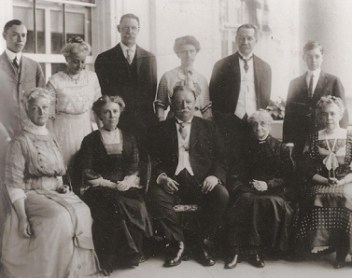
Still, despite a second stroke in 1911, Nellie and Taft were able to celebrate their silver anniversary at the White House–the same event that Nellie had attended as a girl. One can only wonder what someone like Nellie could have accomplished if she’d had access to education; and if she’d lived in a world where women could pursue a career without judgement. Perhaps we’d be writing about her presidency, instead.

Special thanks to our girl Doris Kearns Goodwin & her wonderful Taft/Roosevelt biography: Bully Pulpit: Theodore Roosevelt & The Golden Age of Journalism.
Part III: A Ship in the Storm–Lincoln’s Steady Hand in the Tumultuous Final Years of War

By Duane Soubirous 

January 1, 1863, the day Abraham Lincoln issued the Emancipation Proclamation and declared freedom for all slaves living in the Confederate States of America, was just like any other New Year’s Day to those slaves. In order to gain freedom, they would need to escape behind Union lines or wait for Union troops to advance past them. Slaves living in the loyal border states and parts of the Confederacy that had been pacified by the Union army were kept in bondage. The Emancipation Proclamation freed no one the moment it was issued, but it was the beginning of the end of slavery in the United States. Three years later, slavery was abolished throughout the U.S. with the ratification of the 13th Amendment.

Though the Emancipation Proclamation went into effect on Jan. 1, 1863, Lincoln had issued a preliminary proclamation 100 days earlier, on Sept. 22., This warned that emancipation was coming, but rebels could keep their slaves if they put down their arms and rejoined the Union (no one took that offer). Midterm elections in November 1862 showed that many in the Union agreed with Confederate president Jefferson Davis, who called the Emancipation Proclamation “the most execrable measure recorded in the history of guilty man.”

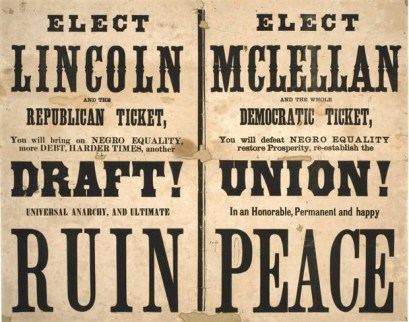
1864Racial violence perpetrated both sides of the conflict. That year, the Democratic Party ran a racist, anti-war campaign, warning that emancipation meant black people would move North in droves and force whites out of their homes. “The Constitution as it is, the Union as it was, and the negroes where they are,” was their campaign slogan. Democrats gained 34 seats in the House of Representatives, won gubernatorial races in New York and New Jersey, and won control of several state legislatures. In 1863, Horatio Seymour, the Democratic governor of New York, said, “I assure you I am your friend,” to anti-draft rioters who had lynched black doormen and burned down the Colored Orphan Asylum in New York City. 
Unfazed by backlash to the Emancipation Proclamation, Lincoln pressed for emancipation in the loyal states. He encouraged a constitutional amendment that would gradually emancipate slaves (until 1900) and provide compensation to slaveholders. Lincoln believed that his emancipation plan for the border states was “one of the most potent, and swift means of ending” the Civil War. “Let the states which are in rebellion see, definitely and certainly, that, in no event, will the states you represent ever join their proposed Confederacy, and they can not, much longer maintain the contest.” To people who didn’t want tax dollars spent on buying slaves, Lincoln replied that compensated emancipation would cost less than a prolonged war: “I had not asked you to be taxed to buy negroes, except in such way, as to save you from greater taxation to save the Union exclusively by other means.” Lincoln also warned that failing to accept gradual, compensated emancipation might lead to immediate, uncompensated emancipation.

  Many soldiers who had enlisted to defend the Union had reservations about fighting to free the slaves. Lincoln deployed his power of persuasion in a letter to be read at a Union rally in Springfield, Illinois: “You say you will not fight to free negroes. Some of them seem willing to fight for you; but, no matter. Fight you, then exclusively to save the Union. I issued the proclamation on purpose to aid you in saving the Union.”

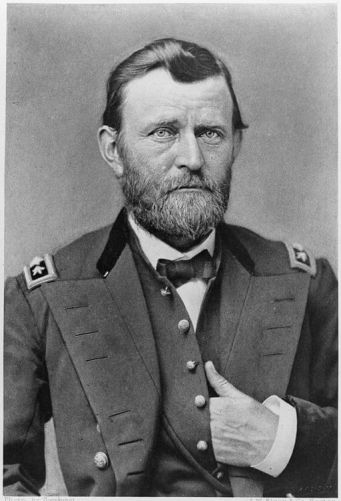
 General Ulysses S. Grant was one soldier who didn’t need convincing. He wrote in a usgletter to Lincoln, “I have given the subject of arming the negro my hearty support. This, with the emancipation of the negro, is the heavyest blow yet given to the Confederacy … by arming the negro we have added a powerful ally. They will make good soldiers and taking them from the enemy weakens him in the same proportion they strengthen us. I am therefore most decidedly in favor of pushing this policy to the enlistment of a force sufficient to hold all the South falling into our hands and to aid in capturing more.”
 After the major Union victories at Gettysburg and Vicksburg in July 1863, the war dragged on through 1864 and Democratic anti-war sentiment rose again. Democrats believed the war could end and the Union restored by negotiating a peace agreement that upheld slavery. Such a treaty would overturn Emancipation Proclamation, which said slaves with disloyal masters “are, and henceforward shall be free; and that the Executive government of the United States, including the military and naval authorities thereof, will recognize and maintain the freedom of said persons.” Lincoln was up for reelection that year, and though his electoral prospects looked grim that summer, he decided to hold firm on his proclamation and insist upon abolitionism in any peace talks.

By the fall of 1864, a string of Union victories dampened anti-war sentiment, and Lincoln and Republican legislators were resoundingly endorsed by the electorate. During the lame-duck session of Congress, when many Democratic congressmen had only a few months left before being replaced by Republicans, Lincoln pressed the House to pass the 13th Amendment, which had passed the previous April with the requisite 2/3 majority in the Senate. After much personal lobbying by Lincoln, just enough lame-duck Democrats either abstained or voted yes to clear the amendment through Congress on Jan. 31, 1865. It was then sent to the states and finally ratified in December 1865.

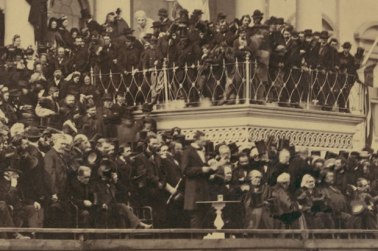
2nd inag abeLincoln’s second inauguration happened on March 4, 1865, when Union victory was imminent. He closed his Second Inaugural Address by extending an olive branch to the defeated Confederates and looking ahead to Reconstruction: “With malice toward none; with charity for all; with firmness in the right, as God gives us to see the right, let us strive on to finish the work we are in; to bind up the nation’s wounds; to care for him who shall have borne the battle, and for his widow, and his orphan—to do all which may achieve and cherish a just, and lasting peace among ourselves, and with all nations.”

After news reached Washington that Robert E. Lee surrendered to Ulysses S. Grant at Appomattox Court House, crowds gathered at the White House to hear Lincoln speak. Instead of delivering a bombastic victory speech, he addressed Rreconstruction. It was the last speech he gave, and true to form, he encouraged moderation. Radical Republicans didn’t want to accept Louisiana back into the Union because its constitution didn’t enfranchise black people. While Lincoln said that he personally supported enfranchisement for “the very intelligent” and “those who serve our cause as soldiers,” he asked, “Will it be wiser to take [Louisiana’s constitution] as it is, and help to improve it; or to reject, and disperse it? Can Louisiana be brought into proper practical relation with the Union sooner by sustaining, or by discarding her new State Government?”

  A distraught Confederate sympathizer named John Wilkes Booth attended Lincoln’s speech and was outraged to hear Lincoln endorse black suffrage in Louisiana. “That means n—-er citizenship. Now by God I’ll put him through. That is the last speech he will ever make,” Booth reportedly said. He assassinated Lincoln three days later.

Abraham Lincoln closed the Gettysburg Address by saying, “We here highly resolve that these dead men shall not have died in vain—that this nation, under God, shall have a new birth of freedom—and that government of the people, by the people, for the people, shall not perish from the earth.” Freedom for all Americans was a work in progress when he died, but it began when Lincoln insisted that for slavery to end, its expansion must be culled.

Lincoln is exalted as a god among men today; he is seen as the savior of black American slaves, and the sole reason that slavery ended. Like all people, Lincoln was flawed–his actions and thoughts, judged by today’s society, would make many uncomfortable. Still, he believed in moderation, in fairness, and in the importance of listening to both sides. This, in any era, makes him one of the nation’s most remarkable leaders. He certainly deserves credit for his handling of the Civil War years.

Theodore Roosevelt and Valentine’s Day 1884

By Kaleena Fraga

On the day after Valentine’s Day, there’s plenty of presidential material to sort through. There are the longest presidential marriages (George and Barbara Bush are the winners here, with a logged 73 years of marital life), Richard Nixon’s surprisingly poetic love letters to his wife, Pat, and Harry Truman, who says that he first fell for his wife, Bess, when he was six years old.

Among the most poignant, and certainly the most tragic, is the story of Theodore Roosevelt’s Valentine’s Day in 1884. Just twenty-five, he lost both his wife and mother on the same day, to unrelated causes. Both died young–his wife, Alice, was only twenty-two, and had just given birth to their daughter. His mother was forty-nine. Roosevelt marked the day with a simple, wrenching entry in his diary. X The light has gone out of my life.

rooseveltdiary.jpg

It was unmistakably the lowest point of Roosevelt’s life. But, as Doris Kearns Goodwin remarked in her Roosevelt biography Bully Pulpit, Roosevelt believed that “frantic activity was the only way to keep sorrow at bay.”

To anyone who has studied Roosevelt’s life, this philosophy is abundantly clear. For those who haven’t, Goodwin describes Roosevelt as someone who simply couldn’t stand still–ever. Journalist Louis Brownlow wrote how Roosevelt, as president, couldn’t stop even for his midday shave. (Journalists were invited to attend, so that Roosevelt could answer questions or give more detail on his ideas). “The President would wave both arms, jump up, speak excitedly, and then drop again into the chair and grin at the barber, who would begin all over.”

When the French ambassador Jules Jusserand visited Roosevelt, dressed for a formal occasion, he was whisked away to the woods with the exuberant president. Describing the event later, Jusserand recalled that they moved at a “breakneck pace” and that when they reached a river, rather than resting, Roosevelt declared that they had better strip “as to not wet our things in the creek.”

After his tragic Valentine’s Day in 1884, Roosevelt would go on to marry his childhood sweetheart, Edith Carow, and have five more children. Roosevelt’s “frantic activity” would propel him to the vice presidency, and then the presidency. If anything, the story of his tragedy is a reminder that someone can go from the lowest of lows to the highest of highs.

Happy Birthday Mr. President: The Ronald Reagan Edition

By Kaleena Fraga

Today, February 6th, 2018, would have been the Gipper’s 107th birthday. In celebration, here are ten of History First’s favorite Reagan facts:

  1. Reagan earned his nickname “the Gipper” from his time as an actor in Hollywood. In the film Knute Rockne: All American, Reagan played a football player named George Gipp who, upon becoming ill, urges his teammates to “win one for the Gipper.” Somewhat ironically given recent events, the film is about a Norwegian immigrant who reinvents football at Notre Dame, and later returns to the school to coach.

2. Reagan won a landslide victory in 1984; his opponent, Walter Mondale, carried only Washington D.C. and his home state of Minnesota.

3. Disunity in the Democratic party in 1980–incumbent Jimmy Carter faced an intraparty challenger in Ted Kennedy-prompted one party operative to declare that the Dems had to take their “unity medicine”: turn around three times and say President Ronald Reagan.

MAGA reagan style4. Reagan-Bush ran a slogan in 1980 that will sound familiar to many Americans today: “Let’s Make America Great Again.”

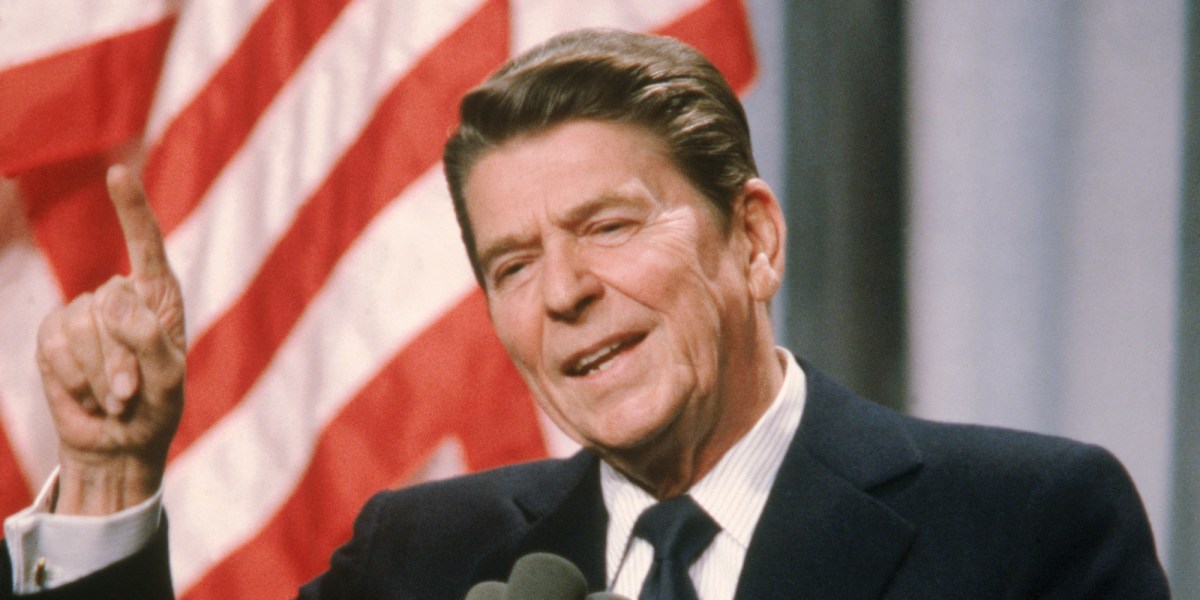
5. Reagan was known for his quips. After he survived an assassination attempt in 1981, he famously said to his wife, Nancy, “Honey, I forgot to duck.” When Reagan met his team of surgeons he’s reported to have remarked, “I hope you’re all Republicans.” Facing accusations of growing too old for the office during his reelection campaign in 1984, Reagan averred during a debate: “I will not make age an issue of this campaign. I am not going to exploit, for political purposes, my opponent’s youth and inexperience.”

6. At the time of his second inauguration, Reagan was 74–making him the oldest president at the beginning of his term.

7. Some found Reagan’s endorsement of his successor, George H.W. Bush, less than sdoenthusiastic. The New York Times called the run up to the endorsement “one of Washington’s longest-running and least suspenseful political dramas,” after Reagan insisted on waiting for the end of the Republican primary to announce his pick. Despite his nickname as the “Great Communicator” and Bush’s eight years of service as VP, Reagan flubbed Bush’s name during the endorsement, pronouncing it George Bosh.
8. Reagan appointed the first female Supreme Court Justice, Sandra Day O’Connor. Her nomination fulfilled one of Reagan’s 1980 campaign promises. O’Connor was confirmed by a Senate vote of 99-0.

9. Famous for loving Jelly Beans, Reagan hated brussel sprouts (maybe never tried roasting them!)

10. Reagan shares a birthday with Aaron Burr, infamous for his role in the death of the first Secretary of the Treasury (and current Broadway star) Alexander Hamilton.

aaronburr

Martin Van Buren and the Myth of OK

By Molly Bloom

Martin Van Buren is generally regarded as a below-average, simply “okay” president and is often overlooked for the two presidents who served contiguous to his term. Andrew Jackson and William Henry Harrison typically garner more attention; the former for his controversial presidency and the infamous Indian Removal Act, and the latter for the shortest presidential term in US history.

whh
The inauguration of William Henry Harrison, 1840

Van Buren was the heir apparent to the presidency after a political career culminating with his service as Andrew Jackson’s vice president. Jackson’s support aided Van Buren’s campaign as a member of the relatively new Democratic Party in 1836, leading to his election. However, after a poorly rated presidency that included the “Panic of 1837” economic depression, his 1840 presidential campaign faced considerable opposition. Harrison defeated Van Buren’s run for a second term in 1840 to become the oldest man elected president, and age was a point of contention during his campaign. (Since then, both Ronald Reagan and Donald Trump have been elected in their 70s). Harrison famously delivered a superfluous inaugural address on a frigid day, refusing to wear a coat to demonstrate that despite being 68 years old, he was still robust and fit to serve. He contracted pneumonia during his excessive speech and died a month later.

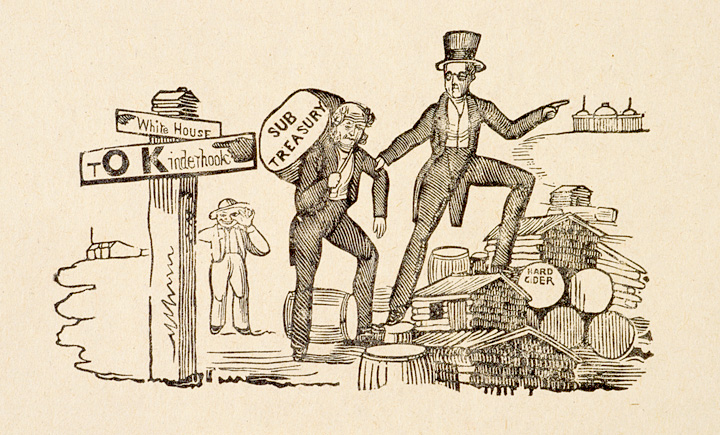
 Van Buren’s 1840 campaign is often credited with the origin of the term “OK,” widely popular both then and now; however, the derivation of “OK” is convoluted. Proposed origins of OK range from the Choctaw okeh which holds the same meaning as the modern okay, to the Greek olla kalla, “all good,” to stories of a baker with the initials OK stamping the letters on army biscuits. Allan Metcalf explains in his book OK: The Improbable Story of America’s Greatest Word that OK grew out of a joke written in March of 1839 by editor Charles Gordon Greene in the Boston Morning Post. The joke was that even if a person couldn’t spell “all correct,” they could “o.k.” something to say it was “oll korrect.” OK came out of a time when intellectuals were using wordplay to publish punchy jabs, and abbreviations were becoming popular- precursors to the modern LOL, JK, and even POTUS.

 Born in Kinderhook, New York, Van Buren earned the nickname of “Old Kinderhook,” further popularizing the abbreviation “OK.” His Whig opponent, William Henry Harrison, was famous as “Old Tippecanoe” or the “Hero of Tippecanoe” due to his military victory at the Battle of Tippecanoe in 1811. With running-mate John Tyler, Harrison’s campaign song of Tippecanoe and Tyler Too included lyrics criticizing Van Buren, calling him “little.” (Sound familiar?) The song stated, “For Tippecanoe and Tyler too/ And with them we’ll beat little Van, Van, Van/ Van is a used up man.”

 OK remained a running theme during the campaign.  OK Clubs of Van Buren’s supporters rose up around the country, using the meaning of OK, all correct, to say that voting for Van Buren was giving a stamp of approval. His opponents used the term OK to attack Van Buren, stating that his political ally Andrew Jackson was so unintelligent that he “OK’d” bills during his presidency since he could not properly spell “all correct.” Regardless of the debated origin of OK, Van Buren’s 1840 run certainly helped disseminate the word. OK is used today as nearly any part of speech; as a noun, verb, adjective, interjection, et cetera, and in almost infinite scenarios so that the meaning has a certain amount of ambiguity. Van Buren’s presidency was just OK, or it could have even been considered oll korrect or all correct depending on your point of view, which is ultimately the legacy of Old Kinderhook’s story.

Inauguration 1961: Truman, Kennedy & a Return to the White House

By Kaleena Fraga

(To check out this piece in podcast form, click here)

January 20th is full of stories of the passage of power from one administration to the next. Since 1936 presidents have been inaugurated on this day, so so there is plenty to remember–FDR marking the beginning of his unprecedented 3rd and 4th terms; Eisenhower playfully lassoed by a cowboy; Jimmy Carter & Rosalynn Carter walking the inauguration route in spite of the protests of the Secret Service–the list goes on and on.

Still, there’s one event worth reflecting on which happened the next day, on January 21st, 1961, and this is President Truman’s invitation to the White House. It was his first time returning to the White House since he’d left eight years earlier.

ike campaign

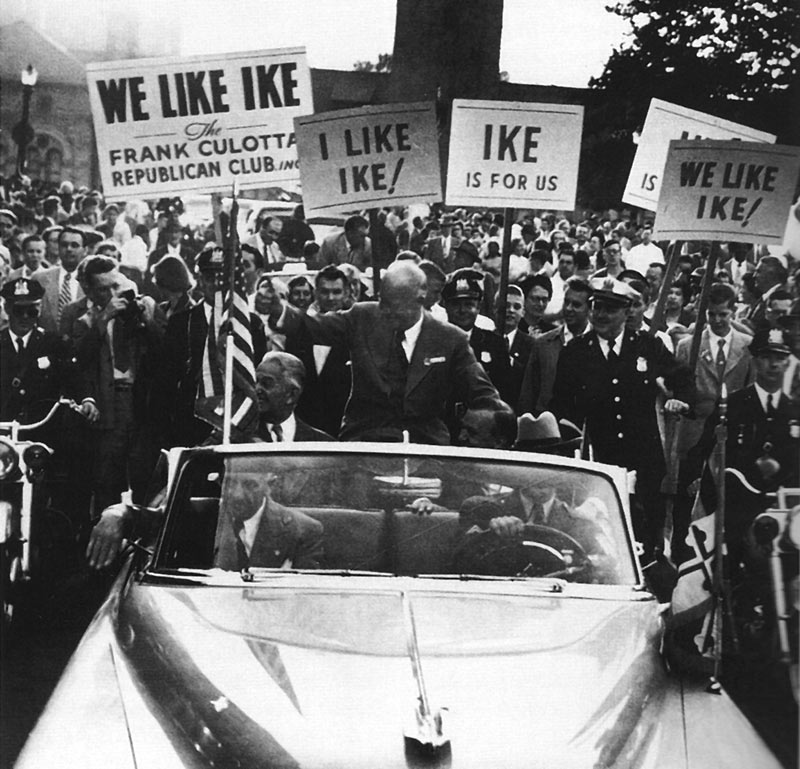
Truman had left in 1953 after a hard defeat for his party. Eisenhower had won a decisive victory over the Democratic candidate, Adlai Stevenson, whom Truman encouraged to run, becoming the first Republican victor in 20 years. Still, Truman was gracious in defeat. He invited Ike to the White House in November 1952 to talk about the job, but later wrote that all he had said to Ike “went into one ear and out the other.” He later postulated that Ike, a war hero, would be unsuited to the task of president. “He’ll sit right here and he’ll say do this, do that! And nothing will happen. Poor Ike–it won’t be a bit like the Army. He’ll find it very frustrating.”

eisenhower-truman1

Inauguration itself had been an awkward affair. Eisenhower, determined to not step foot in the White House that day until he could do so as president, disregarded the tradition of calling on the current president & first lady. The Eisenhowers declined the Trumans’ invitation to lunch, or even a cup of coffee, and did not come out of their car until Truman appeared outside of the White House. As they drove off, an aid to President Truman remarked that he was glad to not be in the car. 

Despite all this, Truman had invited Eisenhower’s son, John, currently serving in Korea, back to the States to watch his father’s inauguration. Neither son nor father knew it had been the president’s orders until Eisenhower asked Truman in the car. According to Eisenhower, Truman simply replied: “I did.”

But any thaw that took place during the car ride had little effect on the Truman/Eisenhower relationship. Shortly after the ceremony ended, Truman returned to Missouri, where he’d largely remain for Ike’s next two terms. It seems the two presidents had little contact during that time. When Ike was in Missouri Truman tried to set up a meeting, but was told that the president’s schedule was much too full. Later in life, according to Truman biographer David McCullough, he could hardly refer to Eisenhower without using profanity.

Truman didn’t exactly start off much better with the man destined to replace Eisenhower. During the Democratic convention in 1961, Truman spoke out against Kennedy, saying:

“I am deeply concerned and troubled about the situation we are up against in the world now…That is why I hope someone with the greatest possible maturity and experience would be available at this time. May I urge you to be patient?”

Kennedy shrugged off the criticism. He had fourteen years in major political office–that was enough.

When Kennedy did become the nominee, Truman offered up his services. But he had his doubts. Writing to his former Secretary of State, Dean Acheson, he declared that “[we] are stuck with the necessity of taking the worst of two evils or none at all. So–I’m taking the immature Democrat as the best of the two. Nixon is impossible. So, there we are.”

Despite his lackluster support, Truman, then seventy-six, went in all for Kennedy. He traveled to nine states and delivered thirteen speeches in support of the Democratic candidate.

Kennedy was grateful. As a gesture of thanks, he made Truman his first official guest to the White House, the day after his inauguration in 1961.

Truman, a talented piano player, was even invited to take up the keys after a formal dinner.

truman piano wh

Truman later wrote of his disappointment that Kennedy did not call on him for advice during his presidency. Later in Kennedy’s term, Truman wrote Acheson to say, “You must remember that our head of State is young, inexperienced and hopeful. Lets hope the hopeful works.”

In any case, Kennedy’s overture to Truman is a reminder that inaugurations don’t have to be chilly affairs–rather, they can be an occasion for mending bridges. Truman would certainly note–especially after the Bay of Pigs–that current presidents have much to learn from the men who occupied the office before them. A lesson that could be applied to 1961 as any political era.

Special thanks to David McCullough’s fantastic tome “Truman”

The Great Emancipator: Lincoln’s Backwards Backwoods Beginning

PART I

By Duane Soubirous

Heroes of American history are posthumously revered as gods by the Americans who follow them. Look at the ceiling of the U.S. Capitol’s rotunda and see Constantino Brumidi’s “Apotheosis of Washington,” depicting slaveowner George Washington’s ascent into heaven accompanied by the goddess of liberty. Walk into the Parthenon-inspired Lincoln Memorial and read Royal Cortissoz’s epitaph,

IN THIS TEMPLE

AS IN THE HEARTS OF THE PEOPLE

FOR WHOM HE SAVED THE UNION

THE MEMORY OF ABRAHAM LINCOLN

IS ENSHRINED FOREVER

Etched in the walls of the Lincoln Memorial are the Gettysburg Address and the Second Inaugural Address, both written within the last 18 months of Lincoln’s life. His earlier speeches go unmemorialized, like this passage from 1858 endorsing white supremacy:

“I am not, nor ever have been, in favor of bringing about in any way the social and political equality of the white and black races – that I am not nor ever have been in favor of making voters or jurors of negroes, nor of qualifying them to hold office, nor to intermarry with white people.”

W.E.B. DuBois quoted this passage in an editorial written in September 1922, four months after the Lincoln Memorial’s dedication. He believed that Lincoln should be honored as the imperfect human being he was, instead of a legend sculpted in marble:

“No sooner does a great man die than we begin to whitewash him. We seek to forget all that was small and mean and unpleasant and remember the fine and brave and good … and at last there begins to appear, not the real man, but the tradition of the man—remote, immense, perfect, cold and dead!”


Recognizing Abraham Lincoln’s flaws and contradictions doesn’t diminish his legacy, DuBois wrote, but rather enhances the worth and meaning of his upward struggle. “The world is full of people born hating and despising their fellows. To these I love to say: See this man. He was one of you and yet he became Abraham Lincoln.”

This three-part series will chronicle Lincoln’s upward struggle, from denouncing black suffrage to Illinois voters in 1858 to supporting black suffrage in his final speech in 1865, from unsuccessfully opposing the expansion of slavery as a one-term congressman to becoming the president who eradicated it.

Abraham Lincoln grew up on the frontier surrounded by what Frederick Douglass called “negrophobia.” It was common for frontiersmen living in free states to abhor slavery and emancipation alike: both were perceived as threats to the unalienable rights of white men. Lincoln didn’t address slavery in his campaigns for the Illinois State Assembly and U.S. Congress in the 1830s and 1840s, but Congressman Lincoln did support two proposals restricting slavery, neither of which succeeded.

In 1849, Lincoln proposed a gradual emancipation of slaves in the District of Columbia, but his plan wasn’t even brought to a vote. In 1862, after Lincoln signed into law the immediate emancipation of slaves in the capital, Lincoln said, “Little did I dream in 1849, when I proposed to abolish slavery at this capital, and could scarcely get a hearing for the proposition, that it would be so soon accomplished.”

Congressman Lincoln also supported the Wilmot Proviso, named for Pennsylvania Congressman David Wilmot. Wilmot wanted to keep slavery out of all territories gained from the Mexican-American War, giving white men to carte blanche to build a better life out West. The Wilmot Proviso passed in the House but failed in the Senate. Leading the opposition in the Senate was Illinois Senator Stephen Douglas, whom Lincoln challenged in 1858.

“If we could first know where we are, and whither we are tending, we could better judge what to do, and how to do it,” begins Lincoln’s “House Divided” speech, delivered upon securing the Illinois Republican Party’s nomination for Senate. Standing on the sidelines of the political arena in the 1850s, Lincoln observed each branch of government working conjunctively to expand slavery, and worried the United States was tending toward nationalizing slavery.

The Kansas-Nebraska Act of 1854, shepherded through Congress by Senator Douglas, repealed a 34-year-old ban on slavery in the Kansas and Nebraska territories. Douglas insisted he didn’t care whether slavery be voted down or up, “but to leave the people thereof perfectly free to form and regulate their domestic institutions in their own way.” Lincoln attacked this principle of popular sovereignty, defining it this way: “That if any one man, choose to enslave another, no third man shall be allowed to object.”

In President James Buchanan’s inaugural address of 1856, he called on Americans to abide by an upcoming Supreme Court decision, “whatever this may be.” Two days later the Supreme Court issued its Dred Scott decision, ruling that Congress cannot ban slavery in the territories and the Constitution affirms the right to own slaves. This decision alarmed Lincoln. If the Constitution forbids states from denying rights affirmed in the Constitution, and the Supreme Court says the right to own slaves is affirmed in the Constitution, Lincoln reasoned that the Supreme Court would soon rule that states’ bans on slavery were unconstitutional. “We shall lie down pleasantly dreaming that the people of Missouri are on the verge of making their State free; and we shall awake to the reality instead, that the Supreme Court has made Illinois a slave state.”

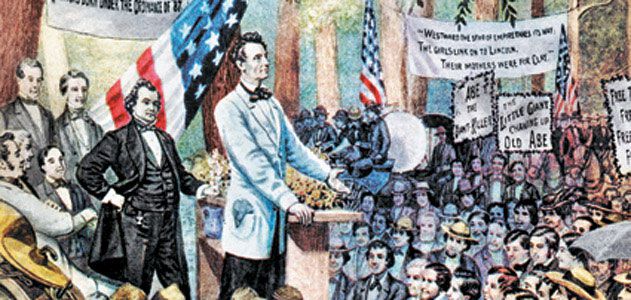
Lincoln and Douglas debated seven times throughout the state. While Lincoln largely appealed to the audiences’ morals in denouncing slavery, Douglas resorted to race baiting. Responding to Lincoln’s assertion that the Declaration of Independence applied to both whites and blacks, Douglas asked how could Jefferson mean to include black people in the words “all men are created equal” when he himself held slaves? Furthermore, if slavery is wrong because the Founding Fathers meant for whites and blacks to be equal, what’s to stop freed slaves from voting, serving on juries, and marrying whites?

Lincoln spent the first three debates trying to dodge Douglas’ assertions that Lincoln believed in full equality for black people. At the fourth debate in Charleston, an especially racist part of the state, Lincoln definitively refuted Douglas: “There is a physical difference between the white and black races which I believe will forever forbid the two races living together on terms of social and political equality.”

In 1858, Illinois’ senators were chosen by the state legislature: the people would vote for state representatives, and whichever party won a majority picked their nominee for Senate. Republicans won the popular vote, but Democrats won a majority of the seats, and Stephen Douglas was reelected as senator. However, Lincoln’s performance in the debates rose him to prominence throughout the North, and when the two ran for president in 1860, Lincoln would emerge the winner.

The President’s Mind: Trump, Reagan, and Mental Health in the Oval Office

By Kaleena Fraga

On Twitter last week, President Trump accused his critics of “taking out the old Ronald Regan playbook and screaming mental instability and intelligence…” Trump later added “Ronald Reagan had the same problem and handled it well. So will I!”

These tweets were in response to reports in the new Michael Wolff book Fire and Fury, which suggest that the president is mentally unfit for his role. Trump’s response attempts to equivocate these suggestions with similar accusations levied against Ronald Reagan in the 1980s. Reagan was later diagnosed with Alzheimer’s, but there is no definitive proof that he suffered from it while in office, or that it inhibited him from performing his duties.

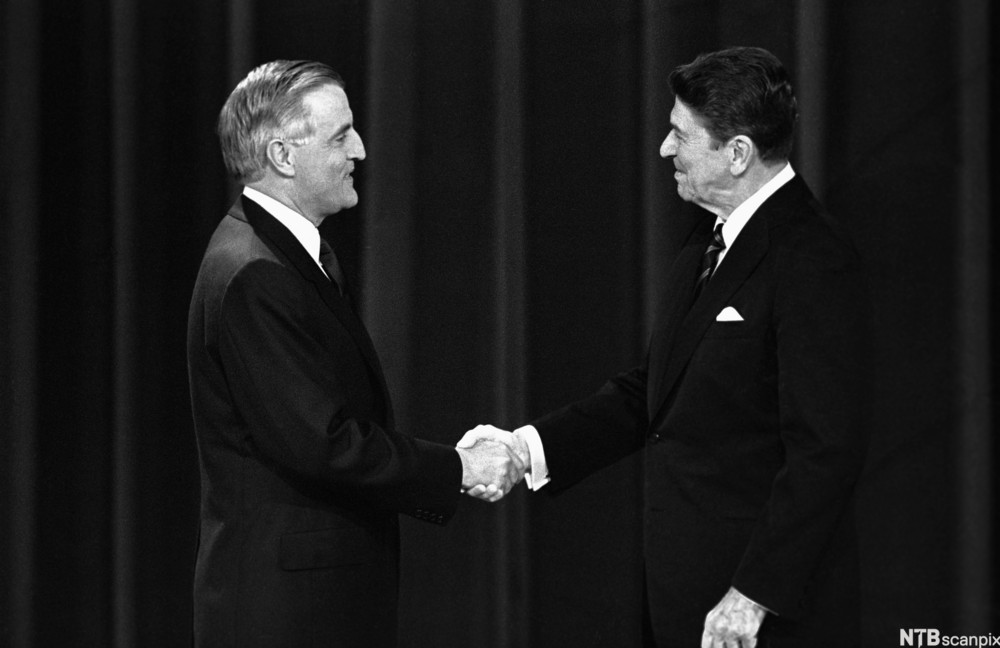
Reagan and Walter Mondale Shaking HandsStill, he did face speculation of diminishing mental capacity during his presidency. In the aftermath of a poor performance in Reagan’s first debate with Democratic challenger Walter Mondale, a New York Times op-ed wrote that there were “legitimate questions that arise when the oldest President in the history of the Republic is seeking re-election to a term that would last from the end of his 73rd year to the end of his 77th…the issue of aging and its effects cannot be avoided.”

Reagan seemed to shake off such doubts in the second debate, when he responded to a probing question about his age by saying:

“I will not make age an issue of this campaign. I am not going to exploit, for political purposes, my opponent’s youth and inexperience.”

In 2011, Ronald Reagan’s son contested his father’s doctors who, at the time of his presidency, had denied seeing any signs of Alzheimer’s. In his book My Father at 100, Reagan suggests that his father did suffer from Alzheimer’s while in office and that, if properly diagnosed, he would have stepped down.

The 25th amendment is supposed to protect the country in the event that the executive is unable to react to the demands of the office. Although it’s been invoked a handful of times since its ratification in 1967 for events like surgery, it’s never been used to permanently remove a president from power.

Trump too faces accusations of a declining mental state. He, like Reagan, is a president in his 70s.  For now, at least, questions of the president’s health are all conjecture. Trump will undergo a physical on January 12th and, although there will be no psychiatric exam, the results will be released to the public.

Then again, according to a recent study, as many as half of all U.S. presidents have suffered from some mental illness. Most for depression–including John Quincy Adams, James Madison, and Abraham Lincoln–and others with probable bipolar disorders, anxiety disorders, and alcohol dependence.