By Kaleena Fraga
We’ve talked about awkward presidential transitions before—we even dove deep into the chilly exchange of power between Harry Truman and Dwight D. Eisenhower.
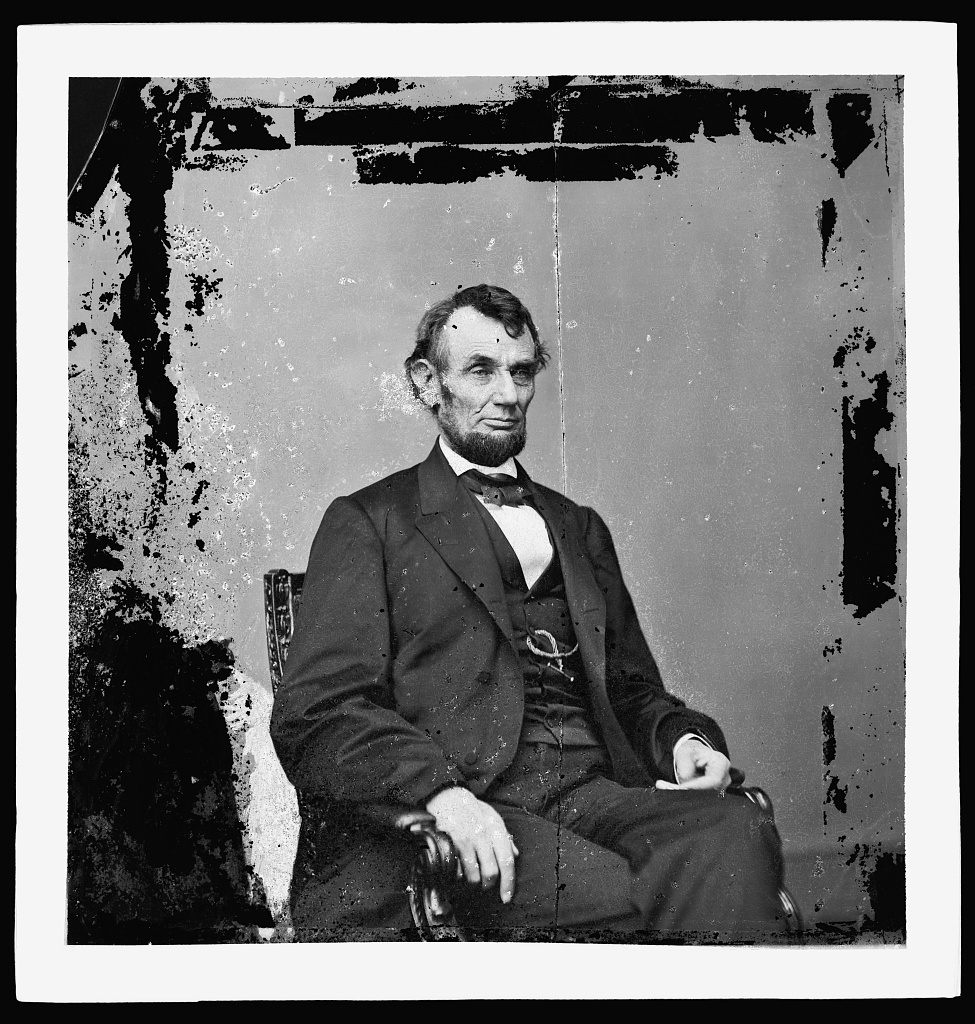
But nothing quite tops Abraham Lincoln’s first inauguration in 1861. By the time Lincoln took the oath of office on March 4th, seven Southern states had seceded from the Union.
The Election of 1860
The Election of 1860 was split between four men. Abraham Lincoln ran under the banner of the Republican party—a new organization which united Know-Nothings, Whigs, and others under one roof. The Republicans largely opposed the expansion—not the existence—of slavery.
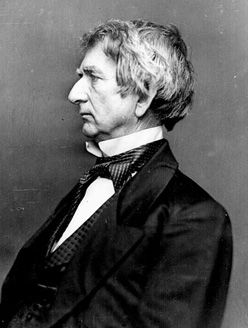
(The party had denied William Seward the nomination. Seward had thundered against slavery, noting that Americans should answer to a “higher law” than the Constitution. The Republicans prefered Lincoln, a moderate from a battleground state.)
Shattered by questions around slavery, the Democrats were a party divided. Democrats in the north nominated Stephen Douglas. However, Democrats in the south nominated John C. Breckinridge, the current vice president. Senator John Bell also threw his hat into the ring, as the nominee for the new Constitutional Union party.
Facing a divided opponent, Lincoln easily swept to victory—even though Southern states omitted Lincoln from the ballot.

“Well, boys,” Lincoln is alleged to have said to reporters after his victory, “your troubles are over now—but mine have just commenced.”
Lincoln’s “troubles” would be greater than he predicted.
The 1860 campaign had been bitter. Even though none of the candidates—except Douglas—openly campaigned, tensions skyrocketed over questions about slavery and its expansion. Newspapers in the South launched deeply racist attacks against Lincoln and, all the while, Southern states rumbled with the threat of secession.
Following Lincoln’s election, they made good on their threat. On December 20th, 1860 South Carolina seceded from the Union. Six more states followed. In February 1861, they formed the Confederate States of America.
Abraham Lincoln’s 1861 Inauguration
Days after Jefferson Davis was elected president of the new Confederacy, Abraham Lincoln set out from Springfield to travel to Washington D.C.
He arrived in the city at the crack of dawn on February 23rd. Because of a possible assassination plot, Lincoln had taken a night train. Rumors, unfounded, quickly spread that the new president had snuck into the city in disguise.
On March 4th, he prepared for his inauguration. Inauguration Day always draws crowds, but a different kind of tension sparked the air in 1861. Elizabeth Keckley, a Black dressmaker and confidante of Mary Lincoln’s, wrote in her memoirs:
“The streets of the capital were thronged with people, for this was Inauguration day. . . Never was such deep interest felt in the inauguration proceedings as was felt today.”
As Lincoln made his way to the Capitol, he was surrounded by heavily armed cavalry. One reporter noted that the president’s carriage was “closely surrounded on all sides by marshals and cavalry, so as almost to hide it from view.”
A young Julia Taft—who would write about Lincoln as an adult—stood in the crowd with her mother. They took care to not get too close—it could be dangerous. She recalled that as they took their place on the edge of the crowd “a file of green-coated sharpshooters went through up to the roof. The whisper went round that they had received orders to shoot at any one crowding toward the President’s carriage.”
In Taft’s recollection, the crowd seemed hostile toward Lincoln. She heard a woman sneer: “There goes that Illinois ape, the cursed Abolitionist. But he will never come back alive.”
In his inaugural address, Lincoln struck a firm but moderate tone. He promised to not interfere with slavery where it existed, but warned that the federal government would “hold, occupy, and possess” its property. Secession, he told the crowd, was “the essence of anarchy.”
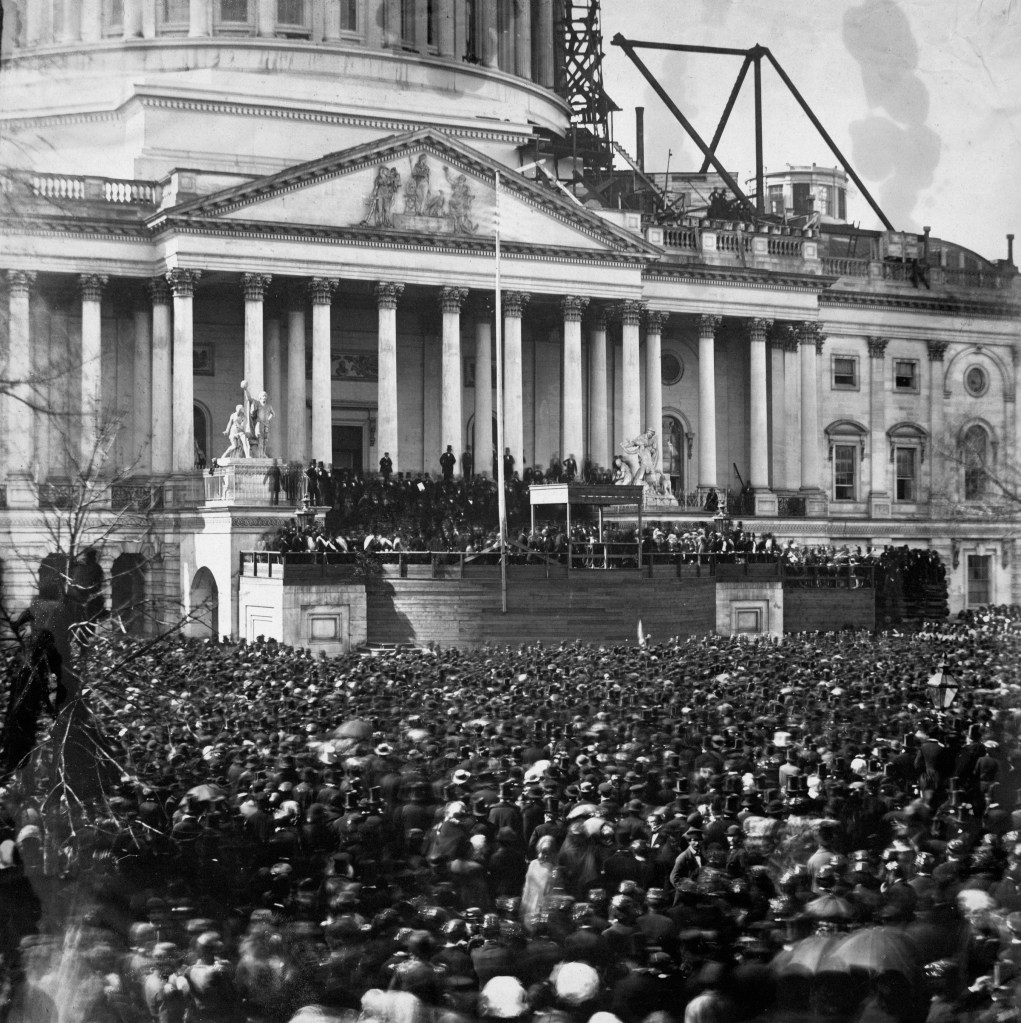
Lincoln warned the South that if conflict were to break out, it would be because of their actions. “In your hands, my dissatisfied fellow countrymen, and not in mine, is the momentous issue of civil war. The government will not assail you. You can have no conflict, without being yourselves the aggressors.”
Lincoln ended his speech—at the suggestion of Seward, his new secretary of state—with “words of affection” toward the South. His words would echo through the ages:
“We are not enemies, but friends. We must not be enemies. Though passion may have strained, it must not break our bonds of affection. The mystic chords of memory, stretching from every battlefield and patriot grave, to every living heart and hearthstone, all over this broad land, will yet swell the chorus of the Union, when again touched, as surely they will be, by the better angels of our nature.”
A little over a month later, shots were fired at Fort Sumter in South Carolina. The Civil War had begun.
Abraham Lincoln in 1865
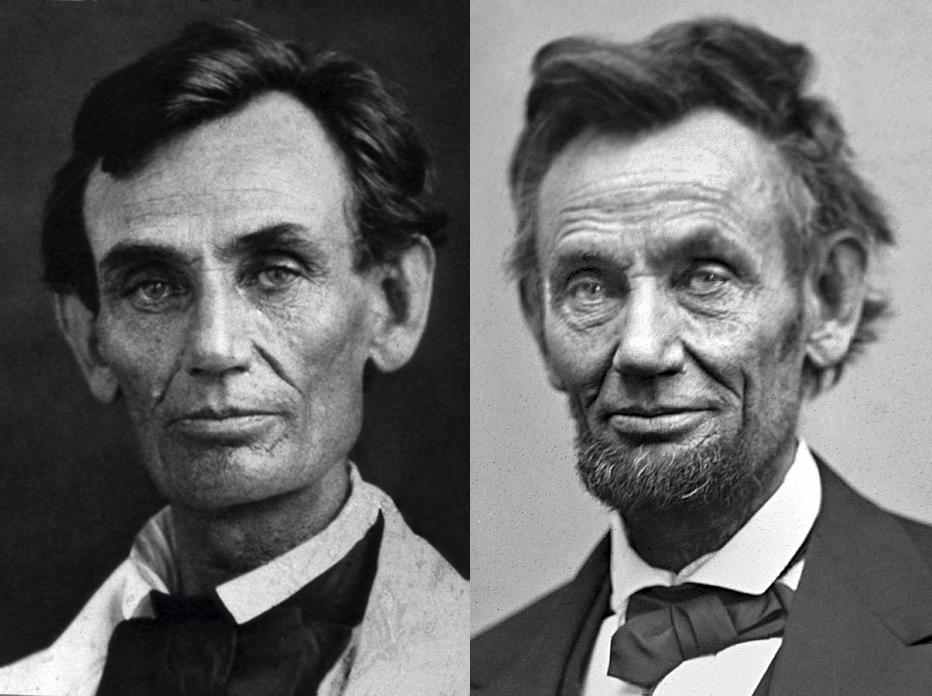
The Civil War changed the country. It changed Abraham Lincoln. He was no longer a moderate from a battleground state; he was the commander-in-chief during a conflict that would kill 600,000 Americans. Lincoln went from assuring Border States that the war wasn’t about slavery to championing the Emancipation Proclamation.
By the time he was inaugurated for the second time in March 1865, the war had begun to limp to its bloody end. A Union victory was in reach.
“At this second appearing to take the oath of the presidential office,” Lincoln noted during his inauguration, “There is less occasion for an extended address than there was at the first.” He gave a short speech—about 700 words—denouncing slavery in searing, religious terms as figures like Walt Whitman, Frederick Douglass, and John Wilkes Booth, Lincoln’s soon-to-be-assassin, looked on.
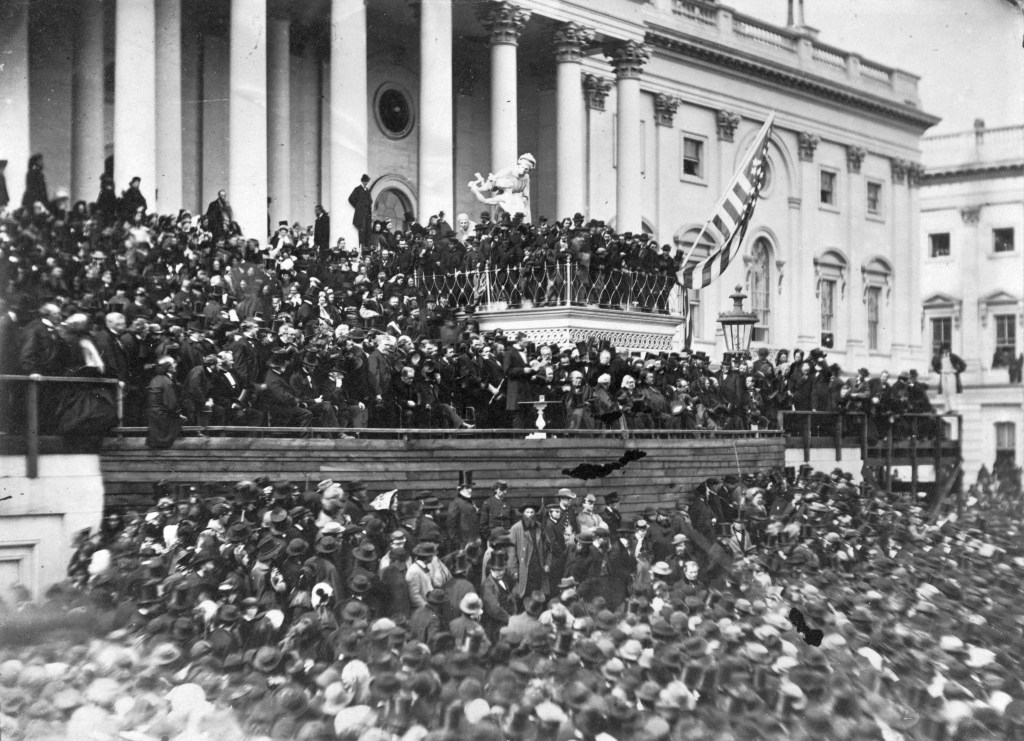
Just as he had four years earlier, Lincoln ended his speech with a call for peace and goodwill: “With malice toward none with charity for all with firmness in the right as God gives us to see the right let us strive on to finish the work we are in to bind up the nation’s wounds, to care for him who shall have borne the battle and for his widow and his orphan — to do all which may achieve and cherish a just and lasting peace among ourselves and with all nations.”
—
It’s true—as Keckley said, and as Taft noted—that inauguration days are always fascinating affairs. The upcoming inauguration of Joe Biden is sure to strike a slightly different tone than normal, however.
The nation—rattled by the events of January 6, 2021 at the US Capitol—awaits his swearing-in with apprehension. Despite possible threats that may exist, Biden has avowed that he is “not afraid” to take the oath of office outside.
Out with the old, in with the new—what will the Biden era bring?


 On the night before the invasion Ike waited with his personal chauffeur (and rumored mistress) Kay Summersby, who noted that the General’s “eyes were bloodshot, and he was so tired that his hands shook when he lit a cigarette.” Still, she wrote, “if Ike had wished, he could have been [with] Churchill…[and] de Gaulle…who were gathered just a few miles away in Portsmouth. But he preferred to wait in solitude.”
 Dr. Robert Moton, a civil rights activist, gave the keynote address. Although he


 In 1842 Whitman attended a lecture given by Ralph Waldo Emerson, where Emerson predicted that America would soon have its own poet who would write about the American experience in a uniquely American style. “When he lifts his great voice, men gather to him and forget all that is past, and then his words are to the hearers, pictures of all history,” Emerson said.
 the Battle of Fredericksburg, where the Union was badly defeated. Whitman rushed to the battlefield, only to find that his brother was minimally injured. Whitman stayed with his brother for over a week and witnessed the realities of war. “Living so close to the front, to the dressing stations and the hospital tents pitched on the frozen ground, the fresh barrel-stave markers in the burial field, the vexed Rappahannock, and the ruins of Fredericksburg, he saw ‘what well men and sick men and mangled men endure,’” Justin Kaplan wrote in Walt Whitman: A Life. Whitman began writing down these observations, later using them for his “Drum-Taps” poems.


 Lincoln wasn’t exactly smitten with Mary Todd. After they got engaged, Lincoln had second thoughts and he tried to get out of their engagement. Several of Lincoln’s friends recollected his misgivings about Mary, which Michael Burlingame documented in his book
  General Ulysses S. Grant at his first appearance in Washington, D.C. as the top general in the Union army. That reception, a journalist noted, was the first time Abraham Lincoln wasn’t the center of attention in the East Room. Grant was elected president in the first election after Lincoln’s assassination. He might have been assassinated with Lincoln on April 14, 1865, if Mary Todd Lincoln hadn’t thrown a tantrum a few weeks earlier in front of Grant’s wife Julia Dent Grant. Even though the morning newspaper reported that the Lincolns and the Grants would attend a showing of
 Racial violence perpetrated both sides of the conflict. That year, the Democratic Party ran a racist, anti-war campaign, warning that emancipation meant black people would move North in droves and force whites out of their homes. “The Constitution as it is, the Union as it was, and the negroes where they are,” was their campaign slogan. Democrats gained 34 seats in the House of Representatives, won gubernatorial races in New York and New Jersey, and won control of several state legislatures. In 1863, Horatio Seymour, the Democratic governor of New York, said, “I assure you I am your friend,” to anti-draft rioters who had lynched black doormen and burned down the Colored Orphan Asylum in New York City.
  letter to Lincoln, “I have given the subject of arming the negro my hearty support. This, with the emancipation of the negro, is the heavyest blow yet given to the Confederacy … by arming the negro we have added a powerful ally. They will make good soldiers and taking them from the enemy weakens him in the same proportion they strengthen us. I am therefore most decidedly in favor of pushing this policy to the enlistment of a force sufficient to hold all the South falling into our hands and to aid in capturing more.”
 Lincoln’s second inauguration happened on March 4, 1865, when Union victory was imminent. He closed his Second Inaugural Address by extending an olive branch to the defeated Confederates and looking ahead to Reconstruction: “With malice toward none; with charity for all; with firmness in the right, as God gives us to see the right, let us strive on to finish the work we are in; to bind up the nation’s wounds; to care for him who shall have borne the battle, and for his widow, and his orphan—to do all which may achieve and cherish a just, and lasting peace among ourselves, and with all nations.”
 History First