
By Kaleena Fraga
On the day after Valentine’s Day, there’s plenty of presidential material to sort through. There are the longest presidential marriages (George and Barbara Bush are the winners here, with a logged 73 years of marital life), Richard Nixon’s surprisingly poetic love letters to his wife, Pat, and Harry Truman, who says that he first fell for his wife, Bess, when he was six years old.
Among the most poignant, and certainly the most tragic, is the story of Theodore Roosevelt’s Valentine’s Day in 1884. Just twenty-five, he lost both his wife and mother on the same day, to unrelated causes. Both died young–his wife, Alice, was only twenty-two, and had just given birth to their daughter. His mother was forty-nine. Roosevelt marked the day with a simple, wrenching entry in his diary. X The light has gone out of my life.

It was unmistakably the lowest point of Roosevelt’s life. But, as Doris Kearns Goodwin remarked in her Roosevelt biography Bully Pulpit, Roosevelt believed that “frantic activity was the only way to keep sorrow at bay.”
To anyone who has studied Roosevelt’s life, this philosophy is abundantly clear. For those who haven’t, Goodwin describes Roosevelt as someone who simply couldn’t stand still–ever. Journalist Louis Brownlow wrote how Roosevelt, as president, couldn’t stop even for his midday shave. (Journalists were invited to attend, so that Roosevelt could answer questions or give more detail on his ideas). “The President would wave both arms, jump up, speak excitedly, and then drop again into the chair and grin at the barber, who would begin all over.”
When the French ambassador Jules Jusserand visited Roosevelt, dressed for a formal occasion, he was whisked away to the woods with the exuberant president. Describing the event later, Jusserand recalled that they moved at a “breakneck pace” and that when they reached a river, rather than resting, Roosevelt declared that they had better strip “as to not wet our things in the creek.”
After his tragic Valentine’s Day in 1884, Roosevelt would go on to marry his childhood sweetheart, Edith Carow, and have five more children. Roosevelt’s “frantic activity” would propel him to the vice presidency, and then the presidency. If anything, the story of his tragedy is a reminder that someone can go from the lowest of lows to the highest of highs.

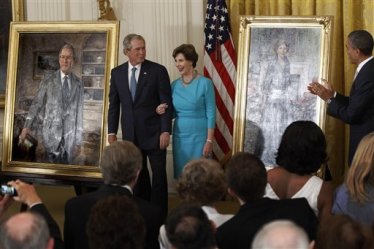 unveiling of their official portraits. Bush’s father and fellow president George H.W. Bush tagged along too. It was a light hearted occasion, with friendly barbs on both sides.
 In 1989, Ronald and Nancy Reagan were invited to the White House for the unveiling of their official portraits. Reagan
 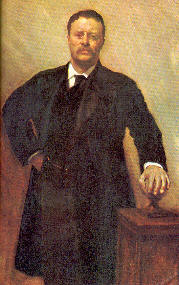 because he thought it made him look like a “mewing cat.” The second painter he hired, John Singer Sargent, found him to be a
 4. Reagan-Bush ran a slogan in 1980 that will sound familiar to many Americans today: “Let’s Make America Great Again.”
 enthusiastic. The New York Times called the run up to the endorsement “one of Washington’s longest-running and least suspenseful political dramas,” after Reagan insisted on waiting for the end of the Republican primary to announce his pick. Despite his nickname as the “Great Communicator” and Bush’s eight years of service as VP, Reagan flubbed Bush’s name during the endorsement, pronouncing it George Bosh.
 History First