The President’s Mind: Trump, Reagan, and Mental Health in the Oval Office

By Kaleena Fraga

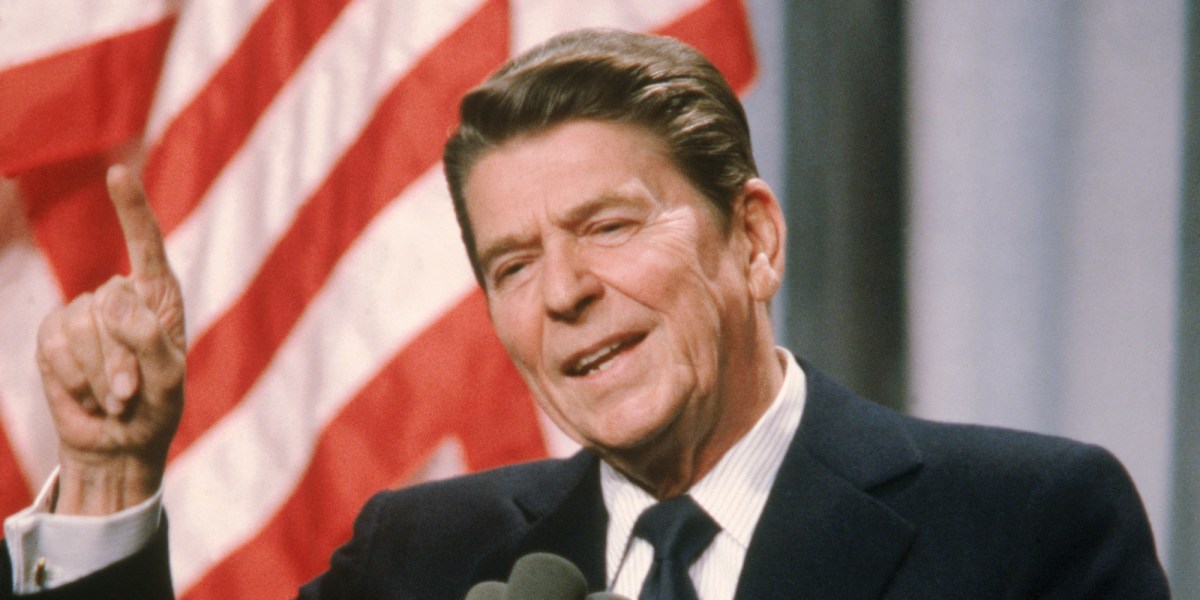
On Twitter last week, President Trump accused his critics of “taking out the old Ronald Regan playbook and screaming mental instability and intelligence…” Trump later added “Ronald Reagan had the same problem and handled it well. So will I!”

These tweets were in response to reports in the new Michael Wolff book Fire and Fury, which suggest that the president is mentally unfit for his role. Trump’s response attempts to equivocate these suggestions with similar accusations levied against Ronald Reagan in the 1980s. Reagan was later diagnosed with Alzheimer’s, but there is no definitive proof that he suffered from it while in office, or that it inhibited him from performing his duties.
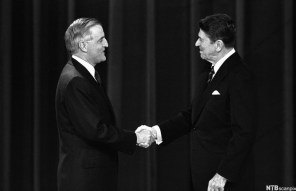
Reagan and Walter Mondale Shaking HandsStill, he did face speculation of diminishing mental capacity during his presidency. In the aftermath of a poor performance in Reagan’s first debate with Democratic challenger Walter Mondale, a New York Times op-ed wrote that there were “legitimate questions that arise when the oldest President in the history of the Republic is seeking re-election to a term that would last from the end of his 73rd year to the end of his 77th…the issue of aging and its effects cannot be avoided.”

Reagan seemed to shake off such doubts in the second debate, when he responded to a probing question about his age by saying:

“I will not make age an issue of this campaign. I am not going to exploit, for political purposes, my opponent’s youth and inexperience.”

In 2011, Ronald Reagan’s son contested his father’s doctors who, at the time of his presidency, had denied seeing any signs of Alzheimer’s. In his book My Father at 100, Reagan suggests that his father did suffer from Alzheimer’s while in office and that, if properly diagnosed, he would have stepped down.

The 25th amendment is supposed to protect the country in the event that the executive is unable to react to the demands of the office. Although it’s been invoked a handful of times since its ratification in 1967 for events like surgery, it’s never been used to permanently remove a president from power.

Trump too faces accusations of a declining mental state. He, like Reagan, is a president in his 70s.  For now, at least, questions of the president’s health are all conjecture. Trump will undergo a physical on January 12th and, although there will be no psychiatric exam, the results will be released to the public.

Then again, according to a recent study, as many as half of all U.S. presidents have suffered from some mental illness. Most for depression–including John Quincy Adams, James Madison, and Abraham Lincoln–and others with probable bipolar disorders, anxiety disorders, and alcohol dependence.

A Busy Day for JFK (& RMN)

By Kaleena Fraga

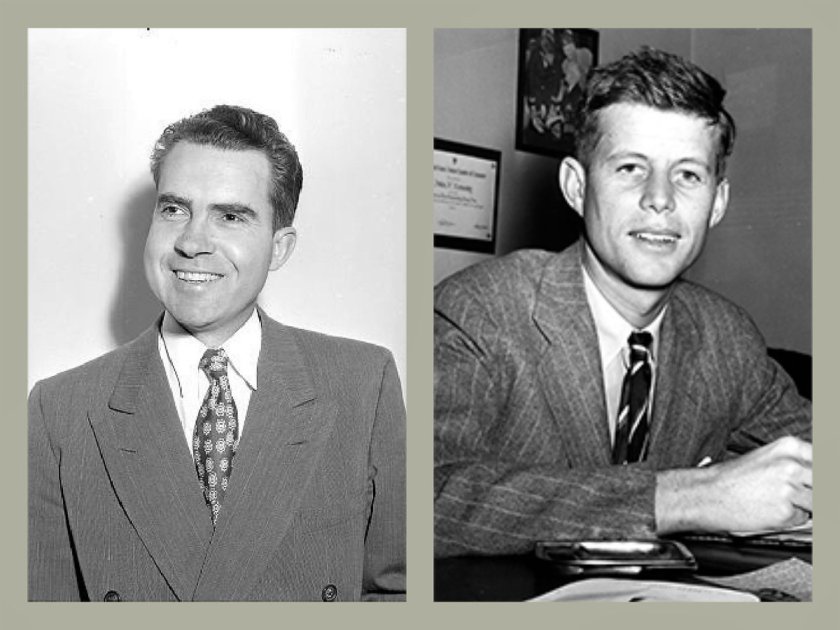
January 3rd is a day that holds special significance for John F. Kennedy. In 1947, it was the day that he was sworn into Congress for the first time as a member of the House of Representatives. On January 3rd in 1960, 13 years later, it was reported that JFK had thrown his hat in the ring to be the next president.

JFK wasn’t the only young Congressman to be sworn in that day in 1947. He was joined by his future political rival Richard Nixon.

jfkrmn
Richard Nixon and John F. Kennedy, circa 1947

Although they would face each other in the bitterly contested election of 1960, Kennedy and Nixon were friendly in the House. According to the 2017 Nixon biography Richard Nixon: The Life by John A. Farrell, the two young congressmen once shared a train car back to D.C. after a cordial debate in West Virginia. They bonded over their passion for international affairs. “Neither one of us was a backslapper,” Nixon wrote later. “He was shy…but it was a shyness born of an instinct that guarded privacy and concealed emotion. I understood these qualities because I shared them.” The Nixons were later invited to attend Jack Kennedy’s wedding.

When Nixon ran for Senate he had the support of the Kennedy clan. According to Farrell’s biography, John Kennedy stopped by Nixon’s office with a check from his father for one thousand dollars. The message? Joseph Kennedy wanted Nixon to win.

By 1960, the two would be rivals. Although Kennedy had followed Nixon to the Senate, Nixon had become Dwight D. Eisenhower’s vice president. While Kennedy finished his Senate term, Nixon spent eight years traveling the world on Ike’s behalf. In 1960 Nixon would argue experience; Kennedy would insist that after eight years of Ike, the country was ready for something new. Kennedy officially announced his candidacy on January 2nd–on January 3rd the announcement made front page news as Kennedy added his name to a growing list of White House-hungry Democrats. A week later, on January 9th, Richard Nixon likewise declared his candidacy.

jfkdeclares

On another January day in 1961, Nixon (the outgoing vice president) would stand behind Kennedy to watch his rival take the oath of office.

inagjfk
January 1961. Nixon is standing behind Kennedy, to the right of the frame

Although the Nixon/Kennedy relationship soured, Nixon later penned a thoughtful note to Jackie Kennedy following her husband’s assassination in Dallas in 1963.

“Dear Jackie

In this tragic hour Pat and I want you to know that our thoughts and prayers are with you. While the hand of fate made Jack and me political opponents I always cherished the fact that we were personal friends from the time we came to the Congress together in 1947…If in the days ahead we could be helpful in any way we shall be honored to be at your command.

Sincerely,
Dick Nixon”

Jackie later replied, thanking Nixon for his note, and writing:

“Dear Mr. Vice President –

I do thank you for your most thoughtful letter –

You two young men – colleagues in Congress – adversaries in 1960 – and now look what has happened – Whoever thought such a hideous thing could happen in this country –…please be consoled by what you already have – your life and your family…

Sincerely

Jacqueline Kennedy”

See full letters here and here


A Brief History of Impeachment

By Kaleena Fraga

Benjamin Franklin noted that throughout history, once political leaders had “rendered [themselves] obnoxious,” the people had no other choice but to assassinate them. Instead, Franklin thought, the Constitution should allow Congress to punish the president when he deserved it, but also give him a trial to prove his innocence.

This week has a couple of significant impeachment anniversaries. First, Bill Clinton was impeached by the House of Representatives on December 19th, 1998. He faced charges of perjury and obstruction of justice related to his affair with White House intern Monica Lewinsky. To the charge of perjury, five Republicans broke from the party and voted against impeachment. However, five Democrats also voted for impeachment. Two other charges–another perjury charge and one abuse of power charge–were defeated.

Clinton would go on to be acquitted in the Senate. A two-thirds majority would have been needed to convict him–the perjury charge was rejected 55 to 45 and the Senate was split 50-50 on obstruction of justicewsj.jpg. Democrats voted together, against impeachment, and they were joined by five Republicans on the obstruction-of-justice charge.
It had been 131 years since a president faced an impeachment hearing–Andrew Johnson was similarly impeached by the House but acquitted by the Senate in 1868. Johnson’s charges were quite different from Clinton’s–the House accused him of violating the Tenure of Office Act–but both men faced Congresses hostile to their presidencies.

In between Johnson and Clinton sits Richard Nixon, who was not impeached but who faced impeachment charges. He resigned before the trial began.

Also on December 19th was the swearing in of Nelson Rockefeller as vice president. Nixon’s vice president, Gerald Ford, had become president when his predecessor chose to resign rather than be impeached. Ford then had the power to appoint his own vice president (pending Senate confirmation) just as Nixon had appointed him when his original vice president, Spiro Agnew, resigned following accusations of corruption and tax fraud.

This must have especially stung for Nixon, who had faced Rocky as a political rival in the 1960 and 1968 elections.

In contentious and politically divided times, the “I” word is often thrown around. Billionaire Tom Steyer is currently offering 10 million dollars to anyone who provides information that leads to Donald Trump’s impeachment. At town halls during the Obama presidency, some Republican leaders agreed with their constituents that Obama should be impeached, but none ever drew up charges against him.

Has the nation treated impeachment as the founders intended? They disagreed on the matter themselves. Many–uncomfortable with the idea of removing an executive from power, as this sort of thing had never been tried with, say, a king–argued that the legislative branch would abuse its power. Elbridge Gerry (of gerrymandering infamy) protested that a good president shouldn’t have to worry about a legislature which honorably represented the people’s interests. “A good magistrate will not fear them,” he said. “A bad one ought to be kept in fear of them.”

RIP George Washington, and the Tradition of Life Masks

By Kaleena Fraga

bust gw
The Houdon bust

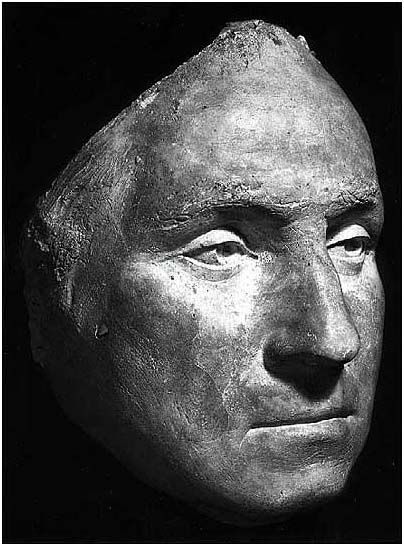
Today, December 14, 2017 is the 218th anniversary of the death of America’s first president, George Washington. At the time, for the many people who loved and admired George Washington, it wouldn’t be the last time they saw his face. Not only had countless portraits been made of the man but he’d also had a life mask made by French sculptor Jean Antoine Houdon. Houdon also created the (perhaps more well known) terracotta bust of Washington.

Washington was reportedly fascinated by the process. Houdon had been brought to Mount Vernon by Thomas Jefferson and Benjamin Franklin, and spent two weeks there to observe Washington’s mannerisms and dress. Although the process was uncomfortable for Washington (it involved lying flat on his back, with two large quills up his nose so he could breathe–read more here) it probably traumatized his young granddaughter Nelly, who walked in on the creation of the mask.

tj life mask
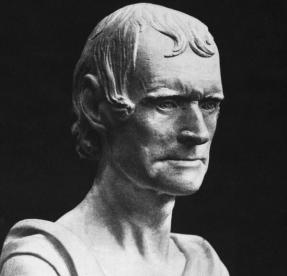
Perhaps this experience is why Jefferson looks so strained

He certainly had a better experience with it than Jefferson, who reportedly almost died while having his own life mask fitted by John H.I. Browere. Browere left the mask on for an hour, instead of the customary twenty minutes. Jefferson, unable to breathe, had to bang his fist against a nearby chair to draw attention to his plight. Afterwards he wrote his friend James Madison:

“I was taken in by Mr. Browere…He was obliged to use freely the mallet and chisel to break [the mask] into pieces and get a piece at a time…I was quite shaken, and there became real danger that the ears would leave from the head sooner than from the plaster.”

Jon Meacham writes (again from his Jefferson biography, Thomas Jefferson: The Art of Power) that it was Jefferson’s butler, Burwell Colbert, who heard the ruckus and alerted Browere. Jefferson, Meacham notes, was saved by a slave.

Interestingly, the life mask of John Adams (Jefferson’s frenemy) was also created by Browere.

The practice didn’t die out after the Founding Fathers’ generation. Abraham Lincoln also underwent the process–twice. The first was done in 1860, the year Lincoln was elected to the presidency, by Leonard Volk. The second was made five years later, in 1865, by Clark Mills. Five hard years–the weight of the presidency, the Civil War, the death of his son, Willie–are clearly etched on his face. Two months after the mask was made, Lincoln would be killed by an assassin’s bullet.

With the invention of the photograph, this style of remembrance has gone out fashion. Celebratory busts and portraits aside, life masks seem to reveal something much more human in these extraordinary men.

Let’s Take a Break and Talk Jefferson

By Kaleena Fraga

Politics lately have been exhausting. So let’s take a break and talk about Thomas Jefferson and his oddities.

monticello
Somewhere in this estate is a floor with a groove

Jefferson liked to wake himself up in the morning by sticking his feet in cold water. He thought this would keep him healthy. Jon Meacham, in his Jefferson biography Thomas Jefferson: The Art of Power, notes that this habit “wore a groove on the floor next to the alcove where he slept.” Since Jefferson lived to be 83 at a time when most men died before 40, maybe he was onto something.

Jefferson kept several mockingbirds as pets. His favorite was called “Dick.” The bird would perch on his shoulder, follow him up the stairs, and sit on his couch while Jefferson napped. Lucia Stanton, a Jefferson scholar, noted that the bird’s name was somewhat disappointing, given Jefferson’s tendency to give his horses more noble names (some highlights: “Allycrocker”, “Peggy Waffington”, “Remus and Romulus”, “Zanga”, Polly Peacham”)

An agrarian at heart, who saw this as the future of the new United States, Jefferson once committed international espionage in order to introduce a superior crop to American soil. As the Minister to France, he saw that Italian rice outsold American rice. Since he believed that, “the greatest service which can be rendered any country is to add an useful plant to it’s [sic] culture,” Jefferson went to Italy and literally put handfuls of the rice in his pockets to bring back to the United States. At the time, such an act was punishable by death.

A less fun fact about Jefferson concerns Sally Hemings. Many know of Jefferson’s relationship with Hemings–if it can be called that, since, as he had all the power and she had none, there really wasn’t a question of consent on her part–but there’s another, fascinating layer to this. Jefferson’s wife, Martha, died when she was 33. He was 39. Martha asked that he never marry again, and Jefferson didn’t. He began his infamous relationship with Hemings instead–Martha’s half sister.


The Presidency & the Power of Nature

By Kaleena Fraga

When considering the power of the presidency in the conservation of nature, Theodore Roosevelt is often the first name that comes to mind. Rightly so. After touring the Grand Canyon in 1903, during a national debate over preserving the land or using it to mine precious medals, he insisted:

“Leave it as it is. The ages have been at work on it, and man can only mar it…Keep it for your children, your children’s children and for all who come after you, as one of the great sights which every American should see.”

He said it would be a tragedy to cut down the great redwoods of California to make decks or porches. To those who advocated progress over preservation, he stated that:

“There is nothing more practical, in the end, than the preservation of beauty, than the preservation of anything that appeals to the higher emotions in mankind.”

TR GC
Roosevelt at the Grand Canyon

Yet we would be remiss to forget Lady Bird Johnson’s legacy of conservation. Although it’s largely a given today that first spouses will work on projects of their own, Lady Bird was the first person to put this into practice. She decided to pursue something that made her “heart sing.” As a little girl, Lady Bird had grown to deeply love the outdoors, and especially the flowers from her native Texas.

Although she’d never particularly liked the term, thinking it too indicative of cosmetics, the project became known as beautification. Writing in her journal in 1965, Lady Bird explained why she thought the project so important: “All the threads are interwoven– recreation and pollution and mental health, and the crime rate, and rapid transit, and highway beautification, and the war on poverty, and parks — national, state and local. It is hard to hitch the conversation into one straight line, because everything leads to something else.”

Lady Bird believed, simply, that people would be happiest surrounded by trees and flowers and greenery (she was right). Lady Bird and Lyndon Johnson took the project national with the Highway Beautification Act–an attempt to clean up the nation’s highways, and take down the billboards. Although watered down, the bill did pass. Lady Bird also focused much of her efforts on cleaning up Washington D.C.

Lady Bird
Lady Bird at the Wildflower Center

After LBJ’s presidency had ended, and after he had died, Lady Bird continued to work on the project. In 1982, Lady Bird started the National Wildflower Researcher Center in Austin, which was renamed the Lady Bird Johnson Wildflower Center on her eighty-fifth birthday. Although it started with Lady Bird’s donation of sixty acres, the Center now stretches across 284 acres and contains more than 800 kinds of native Texas plants.

Preserving nature and protecting federal lands wasn’t always a partisan issue. Theodore Roosevelt was a Republican. Lady Bird and Lyndon Johnson were Democrats. Richard Nixon, whose administration created the EPA, was a Republican. Given that Roosevelt signed the Antiquities Act, which gave the executive the power to protect federal land as a monument, and Lady Bird believed so strongly in the importance of beauty and nature, one has to wonder what they would think about the Trump administration’s decision to reduce the Bear’s Ear Monument by eighty-five percent. Trump, no stranger to unprecedented moments, is the first president to seek to modify a natural monument since the signing of the Antiquities Act in 1906.

Special thanks to Betty Boyd Caroli’s “Lady Bird & Lyndon” and Doris Kearns Goodwin’s “The Bully Pulpt: Theodore Roosevelt and the Golden Age of Journalism” for providing the background for this post.

The 25th Amendment

William H. Harrison on His Death Bed with Visitors
William Henry Harrison, weeks after his inauguration

By Kaleena Fraga

(to listen to this piece in podcast form click here)

Between 1789 and 1967 eight presidents died in office. In 1841, the death of the first president to die in office, William Henry Harrison (a short but tragic tale for another time) raised the question of succession in the event of the executive’s demise. Amidst the confusion, Harrison’s vice president, John Tyler, had to insist that the president’s death meant that he became president, not just “acting president.”

Still, it took the country another one hundred and twenty-six years to formally add an amendment to the constitution outlining the path of succession, and what to do if the president became unable to perform his duties.

It wasn’t as if the question wasn’t raised again–in the time after Harrison’s death until the adoption of the amendment in 1967, four presidents were assassinated, three died in office, and others suffered medical conditions that rendered them incapable to serve. Without clear guidelines, Woodrow Wilson’s stroke made his wife the most powerful woman in America. President Eisenhower, his VP Nixon, and the Attorney General at the time, Herbert Brownell Jr., tried to clarify the procedure after Ike’s heart attack–Nixon would preside over Cabinet meetings when Eisenhower was indisposed, but never assumed power.

ST-1A-1-63
LBJ is sworn in following JFK’s assassination

The issue became more urgent after Kennedy’s assassination in 1963. Given that his death had elevated Lyndon Johnson to the presidency (a man who had a history of heart problems) there was a pressing need to spell out what should happen if LBJ died or became unable to preside as president.

What does the 25th amendment do? Several things.

First, it reaffirms John Tyler’s actions: if the president dies, resigns, or is removed from office, power is transferred to the vice president.

Second, it allows the president to nominate a vice president if the original VP leaves office for whatever reason (this was an issue in 1868 during Andrew Johnson’s impeachment hearing, since he had no vice president. At the time, it was customary to wait for the next election if a VP left office. It was invoked for the first time in 1973, when Spiro Agnew resigned as Nixon’s VP. Nixon nominated Gerald Ford to replace him).

Third, the president can send an official notice to Congress saying he is unable to perform his duties, and another note when he is ready to resume (as in the case of a medical procedure–George W. Bush invoked this section in 2002). In the interim, the vice president has the powers of the president.

Fourth, if the vice president and a majority of the Cabinet or Congress believe that the president is unable to perform his duties, they can remove him from power. This is the only section that has never been invoked.

93 years, 166 days

Last week, President George H.W. Bush became the oldest living president in American history, at 93 years, 166 days old.

He’s beaten Gerald Ford, who died at 93 years, 165 days.

Jimmy Carter, also 93, is 111 days younger than H.W.

Ronald Reagan also lived to be 93.

So far, no president has lived to the ripe age of 94. But quite a few have made it into the 90s, starting with John Adams, who died at the age of 90 in 1826 (meaning he witnessed every presidency between George Washington and his own son, John Quincy Adams). Herbert Hoover also lived into his 90s.

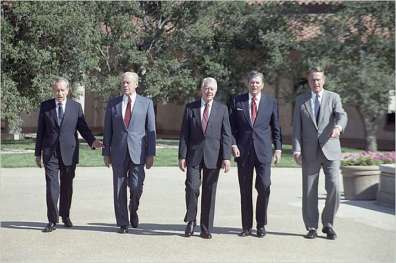
5 pres
Well, we got 5 of them (Nixon, Ford, Carter, Reagan, Bush)

A great tidbit gleaned from this week’s research is this: the greatest number of presidents alive at the same time is six. This has happened four times. The first time was between 1861 and 1862, when Martin Van Buren, John Tyler, Millard Fillmore, Franklin Pierce, James Buchanan, and Abraham Lincoln were alive. The second time was between 1993 and 1994 (when Nixon died). The living presidents for those two years were Nixon, Gerald Ford, Jimmy Carter, Ronald Reagan, George H.W. Bush and Bill Clinton. The third features more or less the same crowd between 2001 and Reagan’s death in 2004–Ford, Carter, Reagan, H.W., Clinton, and George Bush. Today, Carter, H.W., Clinton, Bush, Obama & Trump make up the fourth six.


November 22, 1963

By Kaleena Fraga

Tomorrow, November 22, 2017, is the 54th anniversary of the Jack Kennedy assassination. It’s a tragedy that grabbed the attention of the world and never let go. It’s only this year that hundreds of pages of government files concerning the assassination were released, and more were withheld for security reasons.

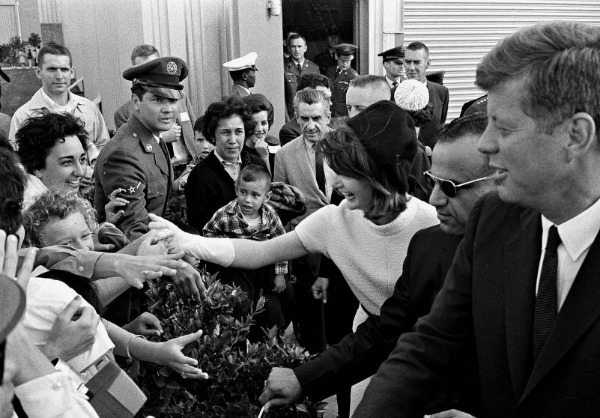
This photo was taken the day before, on November 21, 1963. Kennedy had had a foreboding feeling about the trip, telling a friend that he had, “a terrible feeling,” about visiting Dallas. Kennedy was no stranger to death–he’d lost his brother in WWII, had lost babies, had faced it himself during his bouts of illness. One of his favorite poems was Robert Seeger’s I Have a Rendezvous with Death

In the years after his assassination, many people have cried conspiracy, because how could a nobody like Lee Harvey Oswald murder the president? Yet, in all cases of presidential assassination, the assassin has always been a nobody. James Garfield, Abraham Lincoln, William McKinley, and John F. Kennedy were all killed by nobodies. Other presidents–Andrew Jackson, Gerald Ford, etc.–narrowly escaped the same fate.

Of course, some people thought that Zachary Taylor had been assassinated after he died unexpectedly, but this theory has been largely debunked.

With Oswald’s death, and Jack Ruby’s death, we may never have a definite answer for why JFK was killed on that sunny day in Dallas. He’ll remain a figure of fascination for many years to come. In the meantime the Warren Commission, the first official investigation of his death, makes for some good reading.

Roy Moore, Grover Cleveland, and Morality in American Politics

By Kaleena Fraga

In 2014, the French president François Hollande was photographed visiting his mistresshollande via scooter. The French barely blinked. In the 1990s, when Bill Clinton faced accusations of adultery while in office, the affair consumed the country. For Americans, the private lives of politicians and public officials are often important indications of their character.

Over the past few months, a dam has been breached in American culture and politics concerning sexual harassment, outing powerful figures like Roger Ailes, Kevin Spacey, and Louis C.K. Roy Moore, running for Senate in Alabama, and Al Franken, the current Senator from Minnesota, are the latest public figures to face accusations of sexual impropriety.

While the others can dip out of the spotlight, or “seek treatment,” as many of them have, Moore is facing an election in less than a month. Out of these men, he is the only one who Americans have a chance to judge. For many Alabamans, the choice between Roy Moore, accused by several women of inappropriate behavior when they were children, and Doug Jones, a Democrat, is a choice with no easy out. Representative Mo Brooks of Alabama stated (while being stubbornly pursued by a reporter) that he would still vote for Roy Moore because, “Democrats will do great damage to our country.”
mo brooks.gif
When in history has a candidate’s morality become an issue in an election?

One good example is the campaign of Grover Cleveland in 1884. Cleveland faced accusations of having a baby out of wedlock with a woman named Maria Halpin. When the baby was born, it was put up for adoption and Halpin was committed to a mental asylum–despite doctors there finding nothing especially wrong with her. Halpin said that their encounter had not been consensual, that he’d put the baby up for adoption, and forced her into the hospital.

Ma_ma_wheres_my_paCleveland claimed that the paternity was uncertain; his supporters dismissed the allegations as “boys being boys” although in 1884, Cleveland was 47 years old. Republicans reveled in this, and would gather to chant “Ma, ma, where’s my pa?” at Cleveland rallies.

But the Republicans had problems of their own. Although Cleveland was morally problematic, his opponent, Republican James Blaine, had been roasted over the public coals for his corruption concerning the nation’s railroads. The choice, then, was whether the voters wanted a man who had corrupt morals, or one who was just corrupt.

Cleveland narrowly defeated Blaine, becoming the first Democrat since the Civil War to be elected president. Victorious Democrats answered Republican’s taunts with, “Off to the White House, ha, ha, ha!”

There’s no evidence that Doug Jones is corrupt as Blaine was, but the anecdote does suggest that a candidate, even one as problematic as Moore, could be elected. Especially if some voters in Alabama see electing a Democrat as just as bad, if not worse, than someone accused of sexually harassing young girls.