
By Kaleena Fraga
Talk of impeaching Andrew Johnson began even before his ill-fated presidency.
When Johnson was first sworn in as Abraham Lincoln’s vice president in 1865, he rewarded onlookers to a drunken tirade about his “Plebeian roots” and how he had triumphed over the ruling elite. Senators in attendance covered their faces with embarrassment–Lincoln’s former vice president, Hannibal Hamlin tugged at Johnson’s coattails in a vain attempt to get him to sit down, while the president looked on with an expression of “unutterable sorrow.” A group of Radical Republicans promptly drafted a resolution demanding that Johnson resign, or be impeached.
Johnson survived the demand. Lincoln came to his defense, saying, “It has been a severe lesson for Andy, but I do not think he will do it again.”
A little over a month later, Lincoln was dead–the first president to be assassinated–launching Andrew Johnson, a Democrat, into the presidency just as the Civil War drew to a close.
Although Republicans in Congress had had high hopes for Johnson–after all, he remained loyal to the Union, even though he hailed from Tennessee–they quickly found that he did not intend to reform the South, but rather sought to reinforce old power structures. Johnson got to work choosing conservatives as state governors and issuing pardons to white southerners. He was lenient toward the Southern ruling class, and dismissive and hateful toward newly freed black Americans. “This is a country for white men,” he once declared, “and by God, as long as I am president, it shall be a government for white men.” Before long, the relationship between the new president and Congress became contentious.
As racial violence flared in the South, the Republican Congress, increasingly distrustful of Johnson’s willingness to interfere, passed the Tenure of Office Act. The act was meant to protect members of Lincoln’s Cabinet, whom Johnson had retained when he took over the presidency. The law prohibited the president from removing any officials that had been confirmed by the Senate, without the Senate’s approval. It especially sought to protect the Secretary of War, Edwin Stanton, who had close ties to Radical Republicans in Congress.
When Johnson tried to remove Stanton, Congress responded with articles of impeachment. Nine of the eleven articles related to the Tenure of Office Act–others related to Johnson’s “attempt to bring into disgrace, ridicule, hatred, contempt and reproach, the Congress of the United States…to impair and destroy the regard and respect of all the good people of the United States for the Congress…and to excite the odium and resentment of all good people of the United States against Congress.”
Ultimately the Tenure of Office Act was unclear enough-after all, Stanton had been appointed and confirmed under Lincoln-that Johnson escaped impeachment by one vote.
What does Andrew Johnson have to do with Donald Trump? Aside from sharing several characteristics, recent actions by Congress could put Trump in the same position as Johnson, when Johnson faced impeachment charges.
In the wake of Trump’s decision to revoke security credentials from the former CIA Director John Brennan, Senator Mark Warner has announced his intention of introducing a bill that would bar the president from “arbitrarily revoking security clearances.” The amendment is unlikely to pass–at least as long as Republicans control Congress. Yet, if midterms bring a political shift to Washington D.C. it’s not implausible that such legislation would be revisited.
If that were the case, and if Trump continued to use the revocation of security clearances as a way to punish his critics, he would find himself in the same position as Andrew Johnson–breaking a law set by Congress meant to control him (not to mention Trump has the whole insulting Congress thing in the bag).
For now, at least, it’s a lot of ifs. Still, if Trump finds himself facing a hostile Congress, as Johnson did, it’s not out of the realm of possibility that he would face a similar outcome.
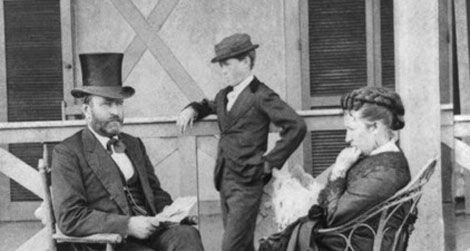
 Their first meeting was auspicious. In his biography of her husband, Ron Chernow writes that it became family lore among the Dents. In their telling, Julia Grant paid a courtesy call on Mary Lincoln, only to find that the First Lady “expected [Julia] to treat her like royalty.” Mary Lincoln is infamous for her wild rages, but she had special reasons to dislike the Grants–she suspected that Ulysses S. Grant wanted her husband’s job, and he had allowed her son Robert to join him as an aide-de-camp, against her wishes.
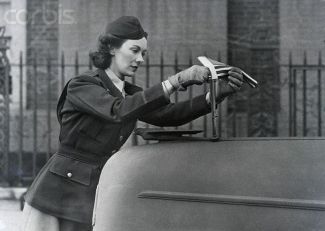 On the night before the invasion Ike waited with his personal chauffeur (and rumored mistress) Kay Summersby, who noted that the General’s “eyes were bloodshot, and he was so tired that his hands shook when he lit a cigarette.” Still, she wrote, “if Ike had wished, he could have been [with] Churchill…[and] de Gaulle…who were gathered just a few miles away in Portsmouth. But he preferred to wait in solitude.”
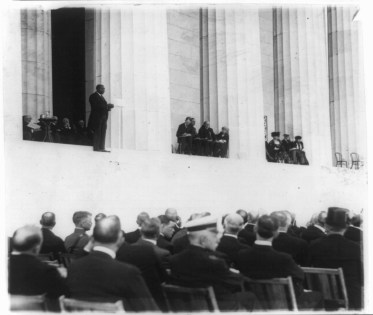 Dr. Robert Moton, a civil rights activist, gave the keynote address. Although he


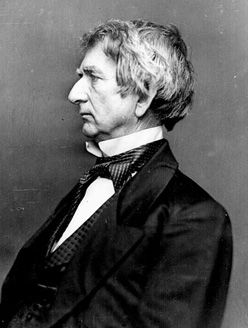


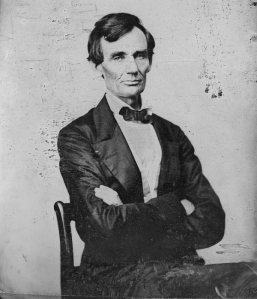 Lincoln wasn’t exactly smitten with Mary Todd. After they got engaged, Lincoln had second thoughts and he tried to get out of their engagement. Several of Lincoln’s friends recollected his misgivings about Mary, which Michael Burlingame documented in his book
  General Ulysses S. Grant at his first appearance in Washington, D.C. as the top general in the Union army. That reception, a journalist noted, was the first time Abraham Lincoln wasn’t the center of attention in the East Room. Grant was elected president in the first election after Lincoln’s assassination. He might have been assassinated with Lincoln on April 14, 1865, if Mary Todd Lincoln hadn’t thrown a tantrum a few weeks earlier in front of Grant’s wife Julia Dent Grant. Even though the morning newspaper reported that the Lincolns and the Grants would attend a showing of
 Racial violence perpetrated both sides of the conflict. That year, the Democratic Party ran a racist, anti-war campaign, warning that emancipation meant black people would move North in droves and force whites out of their homes. “The Constitution as it is, the Union as it was, and the negroes where they are,” was their campaign slogan. Democrats gained 34 seats in the House of Representatives, won gubernatorial races in New York and New Jersey, and won control of several state legislatures. In 1863, Horatio Seymour, the Democratic governor of New York, said, “I assure you I am your friend,” to anti-draft rioters who had lynched black doormen and burned down the Colored Orphan Asylum in New York City.
  letter to Lincoln, “I have given the subject of arming the negro my hearty support. This, with the emancipation of the negro, is the heavyest blow yet given to the Confederacy … by arming the negro we have added a powerful ally. They will make good soldiers and taking them from the enemy weakens him in the same proportion they strengthen us. I am therefore most decidedly in favor of pushing this policy to the enlistment of a force sufficient to hold all the South falling into our hands and to aid in capturing more.”
 Lincoln’s second inauguration happened on March 4, 1865, when Union victory was imminent. He closed his Second Inaugural Address by extending an olive branch to the defeated Confederates and looking ahead to Reconstruction: “With malice toward none; with charity for all; with firmness in the right, as God gives us to see the right, let us strive on to finish the work we are in; to bind up the nation’s wounds; to care for him who shall have borne the battle, and for his widow, and his orphan—to do all which may achieve and cherish a just, and lasting peace among ourselves, and with all nations.”
 History First