Washington and the Myth of Wooden Teeth

By Kaleena Fraga

(to listen to this piece in podcast form click here)

Today is George Washington’s 286th birthday. Name a fact–any fact about him. First president? Revolutionary War general? Something about a cherry tree? Wooden teeth?

Of the many myths surrounding Washington, the one about his teeth is among the most popular. In reality, Washington never had wooden teeth. But he did have dental problems, lots of them, requiring the use of dentures for a good chunk of his adult life. Rather than wooden teeth, however, as Ron Chernow writes in his Washington biography, Washington: A Life, most of the teeth in his dentures were likely made from walrus or elephant ivory. Chernow postulates that the myth arose from the “gradual staining of hairline fractures in the ivory that made it resemble a wood grain.” Washington also used several of his own pulled teeth in his dentures, and there’s documentation of his purchase of teeth from slaves (a grotesque, but common practice in the 18th century).

1789_GeorgeWashington_byChristianGullager

Washington found his dental problems highly embarrassing. They made his lips stick out, and made it hard for him to speak. The fake teeth often became discolored, once so much that Washington sent them to his dentist, John Greenwood for repair. Greenwood noted that they had turned black–possibly because the president drank so much port wine. That Washington felt so self-conscious about his teeth may explain his solemn look in most of his portraits.

Washington’s dental ordeals sound terrible–both painful and embarrassing, especially for someone who, as president and as a beloved public figure, was expected to entertain guests and speak publicly. His wife, Martha, also suffered from dental problems and both of them eventually wore dentures. Martha encouraged her grandchildren to invest in toothbrushes and cleansing powders to avoid the turmoil that she and her husband endured over their teeth.

By the time he became president, Washington had only one natural tooth remaining. When this tooth had to be pulled, Washington gifted it to his dentist, Greenwood. Greenwood originally drilled a hole through the tooth and tied it to his watch chain. He became worried it would break, and transferred it to a locket. On the locket is inscribed: “In New York 1790, Jn Greenwood made Pres Geo Washington a whole sett of teeth. The enclosed tooth is the last one which grew in his head.”

For those curious to see Washington’s smile in person, Mount Vernon has his dentures–the only full set in existence.

Please Pose, Mr. President: A Brief History of Presidential Portraits

By Kaleena Fraga

Yesterday, President Barack Obama and First Lady Michelle Obama’s portraits were unveiled for the first time. Suffice to say, they’ll stand out. Barack Obama was painted sitting with an intense look in his eyes, against a backdrop of bright green leaves and flowers. Among other presidential portraits, which have been more traditionally done, it will certainly draw the eye. Both portraits were painted by black artists, Kehinde Wiley and Amy Sherald–the first to do so.

The Obama portraits themselves are not the only thing that stood out about the unveiling. They were presented at the Smithsonian’s National Portrait Gallery, where many presidents’ portraits are hung. This in itself isn’t unusual. But over the last couple of decades, the unveiling seems to have traditionally taken place at the White House.

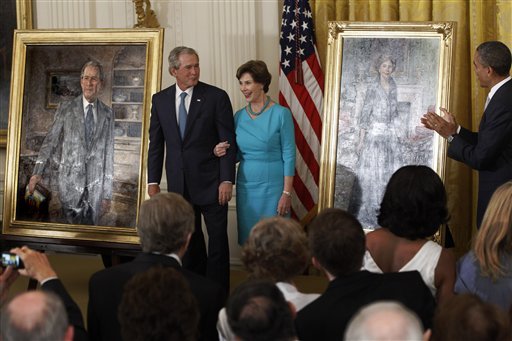
In 2012, George W. Bush and Laura Bush were invited back to the White House for the bush portraitunveiling of their official portraits. Bush’s father and fellow president George H.W. Bush tagged along too. It was a light hearted occasion, with friendly barbs on both sides.
Likewise, Bill and Hillary Clinton returned to the White House for the first time in 2004 to participate in the unveiling of their official portraits, which would hang in the White House. (Clinton also attended an unveiling at the Smithsonian in 2006, for a portrait that would hang in the museum). It was during this unveiling that President Bush remarked that the portrait of Hillary Clinton, then in the U.S. Senate, would be the only portrait of a sitting senator hanging in the White House.

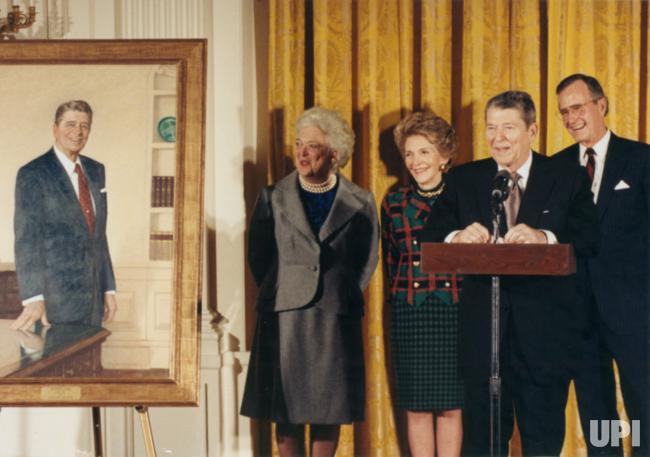
reagan portraitIn 1989, Ronald and Nancy Reagan were invited to the White House for the unveiling of their official portraits. Reagan remarked in his diary that there was “a feeling that [my portrait] could be better. Even the artist, Shikler feels that way & is going to make some changes.” Indeed, Reagan’s portrait was later replaced.

Controversy around a presidential portrait then, is nothing new, including from the subject himself.

Teddy Roosevelt reportedly destroyed the first version of his official portrait, tr portraitbecause he thought it made him look like a “mewing cat.” The second painter he hired, John Singer Sargent, found him to be a difficult subject. After the two had tried several different rooms on the first floor, Roosevelt accused Sargent of not knowing what he wanted as they walked up the stairs to the second. Sargent responded that Roosevelt didn’t know how to pose for a portrait. Roosevelt swung around, gripping the bannister, and said, “Don’t I?” The rest is history.

Lyndon Johnson–surprising no one–also had difficulty getting along with his portrait artist, Peter Hurd. He called Hurd’s first attempt “the ugliest thing I ever saw.” When Hurd felt he needed more time, Johnson informed him that Norman Rockwell had been able to complete a portrait of him in 20 minutes. Hurd got his revenge. He gave the first portrait, the one Johnson had hated, to the National Portrait Gallery. It was later replaced.

There has also been a fair amount of symbolism in presidential portraits. The flowers in the bush behind Obama in his portrait represent his life path–they are from cities and countries from around the world where he has lived. Artist Elaine de Kooning depicted John F. Kennedy sitting awkwardly in a chair–a quiet nod to the back problems he suffered from for most of his life. In 2015, Bill Clinton’s portrait artist Nelson Shanks admitted he’d included symbolism of Monica Lewinsky’s infamous blue dress in his painting of the former president. This portrait, according to the Smithsonian, has been “rotated out of view,” and replaced with a portrait of Clinton by artist Chuck Close.

The Obamas’ portraits are colorful, playful, and stand apart from the serious presidential portraits that most Americans are used to seeing. That the unveiling took place away from the White House seems to be a subtle nod to the rocky history between Obama and the current president, Donald Trump. Still, in other ways the portraits follow the unveiling tradition–they caused some controversy, and Barack Obama’s includes symbols of his path to the presidency. At the end of the day, both will be hung in the National Portrait Gallery, among the presidents and first ladies of days past.