A Brief History of Impeachment

By Kaleena Fraga

Benjamin Franklin noted that throughout history, once political leaders had “rendered [themselves] obnoxious,” the people had no other choice but to assassinate them. Instead, Franklin thought, the Constitution should allow Congress to punish the president when he deserved it, but also give him a trial to prove his innocence.

This week has a couple of significant impeachment anniversaries. First, Bill Clinton was impeached by the House of Representatives on December 19th, 1998. He faced charges of perjury and obstruction of justice related to his affair with White House intern Monica Lewinsky. To the charge of perjury, five Republicans broke from the party and voted against impeachment. However, five Democrats also voted for impeachment. Two other charges–another perjury charge and one abuse of power charge–were defeated.

Clinton would go on to be acquitted in the Senate. A two-thirds majority would have been needed to convict him–the perjury charge was rejected 55 to 45 and the Senate was split 50-50 on obstruction of justicewsj.jpg. Democrats voted together, against impeachment, and they were joined by five Republicans on the obstruction-of-justice charge.
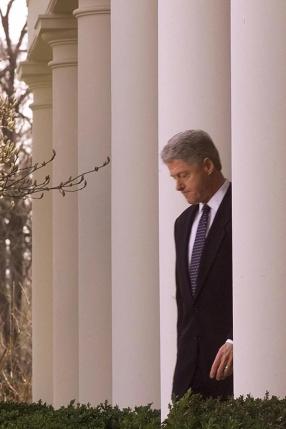
It had been 131 years since a president faced an impeachment hearing–Andrew Johnson was similarly impeached by the House but acquitted by the Senate in 1868. Johnson’s charges were quite different from Clinton’s–the House accused him of violating the Tenure of Office Act–but both men faced Congresses hostile to their presidencies.

In between Johnson and Clinton sits Richard Nixon, who was not impeached but who faced impeachment charges. He resigned before the trial began.

Also on December 19th was the swearing in of Nelson Rockefeller as vice president. Nixon’s vice president, Gerald Ford, had become president when his predecessor chose to resign rather than be impeached. Ford then had the power to appoint his own vice president (pending Senate confirmation) just as Nixon had appointed him when his original vice president, Spiro Agnew, resigned following accusations of corruption and tax fraud.

This must have especially stung for Nixon, who had faced Rocky as a political rival in the 1960 and 1968 elections.

In contentious and politically divided times, the “I” word is often thrown around. Billionaire Tom Steyer is currently offering 10 million dollars to anyone who provides information that leads to Donald Trump’s impeachment. At town halls during the Obama presidency, some Republican leaders agreed with their constituents that Obama should be impeached, but none ever drew up charges against him.

Has the nation treated impeachment as the founders intended? They disagreed on the matter themselves. Many–uncomfortable with the idea of removing an executive from power, as this sort of thing had never been tried with, say, a king–argued that the legislative branch would abuse its power. Elbridge Gerry (of gerrymandering infamy) protested that a good president shouldn’t have to worry about a legislature which honorably represented the people’s interests. “A good magistrate will not fear them,” he said. “A bad one ought to be kept in fear of them.”
RIP George Washington, and the Tradition of Life Masks

By Kaleena Fraga

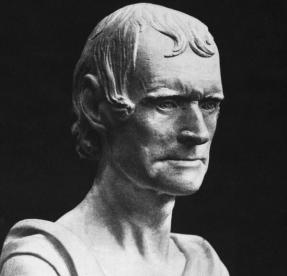
bust gw
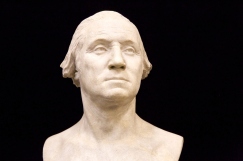
The Houdon bust

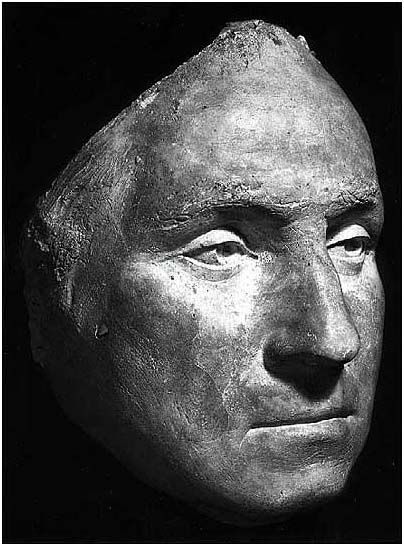
Today, December 14, 2017 is the 218th anniversary of the death of America’s first president, George Washington. At the time, for the many people who loved and admired George Washington, it wouldn’t be the last time they saw his face. Not only had countless portraits been made of the man but he’d also had a life mask made by French sculptor Jean Antoine Houdon. Houdon also created the (perhaps more well known) terracotta bust of Washington.

Washington was reportedly fascinated by the process. Houdon had been brought to Mount Vernon by Thomas Jefferson and Benjamin Franklin, and spent two weeks there to observe Washington’s mannerisms and dress. Although the process was uncomfortable for Washington (it involved lying flat on his back, with two large quills up his nose so he could breathe–read more here) it probably traumatized his young granddaughter Nelly, who walked in on the creation of the mask.

tj life mask
Perhaps this experience is why Jefferson looks so strained

He certainly had a better experience with it than Jefferson, who reportedly almost died while having his own life mask fitted by John H.I. Browere. Browere left the mask on for an hour, instead of the customary twenty minutes. Jefferson, unable to breathe, had to bang his fist against a nearby chair to draw attention to his plight. Afterwards he wrote his friend James Madison:

“I was taken in by Mr. Browere…He was obliged to use freely the mallet and chisel to break [the mask] into pieces and get a piece at a time…I was quite shaken, and there became real danger that the ears would leave from the head sooner than from the plaster.”

Jon Meacham writes (again from his Jefferson biography, Thomas Jefferson: The Art of Power) that it was Jefferson’s butler, Burwell Colbert, who heard the ruckus and alerted Browere. Jefferson, Meacham notes, was saved by a slave.

Interestingly, the life mask of John Adams (Jefferson’s frenemy) was also created by Browere.

The practice didn’t die out after the Founding Fathers’ generation. Abraham Lincoln also underwent the process–twice. The first was done in 1860, the year Lincoln was elected to the presidency, by Leonard Volk. The second was made five years later, in 1865, by Clark Mills. Five hard years–the weight of the presidency, the Civil War, the death of his son, Willie–are clearly etched on his face. Two months after the mask was made, Lincoln would be killed by an assassin’s bullet.

With the invention of the photograph, this style of remembrance has gone out fashion. Celebratory busts and portraits aside, life masks seem to reveal something much more human in these extraordinary men.

November 22, 1963

By Kaleena Fraga

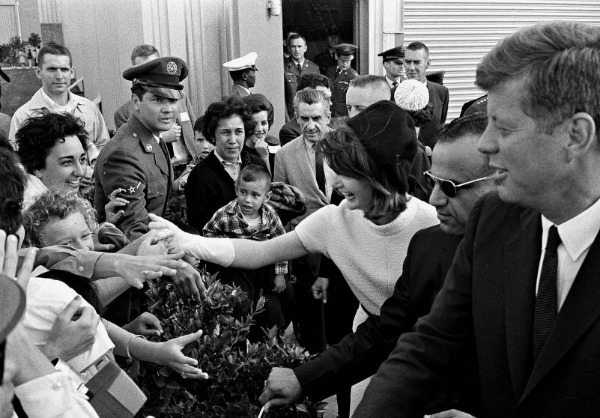
Tomorrow, November 22, 2017, is the 54th anniversary of the Jack Kennedy assassination. It’s a tragedy that grabbed the attention of the world and never let go. It’s only this year that hundreds of pages of government files concerning the assassination were released, and more were withheld for security reasons.

This photo was taken the day before, on November 21, 1963. Kennedy had had a foreboding feeling about the trip, telling a friend that he had, “a terrible feeling,” about visiting Dallas. Kennedy was no stranger to death–he’d lost his brother in WWII, had lost babies, had faced it himself during his bouts of illness. One of his favorite poems was Robert Seeger’s I Have a Rendezvous with Death

In the years after his assassination, many people have cried conspiracy, because how could a nobody like Lee Harvey Oswald murder the president? Yet, in all cases of presidential assassination, the assassin has always been a nobody. James Garfield, Abraham Lincoln, William McKinley, and John F. Kennedy were all killed by nobodies. Other presidents–Andrew Jackson, Gerald Ford, etc.–narrowly escaped the same fate.

Of course, some people thought that Zachary Taylor had been assassinated after he died unexpectedly, but this theory has been largely debunked.

With Oswald’s death, and Jack Ruby’s death, we may never have a definite answer for why JFK was killed on that sunny day in Dallas. He’ll remain a figure of fascination for many years to come. In the meantime the Warren Commission, the first official investigation of his death, makes for some good reading.

Happy 282nd Birthday John Adams!

By Kaleena Fraga

Yesterday, October 30th, 2017, was John Adams’ 282nd birthday. Adams was born in Quincy, MA and was a key figure in the American Revolution and the aftermath–he played an important role in the Continental Congress, worked with allies abroad during the war, and served as the nation’s first vice president and second president.

Adams is the only Founding Father to have never owned slaves; he is also the only one without a monument in Washington D.C.

Adams was known for his intelligence and vanity. He had a quick wit and wasn’t afraid to lash out (unlike his counterparts–who were often more strategic and sly, penning anonymous op-eds or communicating their feelings through friends–Adams couldn’t resist letting his feelings be known).

Adams’ family is remarkable as well–his wife, Abigail Adams, was as quick with a quill if not quicker than her husband. Their son, John Quincy Adams, went on to be president himself. JQA is also debatably the most intelligent of the presidents

John Adams made plenty of enemies as president, including his vice president and former friend, Thomas Jefferson. The two men, however, later reconciled in their old age. They died on the same day, July 4th, 1826.

That Was Close: TR, Jackson, & Would-Be Assassins

By Kaleena Fraga

A handful of American presidents have been assassinated while in office–Garfield, Lincoln, McKinley, and Kennedy. More, however, have survived attempts on their life–often in stunning ways.

Andrew Jackson, known today perhaps because of the controversy surrounding his place in history (and on the twenty dollar bill), was no less polarizing as president. He holds the dubious honor of being the first president to experience an attempt on his life. Jackson was leaving a funeral at the Capitol building when his would-be assassin, Richard Lawrence, ran up to him and shot his gun–but the gun misfired. Jackson, never one to back down from a fight (it was Jackson who said, “I was born for the storm; calm does not suit me”) began to beat Lawrence with his walking cane. Lawrence pulled out a second pistol but–incredibly–this gun also misfired. Experts later claimed that the odds of both guns misfiring were 1 in 125,000.

Approximately 105 years ago, on October 14, 1912, Teddy Roosevelt also survived an assassin’s bullet. Roosevelt was campaigning for president, having decided to run for a non-consecutive third term against his former friend and the incumbent Republican president, William Howard Taft. Arriving at a campaign event, Roosevelt was making his way through the crowd when John Schrank fired. Roosevelt was knocked down, but he struggled back to his feet and asked that the man–apprehended by his stenographer–be brought over. Roosevelt looked his would-be killer in the eyes and asked, “What’d you do it for?” When he got no response, he said,”Oh what’s the use. Take him away.”

teddy's papers
TR’s speech

Although his staff wanted him to go immediately to the hospital, Roosevelt insisted on giving his planned speech, since he could breathe fine and he wasn’t coughing up any blood. To the audience, Roosevelt announced that he’d just survived an assassination attempt but that “it takes more than that to kill a bull moose!” He withdrew his speech–fifty pages of thick paper, folded in half, from his breast pocket. Although Roosevelt had escaped the incident (mostly) unscathed, the speech had not. It, and an eyeglass holder, had deflected the bullet from hitting Roosevelt in the heart.

Spiro, We Hardly Knew Ye

By Kaleena Fraga

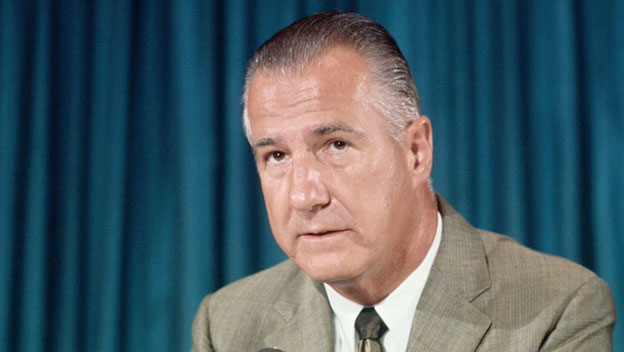
On this day in 1973, Spiro Agnew, VP to Richard Nixon, resigned in disgrace. He was the first vice president to do so.

Vice presidents are rarely remembered, but Agnew’s resignation had consequences because of what happened next. Gerald Ford was nominated by Nixon to fill the post vacated by Agnew because he was seen as well-liked and honest (Agnew, on the other hand, had been caught taking bribes). Both men might have remained footnotes of history had Richard Nixon not resigned less than a year later. Thus Gerald Ford because the first unelected president in American history.

If our friend Spiro had never been caught (or if he’d done his taxes), he could have become president in 1974.

Truman & the Television

By Kaleena Fraga

Last week marked the anniversary of the first televised presidential debate (September 26, 1960) between Richard Nixon and John F. Kennedy. This is a moment that gets the most attention–it arguably altered American politics forever by bringing in a new level of stakes for candidates. Image became paramount. It’s an oft repeated anecdote that while radio listeners gave the debate to Nixon, television viewers awarded it to Kennedy. Any observers of the 2016 election would likely agree that the fever pitch around the debates (especially during the primaries) is indicative of the importance of image in today’s political culture.

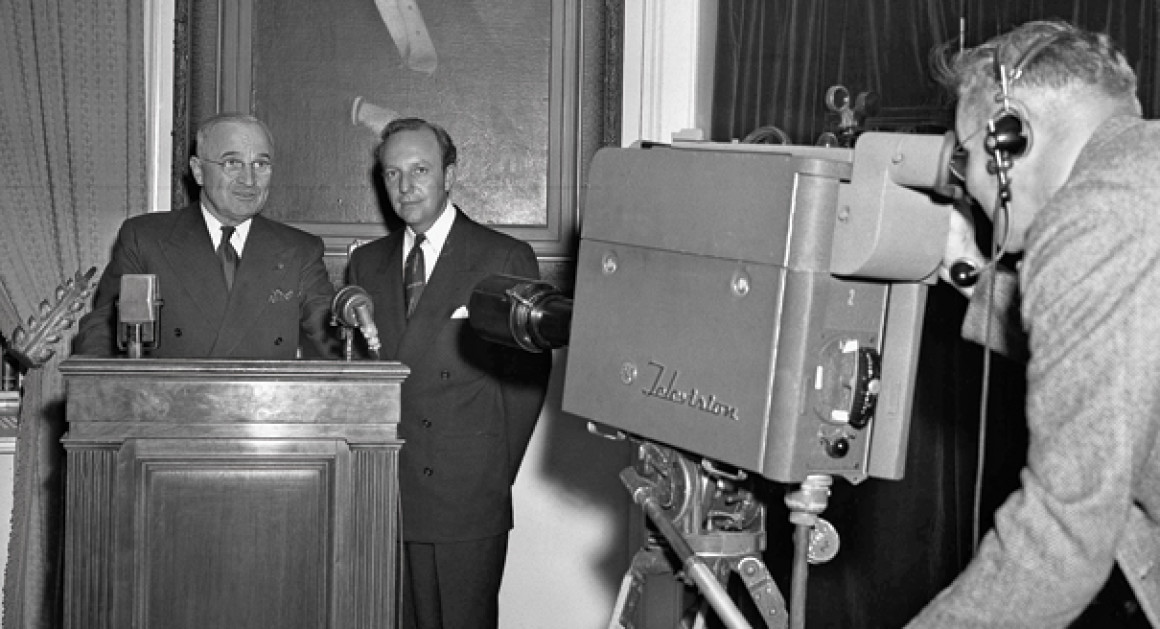
But the real television trailblazer is Harry S Truman, who on this day (October 5th, 1947) gave the first televised address by a U.S. president. Pre-Marshall Plan, Truman was appealing to his fellow Americans to help support war-torn Europe by not eating meat on Tuesdays, not eating chicken on Thursdays, and to eat less bread.

Truman didn’t have a large audience–the television itself was still something of a commodity. But he seemed to have faith in the medium–the rest of his White House speeches were all televised.

TRUMAN
Truman’s televised inauguration in 1949

He also was the first president to have his inauguration televised. We can only speculate on what a Truman-Dewey debate might have been like!

(Thanks to “Truman” by my fave David McCullough)


Chester A. Arthur Becomes President

By Kaleena Fraga

On this day: 

On this day in 1881 Chester A. Arthur became president after James Garfield succumbed to wounds from an assassin’s bullet. The shot itself didn’t kill Garfield–sloppy medical care resulted in the infection that ended his life.

The assassin, Charles J. Guiteau, argued before the judge that he should not be hanged for murder, since it wasn’t his bullet that killed President Garfield. He declared: “The doctors killed Garfield, I just shot him.”

We probably hear most about Chester A. Arthur through frequent NYT Crossword clues about his middle name (Alan!) but there is a new biography coming out that should shed some light on this largely forgotten (and accidental) president.

The First Cornerstone

By Kaleena Fraga

On this day: 

On this day in 1793, George Washington laid the first cornerstone for what would become the U.S. Capitol building.

The exact location of this stone has been lost to time.

When the White House was renovated in the 1950s, many of its bricks were found to have Masonic symbols. Washington is one of many prominent Masons who have held power throughout American history.