
By Kaleena Fraga
Benjamin Franklin noted that throughout history, once political leaders had “rendered [themselves] obnoxious,” the people had no other choice but to assassinate them. Instead, Franklin thought, the Constitution should allow Congress to punish the president when he deserved it, but also give him a trial to prove his innocence.
This week has a couple of significant impeachment anniversaries. First, Bill Clinton was impeached by the House of Representatives on December 19th, 1998. He faced charges of perjury and obstruction of justice related to his affair with White House intern Monica Lewinsky. To the charge of perjury, five Republicans broke from the party and voted against impeachment. However, five Democrats also voted for impeachment. Two other charges–another perjury charge and one abuse of power charge–were defeated.
Clinton would go on to be acquitted in the Senate. A two-thirds majority would have been needed to convict him–the perjury charge was rejected 55 to 45 and the Senate was split 50-50 on obstruction of justice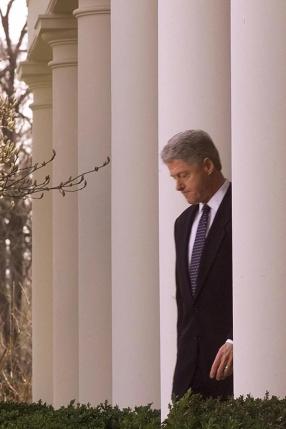 . Democrats voted together, against impeachment, and they were joined by five Republicans on the obstruction-of-justice charge.
It had been 131 years since a president faced an impeachment hearing–Andrew Johnson was similarly impeached by the House but acquitted by the Senate in 1868. Johnson’s charges were quite different from Clinton’s–the House accused him of violating the Tenure of Office Act–but both men faced Congresses hostile to their presidencies.
In between Johnson and Clinton sits Richard Nixon, who was not impeached but who faced impeachment charges. He resigned before the trial began.
Also on December 19th was the swearing in of Nelson Rockefeller as vice president. Nixon’s vice president, Gerald Ford, had become president when his predecessor chose to resign rather than be impeached. Ford then had the power to appoint his own vice president (pending Senate confirmation) just as Nixon had appointed him when his original vice president, Spiro Agnew, resigned following accusations of corruption and tax fraud.
This must have especially stung for Nixon, who had faced Rocky as a political rival in the 1960 and 1968 elections.
In contentious and politically divided times, the “I” word is often thrown around. Billionaire Tom Steyer is currently offering 10 million dollars to anyone who provides information that leads to Donald Trump’s impeachment. At town halls during the Obama presidency, some Republican leaders agreed with their constituents that Obama should be impeached, but none ever drew up charges against him.
Has the nation treated impeachment as the founders intended? They disagreed on the matter themselves. Many–uncomfortable with the idea of removing an executive from power, as this sort of thing had never been tried with, say, a king–argued that the legislative branch would abuse its power. Elbridge Gerry (of gerrymandering infamy) protested that a good president shouldn’t have to worry about a legislature which honorably represented the people’s interests. “A good magistrate will not fear them,” he said. “A bad one ought to be kept in fear of them.”




 History First