
By Kaleena Fraga
Some of you may know that I’ve started a podcast with a former colleague of mine. Yesterday in Travel focuses on moments in travel history—but there’s quite a bit of overlap with what we like to discuss here at History First.
In our last episode, my co-host and I discussed President Obama’s 2016 trip to Cuba. As part of our discussion, we touched on Calvin Coolidge’s 1928 trip to Cuba and man—that’s a fantastic story.
Today, we’re going to delve into Coolidge’s 1928 trip. At the time, it seemed like a rather serene affair. The wild truth about the trip didn’t come out until decades later.
Why did Calvin Coolidge go to Cuba?
Thirty years before Calvin Coolidge visited Cuba, Theodore Roosevelt charged up San Juan Hill during the Spanish-American War in 1898. Since then, the United States, empowered by the Platt Amendment, reserved the right to intervene in Cuban affairs. (The 1903 amendment also leased Guantanamo Bay to the Americans.)
By 1928, attitudes toward the Americans had soured. Even Coolidge, who expressed little interest in foreign affairs, recognized the need for action. His term in office lasted between 1923 and 1929—a lull of a decade between WWI and WWII—and many of the foreign affair issues of the day had to do with American intervention in Latin America. (Coolidge himself had only left the country once before—for his honeymoon in Canada.)
Coolidge went to Cuba in 1928 to attend the Pan American Conference in Havana. The president and his entourage sought to persuade delegates away from passing anti-U.S. resolutions. Many Latin American countries critiqued American military interventions in places like Panama, Honduras, Nicaragua, and Haiti, and Coolidge wanted to keep the peace. (This was not helped by the fact that Coolidge ordered an invasion of Nicaragua as he prepared to depart for Cuba.)
In Cuba, Coolidge extended an olive branch. He emphasized—in an attempt to quell criticism—that all the countries in the Pan American conference were equal. Coolidge focused on “peace and goodwill” in his public remarks—although he arrived in Cuba on a massive WWI battleship called Texas.
Overall, Coolidge saw the trip to Cuba as a way to begin a campaign for world peace. The ensuing Kellogg-Briand Pact, a worldwide peace treaty that banned war, hoped to avoid the violence of WWI in the future. Of course, sadly, the world leaped into the bloody conflict of WWII not soon after the Pact was created in 1928.
What happened during the trip to Cuba?
If you read the newspapers of the day, you would have the impression that a serious president had conducted his serious mission, seriously. After all, this was a serious time, right in the apex of the Prohibition era in the United States—not that Coolidge was much of a drinker.
But thirty years after the trip, one of the traveling members of the press revealed that Coolidge’s trip to Cuba wasn’t the stodgy affair that it had seemed in the papers. Beverly Smith Jr. had accompanied the president as a reporter for the New York Herald Tribune. In 1958, he revealed that much of the trip never made the papers.
The 6 day junket to Cuba and return had in it elements of pageantry, drama, comedy, and farce…it became, in its latter stages, a large scale smuggling operation. The whole show took on a special illicit zest because it was conducted under the dour, dead-pan aegis of President Coolidge—Silent Cal, Cautious Cal, austere symbol of the old Puritan virtues, staunch upholder of the Prohibition Amendment.
Beverly Smith, Jr.
The trip got wild from the get-go. Once the party traveling with the president arrived in Key West, they quickly realized that—despite the strict state of Prohibition around the country—alcohol still flowed freely in the bars of this Floridian city.
The president went to bed at a respectful hour. After all, people called him “Silent” Cal not “Fun” Cal. (Someone—perhaps Alice Roosevelt Longworth, although she later denied it—once described Calvin Coolidge as having the expression of a man “who has been weaned on a pickle.”)
When Coolidge’s secretary announced that the president had gone to bed, the party began. “With these words,” Smith wrote thirty years later, “the dignity of the tour began to crack. It was as though mice had been informed that the cat was away.”
The party lasted all night, with many people stumbling home in the wee hours of the morning. The next day, one reporter was so drunk that he fell into the ocean while boarding the ship to Cuba. Smith, looking back, noted that at the time many Americans saw it as their patriotic duty to “[sluice] down any drinks within reach.” Clearly, the traveling press corp felt up to this particular patriotic challenge.
Once the USS Texas landed in Cuba, Coolidge and his party were greeted by a massive crowd—perhaps up to 200,000—of cheering Cubans. In her biography of Calvin Coolidge, Amity Shlaes wrote, “Thousands climbed onto the Morro Castle and the rooftops of buildings, craning their necks to get a glimpse of the battleship USS Texas as it moved into the harbor.”
Smith noted that even the usually subdued Coolidge cracked a smile at the reception. “[The president] showed more animation than usual. He bowed, he smiled, he took off his silk hat.” The crowd included—to Coolidge’s horror, once he made the realization—an enthusiastic group of “highly painted young ladies” from a nearby brothel.
The president once again retired early. Once again, the press took to the streets. There, the group of reporters made a thrilling discovery. One of their own had an uncanny likeness to the president. “I suspect,” wrote Smith, “that there are some older Havanas who believe that Cal, outside office hours, was a gay dog.” (Remember—this was the 1920s!)
At one point during their stay in Cuba, Coolidge was presented with a diplomatic conundrum. At the estate of Gerardo Machado, the president of Cuba, Coolidge was offered an alcoholic drink. At least—someone tried to offer him one. And what was the president to do? He couldn’t take the drink in front of the press corps. But a refusal could be seen as a diplomatic faux pas. Smith wrote:
“Cal himself, of course, was the cynosure of the drama. As the tray approached from his left, he wheeled artfully to the right, seeming to admire a portrait on the wall. The tray came closer. Mr. Coolidge wheeled right another 90 degrees, pointing out to Machado the beauties of the tropical verdure. By the time he completed his 360-degree turn, the incriminating tray had passed safely beyond him. Apparently, he had never seen it. His maneuver was a masterpiece of evasive action.”
Beverly Smith, Jr.
As the presidential party prepared to pack up and leave—back to dreary, dry America—the press suddenly got word that they would not need to go through customs in Florida. So…if no one was going to check their bags…
Yes—a mad dash ensued to buy as much alcohol as possible to smuggle home. (They were just doing their patriotic duty, right?) Some reporters bought extra suitcases. Others threw out their clothing to make room for all that rum.
Smith wondered if the president secretly knew. “Was it, incredibly, Calvin himself, out of that quirky humor which was supposed to lurk behind the vinegary Vermont visage?” Smith wondered thirty years later.
—
Maybe Cal did have a secret sense of humor. He certainly had a simple, straight-forward way of doing things. One of History First’s favorite anecdotes about Silent Cal is that, when asked if he would run for a second term, he handed his press secretary a note that said simply: “I do not choose to run for president in nineteen twenty-eight.” (Probably a good decision. The economy crashed in 1929.)

If you’re curious to learn more about President Obama’s trip to Cuba in 2016, then I encourage you to take a listen to our podcast episode! We get into how the trip happened, what happened during the trip—spoiler alert: it wasn’t as wild as Cal’s trip, but, then again, maybe we’ll learn more in 30 years—and what Obama’s trip to Cuba means for Americans who want to go there today.

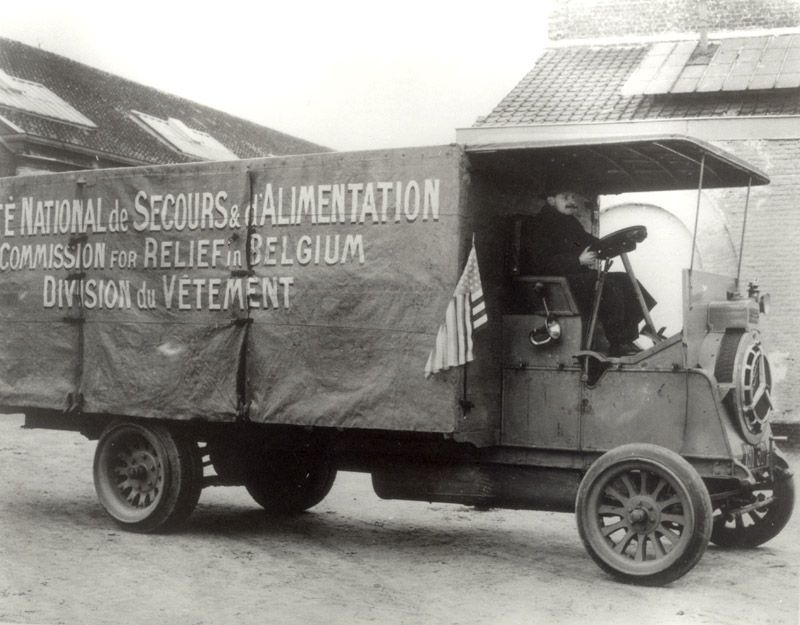 The organization Hoover set up, the Committee for the Relief of Belgium (CRB), faced a problem of breathtaking scale. It needed to raise at least $1 million a week, buy tens of thousands of tons of food from all over the world, transport it across dangerous waters, and make sure the food reached the right people. As the U.S. Ambassador to Belgium said, the undertaking was “a piece of temerity that no one but a set of God’s own fools would ever have undertaken.” Yet Hoover and his associates were equal to the challenge. Hoover negotiated with foreign ministers and heads of state from all the great powers and rapidly built the CRB into, as one British Foreign Office functionary put it, “a piratical state organized for benevolence.” By early 1915, the CRB operated several dozen cargo vessels flying the CRB’s own flag (the only flag that all belligerents entered into an agreement to respect and defend) and coordinated a network of tens of thousands of volunteers raising money and distributing food.
 Republican nomination and the presidency in 1928. He also benefited from the roaring economy and despite private concerns about a stock market bubble, campaigned on continuing the economic good times begun under the previous Republican presidents. Sadly for Hoover and the country, the good times came to a screeching halt just as he ascended to the pinnacle of public life. For all he had to offer, his inflexibility, his exaggerated faith in volunteerism, and, most importantly, the sheer size of the catastrophe, rendered Hoover unable to stem the tide of depression. His was not a successful presidency, and it’s fair to view him as a model of failure in that office. But he was far from a failure in life. Tomorrow, on his birthday, let us remember not just Herbert Hoover the president, but Hoover the world-renowned mining engineer, Hoover the superb administrator, and Hoover the towering humanitarian.
 History First